
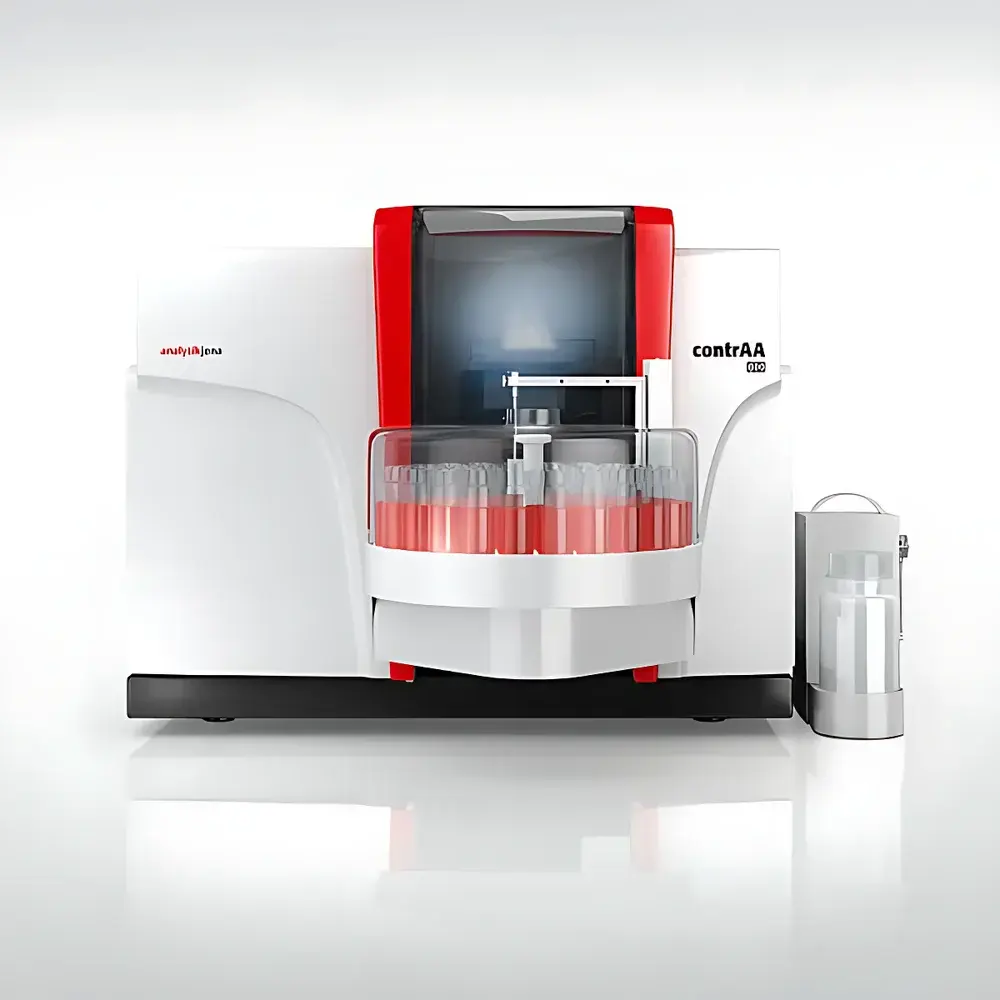
Analytik Jena contrAA 800 High-Resolution Continuum Source Atomic Absorption Spectrometer
| Brand | Analytik Jena |
|---|---|
| Origin | Germany |
| Model | contrAA 800 |
| Instrument Type | Flame and Graphite Furnace AAS |
| Wavelength Range | 185–900 nm |
| Light Source | High-Intensity Short-Arc Xenon Lamp |
| Detection Principle | High-Resolution Continuum Source AAS (HR-CS AAS) |
| Detector | CCD Array |
| Background Correction | Automatic Background Correction (ABC) and Concurrent Spectrum Interference Correction (CSI) |
| Detection Limit | Sub-ppb for most elements |
| Elemental Coverage | Simultaneous multi-element analysis across full UV-VIS-NIR range |
| Atomization Modes | Integrated flame and electrothermal (graphite furnace) atomization |
Overview
The Analytik Jena contrAA 800 is a high-resolution continuum source atomic absorption spectrometer (HR-CS AAS) engineered for precision elemental quantification in complex matrices. Unlike conventional line-source AAS systems that rely on discrete hollow cathode lamps, the contrAA 800 employs a high-intensity short-arc xenon lamp emitting continuous radiation across the full spectral range of 185–900 nm. Coupled with a high-finesse monochromator and a linear CCD array detector, this architecture enables true spectral resolution down to ≤ 2 pm—sufficient to resolve atomic absorption lines from adjacent molecular bands and neighboring atomic transitions. The system operates on the fundamental principle of measuring narrow-line absorption against a broadband continuum background, allowing direct acquisition of complete spectral profiles—not just integrated absorbance at a single wavelength. This spectral fidelity underpins its ability to perform automatic background correction, interference identification, and simultaneous multi-element analysis without hardware reconfiguration.
Key Features
- Single xenon lamp serving as universal light source for all elements—eliminating lamp changes and alignment drift
- Integrated dual-atomization platform supporting both flame AAS (FAAS) and graphite furnace AAS (GFAAS) in one instrument chassis
- High-resolution optical system delivering spectral resolution ≤ 2 pm and wavelength accuracy ± 0.002 nm
- Real-time 3D spectral visualization for method development, interference assessment, and peak validation
- Automated background correction using ABC (Automatic Background Correction) and CSI (Concurrent Spectrum Interference) algorithms—based on full spectral fitting rather than two-point or deuterium subtraction
- Direct solid sampling capability via optional high-precision autosampler with laser-assisted ablation interface—minimizing sample preparation artifacts
- Full spectral acquisition enables post-acquisition re-evaluation: reprocessing raw spectra for alternative wavelengths, secondary lines, or molecular absorption bands (e.g., for non-metals such as Cl, F, S)
Sample Compatibility & Compliance
The contrAA 800 accommodates liquid, digested solid, and directly introduced solid samples—including soils, biological tissues, pharmaceutical excipients, and environmental filter extracts. Its dual-atomization design meets ISO 8288, ASTM D1688, and EN 14802 requirements for trace metal determination in water, food, and clinical specimens. Software supports audit-trail-enabled operation compliant with FDA 21 CFR Part 11, EU Annex 11, and GLP/GMP data integrity standards—including electronic signatures, version-controlled method storage, and immutable raw spectral archives. All calibration protocols adhere to ICH Q2(R2) guidelines for analytical method validation.
Software & Data Management
The instrument is controlled by the ASpect software suite, a Windows-based application designed for regulated laboratory environments. It provides intuitive spectral navigation, automated peak identification, and customizable reporting templates aligned with ISO/IEC 17025 documentation requirements. Raw spectral data are stored in vendor-neutral HDF5 format, enabling third-party spectral processing and long-term archival. Method files include embedded metadata (lamp settings, slit width, integration time, atomization parameters), ensuring full traceability. Batch processing supports scheduled analyses with auto-calibration verification, QC flagging, and LIMS export via ASTM E1384-compliant XML or CSV interfaces.
Applications
The contrAA 800 is routinely deployed in environmental monitoring laboratories for Pb, Cd, As, and Hg speciation in wastewater and sediment; in clinical labs for Cu, Zn, Fe, and Se quantification in serum and whole blood; in metallurgical QA/QC for alloy certification (Ni, Cr, Mo, Co); and in pharmaceutical manufacturing for catalyst residue testing (Pd, Pt, Rh) per ICH Q3D. Its capacity to measure non-metals via molecular absorption bands (e.g., NO, SO₂, ClO) extends utility into air quality and combustion research. The HR-CS architecture also facilitates method development for emerging contaminants where reference standards are scarce—enabling spectral library matching and interference mapping without prior method optimization.
FAQ
How does HR-CS AAS differ from conventional line-source AAS?
HR-CS AAS uses a broadband xenon lamp and high-resolution monochromator to acquire full spectral windows around absorption lines, enabling interference correction and multi-wavelength evaluation. Line-source AAS measures only one wavelength per lamp and requires physical lamp swaps.
Can the contrAA 800 quantify non-metal elements?
Yes—by exploiting molecular absorption bands (e.g., ClO at 257.7 nm, NO at 214.4 nm) or using secondary atomic lines, the system supports quantitative analysis of Cl, F, Br, I, S, P, and N without specialized instrumentation.
Is graphite furnace and flame atomization truly interchangeable on one platform?
Yes—the contrAA 800 features a unified optical path and automated switching between flame burner head and GFAAS autosampler, with shared wavelength calibration and background correction routines.
What spectral resolution is achieved, and why does it matter?
The system achieves ≤ 2 pm resolution at 250 nm, sufficient to separate atomic lines from rotational-vibrational bands of oxides and hydroxides—reducing polyatomic interferences without chemical modifiers.
How is data integrity ensured during regulatory audits?
ASpect software enforces role-based access control, electronic signatures, full audit trails for all spectral acquisitions and processing steps, and tamper-proof archiving of raw HDF5 spectra—fully compliant with 21 CFR Part 11 and EU Annex 11.




