
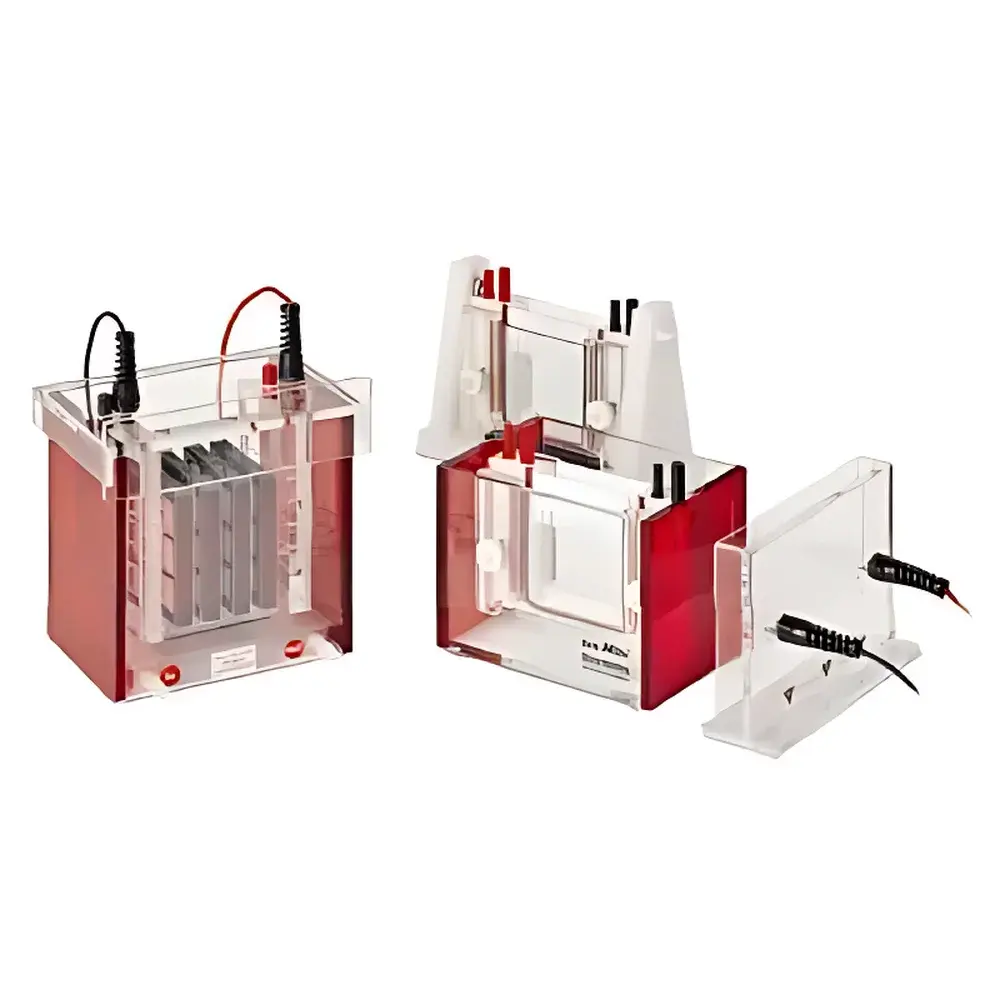
Analytik Jena Eco-Mini and Eco-Maxi Vertical Electrophoresis Systems
| Brand | Analytik Jena |
|---|---|
| Origin | Germany |
| Manufacturer | Analytik Jena AG |
| Product Type | Imported |
| Models | Eco-Mini, Eco-Maxi |
| Pricing | Upon Request |
| Gel Dimensions (Eco-Mini) | 9.4 × 8.0 cm |
| Gel Dimensions (Eco-Maxi) | 19.4 × 18.5 cm |
| Glass Plate Dimensions (Eco-Mini) | 11.0 × 10.0 cm |
| Glass Plate Dimensions (Eco-Maxi) | 21.0 × 20.0 cm |
| Max. Gels per Run | 2 |
| Comb Thickness Options | 0.75 mm, 1.0 mm, 1.5 mm |
| Comb Tooth Counts | 9–30 (Eco-Mini), 12–60 (Eco-Maxi) |
| Sample Capacity | Up to 30 wells (Eco-Mini), up to 60 wells (Eco-Maxi) |
| Well Volume Range | 15–165 µL |
| Buffer Volume (Eco-Mini) | 1580 mL (electrophoresis), 2180 mL (blotting) |
| Buffer Volume (Eco-Maxi) | 5400 mL (electrophoresis), 6100 mL (blotting) |
Overview
The Analytik Jena Eco-Mini and Eco-Maxi Vertical Electrophoresis Systems are precision-engineered benchtop platforms designed for high-reproducibility protein and nucleic acid separation via polyacrylamide gel electrophoresis (PAGE). These systems implement standard vertical slab-gel electrophoresis principles—applying a constant electric field across a polymerized acrylamide matrix to resolve biomolecules by charge-to-mass ratio and molecular sieving effects. Unlike horizontal or capillary formats, vertical electrophoresis enables higher resolution of complex protein mixtures, particularly under denaturing (SDS-PAGE) or native conditions, and supports seamless integration with downstream western blotting workflows. Both models comply with fundamental laboratory safety and operational standards for low-voltage DC power applications (typically ≤ 300 V), and their modular architecture permits concurrent dual-gel runs without cross-contamination or thermal interference.
Key Features
- Integrated vertical electrophoresis and wet-transfer blotting functionality—switch between modes in under two minutes using standardized clamp assemblies and alignment slots;
- Robust 3-mm-thick borosilicate glass plates with permanently affixed sealing spacers, eliminating misalignment and gel leakage during casting;
- Precision-machined gel cassette holder with recessed grooves that secure both electrophoresis sandwich assemblies and transfer cassettes at fixed vertical orientation;
- Ergonomic safety lid with broad lateral flanges enabling stable upright storage on lab benches—prevents contamination and conserves workspace;
- Combs engineered for compatibility with standard 8-channel and 12-channel pipettes (9-, 12-, 19-, 25-, 30-, and 60-well configurations), ensuring consistent sample loading across replicates;
- Optional recirculating cooling module maintains buffer temperature uniformity ±0.5 °C during extended runs (>90 min), mitigating band distortion from Joule heating;
- Tool-free gel casting system featuring compression-molded silicone gaskets—no external clamps required; achieves leak-proof seals across all comb thicknesses (0.75, 1.0, and 1.5 mm);
- Full compatibility with user-poured gels and commercial pre-cast gels (e.g., Bio-Rad Criterion, Thermo Fisher Novex, Cytiva Amersham), supporting method transfer and protocol harmonization.
Sample Compatibility & Compliance
The Eco series accommodates diverse sample types including purified proteins, cell lysates, immunoprecipitates, PCR amplicons, and RNA preparations. Its open architecture allows optimization of gel concentration (8–20% T), crosslinker ratio (C), and running buffer composition (Tris-Glycine, Tris-Tricine, Bis-Tris-MES) per application requirements. From a regulatory standpoint, the systems support GLP-compliant documentation when paired with validated power supplies and digital loggers. While the electrophoresis units themselves are not FDA-cleared devices, they meet essential design criteria referenced in ISO 13485 Annex A (for ancillary lab equipment) and align with ASTM D5227-21 guidelines for electrophoretic apparatus performance verification. The absence of embedded data storage or electronic signatures means no 21 CFR Part 11 constraints apply—however, full audit trails can be maintained externally via LIMS-integrated camera systems and timestamped imaging software.
Software & Data Management
The Eco-Mini and Eco-Maxi operate as standalone hardware platforms with no proprietary firmware or bundled acquisition software. This design philosophy prioritizes interoperability: users retain full control over imaging, quantification, and reporting via third-party tools such as ImageLab (Bio-Rad), AlphaView SA (ProteinSimple), or open-source alternatives like Fiji/ImageJ. All physical dimensions, well geometries, and buffer volumes are documented in SI units and published in the manufacturer’s technical manual—enabling precise replication in SOPs and regulatory submissions. For laboratories implementing digital workflow management, the standardized gel format (including exact inter-well spacing and gel-to-glass margins) ensures automated lane detection and molecular weight calibration across instrument platforms and timepoints.
Applications
- SDS-PAGE for protein purity assessment, subunit analysis, and quality control in biopharmaceutical manufacturing;
- Native PAGE for functional oligomeric state characterization of enzymes and membrane protein complexes;
- Tricine-SDS systems for high-resolution separation of low-MW peptides (<10 kDa) and proteolytic fragments;
- Two-dimensional electrophoresis (2D-PAGE) first-dimension compatibility when used with IPG strips and rehydration trays;
- Electroblotting of resolved proteins onto PVDF or nitrocellulose membranes for subsequent immunochemical detection;
- Teaching laboratories requiring robust, intuitive platforms for undergraduate biochemistry and molecular biology curricula;
- Core facility deployment where throughput, reproducibility, and serviceability are prioritized over automation.
FAQ
Can the Eco-Mini and Eco-Maxi be used with pre-cast gels from other vendors?
Yes—both systems accept commercially available pre-cast gels with standard dimensions (e.g., 10 × 10 cm or 20 × 20 cm), provided the gel thickness matches the selected comb and spacer configuration.
Is the optional cooling module compatible with both models?
Yes—the same circulating chiller unit (Analytik Jena CoolBox Pro) interfaces with either Eco-Mini or Eco-Maxi via standardized inlet/outlet ports and flow-rate calibration.
What is the maximum recommended run time at 200 V for Eco-Maxi with 1.5 mm gels?
Under ambient lab conditions (22 °C), continuous operation up to 120 minutes is routinely achieved with active cooling; without cooling, voltage should be reduced to ≤150 V beyond 60 minutes to prevent buffer stratification.
Are replacement glass plates and combs available as consumables?
Yes—Analytik Jena supplies certified spare parts including tempered glass plates (part numbers ECO-GP-MINI / ECO-GP-MAXI), stainless-steel combs (0.75/1.0/1.5 mm), and silicone gasket kits with lot-specific QC certificates.
Does the system include a power supply?
No—the Eco series is designed for use with external DC power supplies meeting IEC 61010-1 safety standards; recommended output range: 0–300 V, 0–500 mA, with constant voltage or constant current modes.
Related Products




