
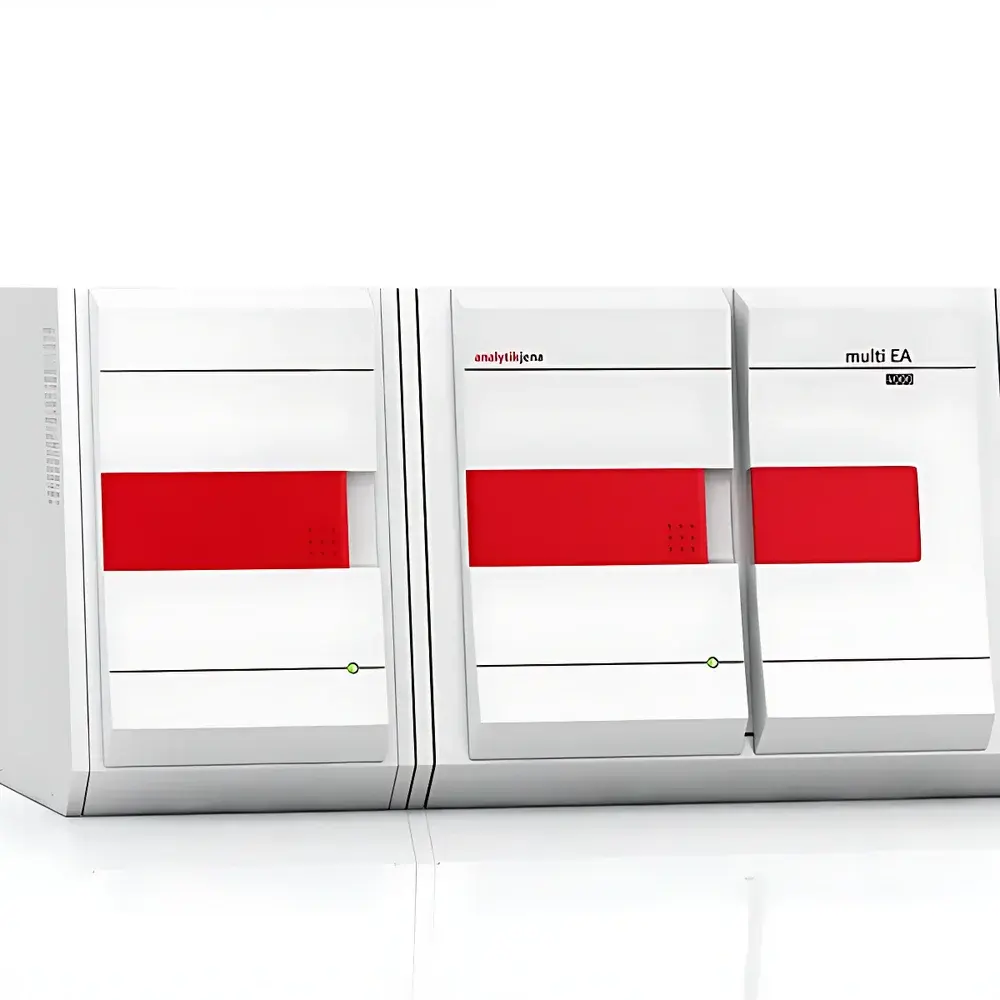
Analytik Jena multi EA 4000 Carbon-Sulfur-Chlorine Elemental Analyzer
| Brand | Analytik Jena |
|---|---|
| Origin | Germany |
| Manufacturer | Analytik Jena GmbH |
| Type | Imported Instrument |
| Model | multi EA 4000 |
| Measurement Principle | Infrared Absorption (CO₂, SO₂, HCl detection) |
| Heating System | High-Temperature Ceramic Furnace (HTC) |
| Sample Form | Solid and viscous samples |
| Modular Configuration | Independent C, S, Cl analysis modules |
| Compliance | ASTM D4293, ASTM D5178, ISO 20565, DIN 51721, EN 15408, EPA Method 9096A (for AOX), USP <281> (for residual chlorine) |
| Software | multiWin v5.x with 21 CFR Part 11 compliance options |
| Safety | Integrated Self-Check System (SCS), automatic gas leak detection, overpressure protection |
Overview
The Analytik Jena multi EA 4000 is a high-performance, modular elemental analyzer engineered for the quantitative determination of total carbon (TC), total sulfur (TS), total halogens (TX, especially chlorine), total organic carbon (TOC), total inorganic carbon (TIC), elemental carbon (EC), and bound organic carbon (BOC) in solid and semi-viscous matrices. It operates on the principle of high-temperature combustion followed by selective infrared absorption spectroscopy — a reference-grade method validated across environmental, petrochemical, metallurgical, and pharmaceutical quality control laboratories. Unlike conventional resistance-heated furnaces, the multi EA 4000 employs a proprietary High-Temperature Ceramic (HTC) furnace capable of stable operation up to 1,350 °C without catalysts, enabling complete oxidation of refractory compounds including silicon carbides, tungsten carbides, and alkaline metal salts. This eliminates catalytic deactivation, reduces consumable costs, and ensures long-term measurement stability under routine high-throughput conditions.
Key Features
- Modular architecture supporting independent or simultaneous C/S/Cl analysis — users configure only required modules, minimizing footprint and operational overhead.
- HTC furnace technology delivering robust thermal performance across 1,000–1,350 °C with ±2 °C temperature homogeneity, eliminating need for platinum or cobalt-based catalysts.
- Large-sample capacity up to 3,000 mg — critical for heterogeneous materials such as soils, slags, fly ash, and polymer composites where representative sampling directly impacts result reproducibility.
- Corrosion-resistant gas path components (quartz, Inconel, ceramic) engineered for sustained exposure to HCl, HF, SO₃, and alkali vapors generated during analysis of chlorinated organics or high-salt-content samples.
- Integrated TOC/TIC mode via acidification module: automated sparging and acid addition enables sequential quantification of inorganic and organic carbon fractions within a single run.
- AOX-ready configuration: optional adsorption column and pyrolysis unit compliant with EPA Method 9096A and DIN EN ISO 9562 for adsorbable organic halogen determination.
Sample Compatibility & Compliance
The multi EA 4000 accommodates a broad spectrum of sample types — from coal, coke, and ores to pharmaceutical excipients, catalysts, polymers, and environmental solids (sediments, sludges, filter media). Its design meets stringent regulatory requirements for method validation and data integrity: full alignment with ASTM D4293 (sulfur in coal), ASTM D5178 (chlorine in petroleum products), ISO 20565 (carbon in ferroalloys), and EN 15408 (halogens in waste). The system supports GLP/GMP workflows through audit-trail-enabled software, electronic signatures, and configurable user access levels. Optional 21 CFR Part 11 compliance packages include electronic record retention, change control logs, and instrument calibration history tracking.
Software & Data Management
Controlled via multiWin v5.x — a Windows-based platform offering intuitive method setup, real-time gas signal visualization, and automated baseline correction. The software includes built-in self-diagnostic routines (Self-Check System, SCS) that verify furnace temperature stability, carrier gas flow accuracy, IR detector responsiveness, and reagent cartridge status prior to each analysis. All raw spectra, integration parameters, calibration curves, and QC reports are stored in a relational database with export to CSV, PDF, or LIMS-compatible formats. Batch processing, statistical evaluation (RSD%, recovery %, drift monitoring), and customizable certificate generation are standard features.
Applications
- Environmental testing labs: TC/TS in contaminated soils per EPA SW-846; AOX in wastewater effluents and pulp/paper extracts.
- Metallurgy & foundries: Carbon/sulfur specification control in cast iron, steel, and non-ferrous alloys per ISO 15350.
- Petrochemical QA/QC: Total chlorine in crude oil, distillates, and lubricants per ASTM D4294 and D5178.
- Pharmaceutical manufacturing: Residual chlorine in active pharmaceutical ingredients (APIs) and excipients per USP .
- Research institutions: Quantitative carbon speciation (TOC/TIC/EC) in geological samples, biochars, and carbon capture materials.
FAQ
Can the multi EA 4000 measure both carbon and sulfur simultaneously in one run?
Yes — dual IR cell configuration allows concurrent detection of CO₂ and SO₂ with independent calibration and signal processing.
Is catalyst replacement required during routine operation?
No — the HTC furnace achieves complete oxidation without noble-metal catalysts, reducing maintenance frequency and consumable cost.
What is the minimum detectable concentration for chlorine?
Detection limits are method-dependent; typical values range from 0.5 ppm (solid matrix, 100 mg sample) to 5 ppm (high-salt samples), verified per ISO 20565 Annex B.
Does the system support automated calibration verification?
Yes — multiWin includes scheduled calibration check routines using certified reference materials (CRMs) with pass/fail criteria based on user-defined tolerance bands.
Can TOC and TIC be determined without hardware modification?
TOC/TIC analysis requires the optional acidification/sparging module, which integrates seamlessly into the existing combustion gas path and is controlled via the same software interface.
Related Products





