
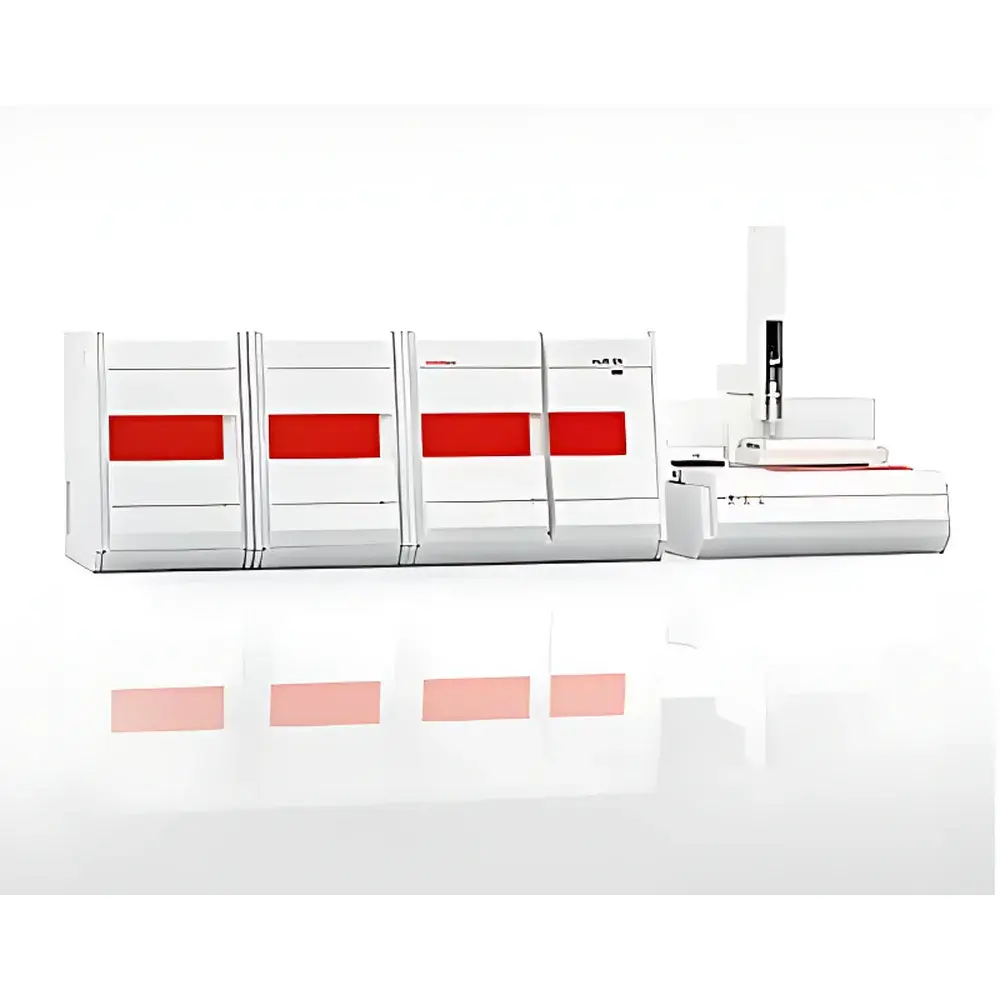
Analytik Jena multi EA S 5000 Elemental Analyzer for Carbon, Nitrogen, Sulfur and Chlorine
| Brand | Analytik Jena |
|---|---|
| Origin | Germany |
| Manufacturer | Analytik Jena AG |
| Product Type | Imported Instrument |
| Model | multi EA S 5000 |
| Measurement Principle | Infrared Absorption (for C), Chemiluminescence (for N), UV Fluorescence or Microcoulometric Detection (for S), Microcoulometric Detection (for Cl) |
| Furnace System | Dual-mode resistive furnace (vertical/horizontal configuration) |
| Detection Limit | ppb-level |
| Measurement Range | ppb to wt% |
| Accuracy | ±0.01 ppm |
| Analysis Time | 2–4 minutes |
| Maximum Furnace Temperature | 1100 °C |
| Liquid Sample Volume | 1–100 µL |
| Gas Sample Volume | up to 100 mL |
| Solid Sample Mass | up to 100 mg |
| LPG Sample Volume | 1–50 µL |
Overview
The Analytik Jena multi EA S 5000 is a high-performance, multi-element combustion analyzer engineered for the quantitative determination of total carbon (C), nitrogen (N), sulfur (S), and chlorine (Cl) in heterogeneous sample matrices—including solids, liquids, liquefied petroleum gas (LPG), and compressed gases. It operates on high-temperature catalytic combustion followed by selective detection: carbon is quantified via non-dispersive infrared (NDIR) absorption; nitrogen via chemiluminescence detection (CLD); sulfur via either ultraviolet fluorescence (UVF) or microcoulometric titration; and chlorine exclusively via microcoulometric detection. The system integrates a patented dual-mode resistive furnace architecture—capable of switching between vertical and horizontal combustion configurations without hardware modification—enabling optimal thermal decomposition pathways for diverse sample types. This design ensures complete oxidation of refractory compounds while minimizing matrix interference and carbon residue formation. The instrument complies with core international standards for elemental analysis, including ASTM D5291, D7183, D7622, ISO 14852, ISO 14855, and USP , supporting regulated environments requiring trace-level quantification in petrochemicals, polymers, pharmaceutical excipients, environmental solids, and high-purity industrial feedstocks.
Key Features
- Dual-mode furnace system: Automatically configurable as vertical or horizontal combustion geometry—no manual tube replacement required; position auto-detected and process parameters dynamically adjusted.
- Real-time flame monitoring: Integrated patented flame sensor continuously evaluates combustion stability, modulates sample introduction rate, and prevents flash ignition or soot accumulation—enhancing safety and analytical robustness.
- Modular detector selection: Independent, software-selectable detector modules for N (CLD), S (UVF or microcoulometric), Cl (microcoulometric), and C (NDIR); no mechanical reconfiguration needed between elements.
- Universal autosampler compatibility: Single autosampler platform supports liquid (1–100 µL), solid (up to 100 mg), LPG (1–50 µL), and gaseous samples (up to 100 mL) with temperature-compensated gas injection ensuring <±0.5% RSD repeatability.
- Maintenance-reduced gas handling: Integrated pressure stabilization system tolerates inlet O2 pressure fluctuations from 0.2–0.6 MPa without affecting calibration; out-of-range conditions trigger audible/visual alarms. Built-in heated membrane dryer eliminates condensation and extends detector lifetime.
- Self-optimizing calibration: Single calibration curve covers full dynamic range (ppb to wt%) via automatic dilution and gain adjustment—eliminating manual curve segmentation or multi-point recalibration.
Sample Compatibility & Compliance
The multi EA S 5000 accommodates a broad spectrum of sample forms without pre-treatment: polymeric pellets, catalyst powders, lubricating oils, diesel fuels, halogenated solvents, coal ash, activated carbon, pharmaceutical tablets, and municipal sludge. Its combustion efficiency (>99.9% for organochlorines and thiophenic compounds) meets EPA Method 5050B and ISO 20567-2 requirements for total halogen screening. For regulated laboratories, the system supports audit-ready operation under GLP and GMP frameworks, with optional 21 CFR Part 11-compliant software enabling electronic signatures, user access control, and immutable audit trails for all method parameters, calibration events, and raw data files.
Software & Data Management
Control and data acquisition are managed through the EA Control Suite v4.x—a Windows-based application featuring intuitive workflow navigation, real-time chromatogram visualization, peak integration with baseline correction algorithms, and automated report generation compliant with ISO/IEC 17025 documentation requirements. All method settings—including furnace ramp profiles, detector gain, gas flow rates, and integration windows—are stored as encrypted, version-controlled templates. Raw signal data (time-resolved detector output) and processed results are archived in vendor-neutral CSV and XML formats, facilitating third-party statistical analysis (e.g., JMP, Minitab) and LIMS integration via ASTM E1384-compliant drivers.
Applications
- Petrochemical QA/QC: Total sulfur in ultra-low-sulfur diesel (ULSD), chlorine in reformulated gasoline, nitrogen in crude fractions per ASTM D5762.
- Pharmaceutical impurity profiling: Residual catalyst metals (as chloride salts), organic nitrogen impurities in APIs, and extractable/leachable halogens from packaging.
- Environmental compliance: Total organic carbon (TOC) and adsorbable organic halides (AOX) in wastewater per ISO 9562 and EPA 1650C.
- Materials science: Carbon content in carbon black, sulfur in vulcanized rubber, chlorine in flame-retardant polymers (e.g., PVC, PBT).
- Energy research: Chlorine-induced corrosion potential in biomass-derived syngas; nitrogen speciation in coal fly ash for NOx emission modeling.
FAQ
Can the same autosampler handle both liquid and solid samples without hardware changes?
Yes—the integrated autosampler uses interchangeable sample carriers and programmable needle depth control to accommodate liquids (via syringe injection), solids (via ceramic boat loading), and LPG (via pressurized loop injection) within one unified platform.
Does the instrument support regulatory audit requirements such as FDA 21 CFR Part 11?
When equipped with the optional EA Security Pack, the system provides role-based user authentication, electronic signature capture, and tamper-evident audit logs meeting 21 CFR Part 11 Subpart B requirements for electronic records and signatures.
How does the dual-furnace design improve accuracy for difficult matrices like coal or rubber?
Vertical mode enhances volatile element recovery (e.g., Cl in PVC), while horizontal mode improves combustion completeness for high-carbon, low-volatility samples (e.g., graphite, coke); the system selects optimal geometry based on sample type and target element, reducing memory effects and improving long-term reproducibility.
Is carrier gas purity critical for microcoulometric detection of chlorine?
Yes—chlorine analysis requires ultra-high-purity oxygen (≥99.999%) and zero-halogen scrubbers; the instrument includes integrated gas purification modules and continuous purity monitoring with alarm thresholds set per ASTM D7183 Annex A3.
What maintenance intervals are recommended for routine operation?
Under standard use (≤100 analyses/day), the combustion tube requires replacement every 6–12 months; the NDIR cell and CLD ozone generator are rated for ≥2 years; all consumables are tracked via embedded usage counters and flagged in the software maintenance dashboard.




