
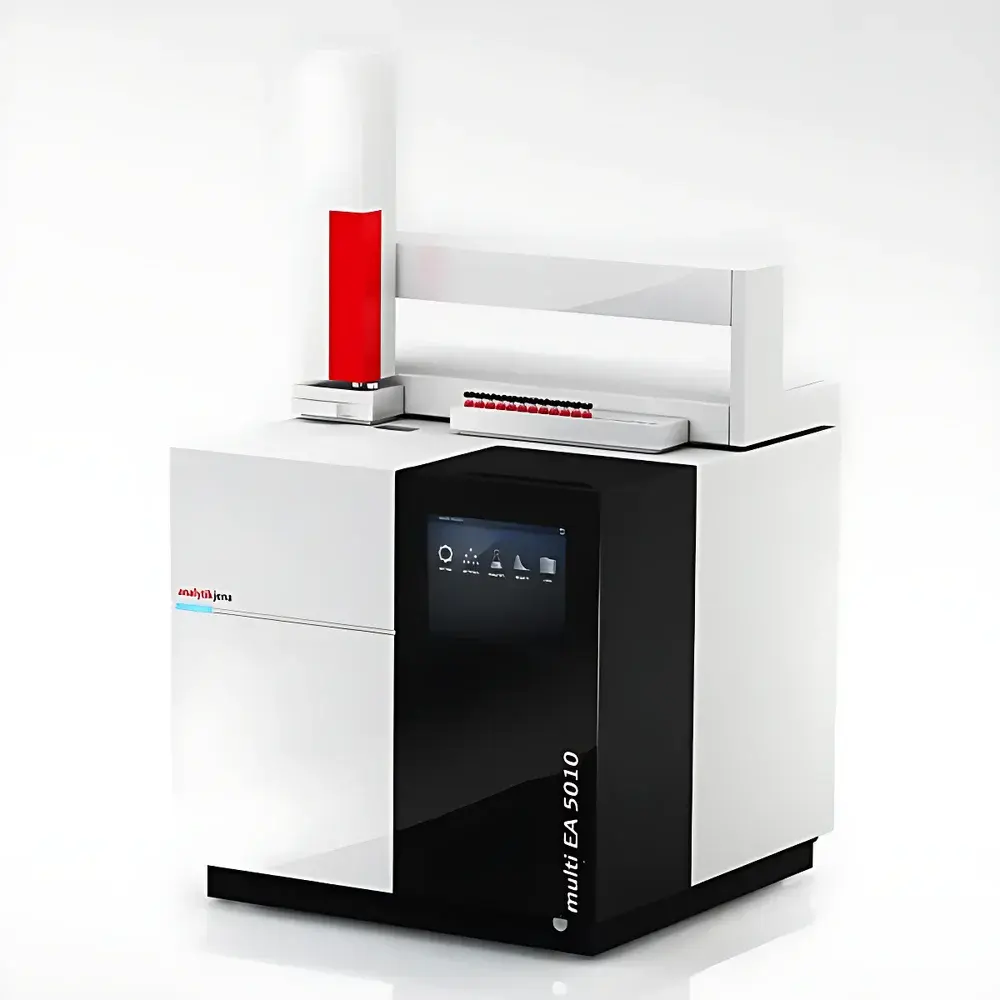
Analytik Jena multi EA 5010 Sulfur and Nitrogen Elemental Analyzer
| Brand | Analytik Jena |
|---|---|
| Origin | Germany |
| Manufacturer Type | Original Equipment Manufacturer (OEM) |
| Origin Category | Imported Instrument |
| Model | multi EA 5010 |
| Price | Upon Request |
| Detector | HiPerSens UV Fluorescence & Chemiluminescence Detector |
| Measurement Range | 0.0x ppm to 100% (w/w or v/v) |
| Sample Volume | Liquids: 50 µL |
| Gases | 20 mL |
| Combustion Furnace Temperature | Up to 1100 °C |
| Compliance | ASTM D5453, D7183, D7039, ISO 20846, ISO 20884, UOP 97, IP 433, IP 541, EN 15486 |
| Software | multiWin v5.x with 21 CFR Part 11 compliance modules |
| Connectivity | Ethernet, LIMS-ready, Remote Web Access via Browser or Mobile App |
| Safety | Automated Self-Check, Real-Time Parameter Monitoring, Push Notification Alert System |
Overview
The Analytik Jena multi EA 5010 is a fully integrated, high-throughput elemental analyzer engineered for the precise, simultaneous, or independent quantification of total sulfur (S) and total nitrogen (N) in liquid, gaseous, and liquefied petroleum gas (LPG) samples. It operates on high-temperature combustion coupled with selective detection: sulfur is measured via ultraviolet fluorescence (UVF), while nitrogen is determined by chemiluminescence (CLD), both enabled by the proprietary HiPerSens detector architecture. This dual-detection design eliminates cross-interference and ensures linear dynamic response across an exceptionally wide concentration range—from sub-ppm trace levels to 100% w/w—without dilution or pre-concentration. The instrument features a compact, self-contained combustion module operating at up to 1100 °C, utilizing catalyst-free oxidation to minimize maintenance, reduce consumable usage, and enhance long-term baseline stability. Its all-in-one benchtop footprint (under 0.5 m²) reflects a deliberate engineering focus on laboratory space efficiency and energy-conscious operation—consistent with modern green lab standards.
Key Features
- HiPerSens dual-channel detector system enabling concurrent or sequential S/N analysis with <1 ppb detection limits and ≤2% RSD precision at low ppm levels
- Catalyst-free high-temperature combustion furnace (up to 1100 °C) ensuring complete sample mineralization and minimal carryover
- Integrated industrial-grade touch-screen PC with multiWin v5.x software—no external computer required
- Remote operation capability via secure web interface compatible with desktop, tablet, and iOS/Android mobile devices
- Automated safety protocol suite including real-time pressure/temperature monitoring, leak detection, and emergency shutdown logic
- Smart alert system delivering push notifications to designated endpoints (e.g., smartphones) when manual intervention is required
- MPO (Multi-Parameter Optimization) technology for adaptive calibration and parameter tuning—particularly effective for high-nitrogen matrices containing trace sulfur
Sample Compatibility & Compliance
The multi EA 5010 accommodates diverse physical sample forms without derivatization or extensive pretreatment: homogenous liquids (e.g., gasoline, diesel, jet fuel, lubricants), compressed gases (e.g., natural gas, refinery off-gas), and LPG streams. Sample introduction is fully automated via programmable syringe injection (50 µL for liquids) or gas loop sampling (20 mL). Method validation and regulatory alignment are embedded in its operational framework: built-in method templates conform to ASTM D5453 (UVF-S), ASTM D7183 (CLD-N), ASTM D7039 (S in middle distillates), ISO 20846 (petrol S), ISO 20884 (diesel S), UOP 97 (S in naphthas), IP 433 (S in residual fuels), IP 541 (N in hydrocarbons), and EN 15486 (biofuel S). Data integrity is assured through audit-trail-enabled software compliant with FDA 21 CFR Part 11 and GLP/GMP documentation requirements.
Software & Data Management
multiWin v5.x serves as the central control, acquisition, and evaluation platform—hosted locally on the instrument’s embedded Windows OS. It provides intuitive workflow navigation, customizable report generation (PDF, CSV, XML), and seamless bidirectional integration with LIMS via ASTM E1384-compliant interfaces. All analytical sequences—including calibration curves, blank subtraction, drift correction, and QC checks—are scriptable and version-controlled. Electronic signatures, user role-based access (admin/operator/auditor), and immutable audit trails satisfy strict data governance mandates. Raw signal chromatograms, peak integration parameters, and system suitability metrics are stored with time-stamped metadata for full traceability.
Applications
The multi EA 5010 is deployed across quality control, research, and regulatory testing environments where accurate S/N speciation directly impacts product compliance and process optimization. Key use cases include: sulfur specification testing in transportation fuels per Euro 5/6 and Tier 3 standards; nitrogen profiling in crude assay and hydrotreater feedstock evaluation; impurity screening in pharmaceutical excipients and synthetic intermediates; sulfur content verification in polymer additives and elastomers; and environmental monitoring of SOx/NOx precursors in refinery emissions streams. Its robustness supports unattended overnight runs in high-volume labs, while its sensitivity enables method development for emerging bio-based feedstocks with inherently variable heteroatom profiles.
FAQ
Does the multi EA 5010 require catalysts for combustion?
No. It employs a catalyst-free, high-temperature (up to 1100 °C) quartz-tube combustion system optimized for complete oxidation of refractory sulfur and nitrogen compounds.
Can it analyze both sulfur and nitrogen in a single run?
Yes—via time-resolved dual-channel detection. The HiPerSens detector independently processes UVF (S) and CLD (N) signals from the same combustion event, eliminating need for duplicate injections.
Is remote diagnostics supported?
Yes. Secure HTTPS-based web access allows real-time instrument status monitoring, method editing, and data export from any network-connected device—including smartphones—with configurable notification thresholds.
What sample types are validated for routine use?
Liquid hydrocarbons (gasoline, diesel, kerosene, biodiesel), gaseous fuels (natural gas, propane, butane), and LPG blends—as specified in ASTM, ISO, and UOP standard methods.
How is data integrity ensured for regulated environments?
Through multiWin’s 21 CFR Part 11-compliant architecture: electronic signatures, automatic audit trails, role-based permissions, and encrypted database storage meet FDA, EMA, and ISO/IEC 17025 requirements.





