
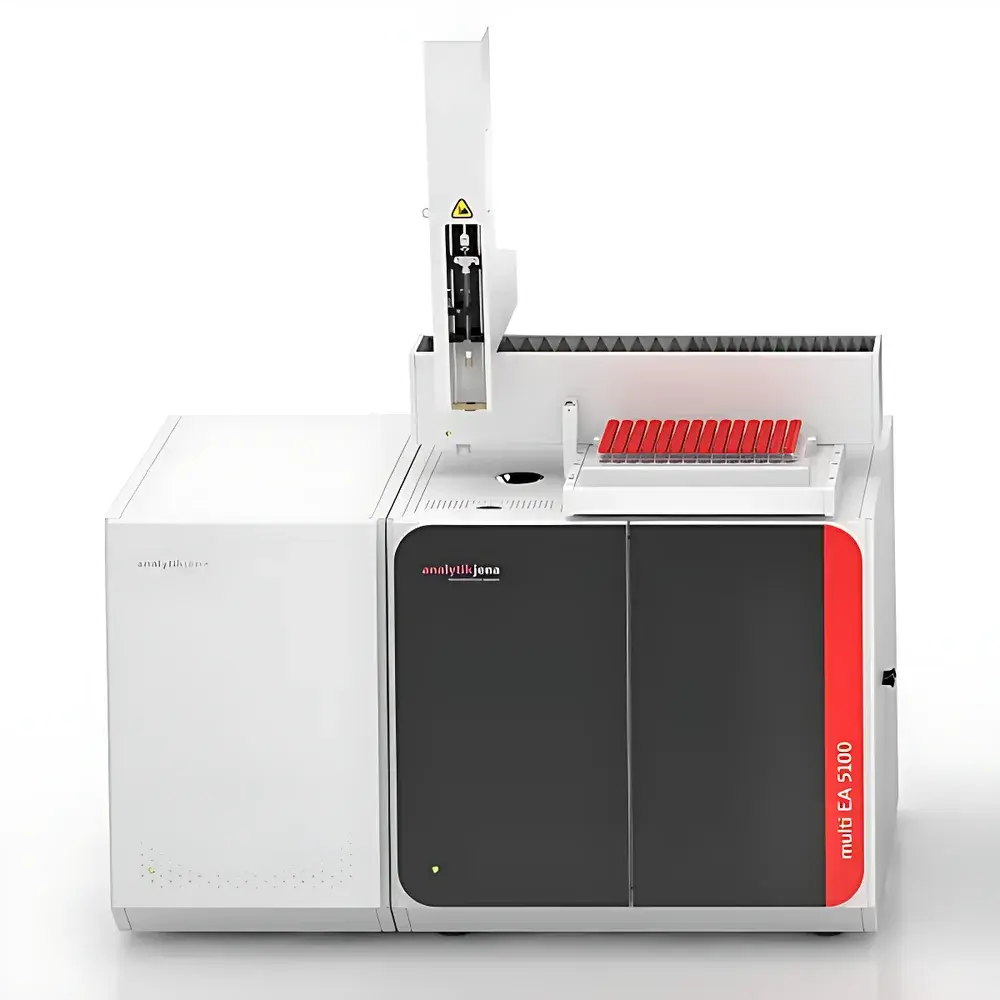
analytik jena multi EA 5100 Elemental Analyzer for Carbon, Nitrogen, Sulfur and Chlorine
| Brand | analytik jena |
|---|---|
| Origin | Germany |
| Model | multi EA 5100 |
| Detection Elements | C, N, S, Cl |
| Furnace Configurations | Dual-mode vertical & horizontal combustion furnace |
| Detector Technology | HiPerSens® electrochemical and thermal conductivity detection |
| Sample Forms | Solid, liquid, gaseous & supercritical fluid |
| Automation | Fully automated direct injection |
| Compliance | Designed for GLP/GMP environments |
| Safety Systems | Integrated self-diagnostic module, flame sensor (horizontal mode), aerosol/liquid ingress protection, auto-leak monitoring, active gas stream drying & purification |
Overview
The analytik jena multi EA 5100 Elemental Analyzer is a high-precision, dual-furnace combustion-based system engineered for the quantitative determination of carbon (C), nitrogen (N), sulfur (S), and chlorine (Cl) in solid, liquid, gaseous, and supercritical fluid samples. It operates on high-temperature catalytic combustion (900–1150 °C) followed by selective detection via optimized electrochemical (for Cl, S) and thermal conductivity (for N, CO₂-derived C) detection principles. Unlike single-furnace analyzers, the multi EA 5100 integrates both vertical and horizontal combustion architectures within one platform—enabling method-agnostic adaptation to sample matrix complexity, volatility, viscosity, and thermal stability. This architecture eliminates the need for manual hardware reconfiguration or method revalidation when switching between sample types, thereby reducing turnaround time and inter-method variability. The system is designed for routine operation in regulated environments—including pharmaceutical QC labs, petrochemical testing facilities, and environmental monitoring centers—where trace-level accuracy (sub-ppm detection limits), method robustness, and audit-ready data management are mandatory.
Key Features
- Dual-combustion furnace architecture: Interchangeable vertical and horizontal furnaces—switchable in under 5 minutes without tools or recalibration.
- HiPerSens® detection technology: Wide linear dynamic range (0.01–100% w/w for most matrices) with no manual range switching; enables simultaneous low- and high-concentration analysis in a single sequence.
- Intelligent self-diagnostic system: Continuously monitors critical parameters—including furnace temperature uniformity, gas flow stability, detector baseline drift, and combustion efficiency—and initiates corrective actions or alerts.
- Flame sensor integration (horizontal mode): Dynamically adjusts oxygen supply and combustion kinetics to prevent carbon deposition and ensure complete oxidation—even for high-boiling, viscous, or halogen-rich organics.
- Automated gas stream conditioning: Integrated drying, filtration, and leak-detection modules maintain stoichiometric combustion gas purity and suppress interference from moisture, aerosols, or particulates.
- Modular plug-and-play expansion: Optional add-ons include autosamplers for 100+ positions, inert gas purging kits for oxygen-sensitive samples, and dedicated halogen scrubbers for Cl-rich matrices.
Sample Compatibility & Compliance
The multi EA 5100 accepts diverse sample forms without derivatization or pre-treatment: powders, pellets, oils, solvents, polymers, catalysts, fuels, soils, and compressed gases (via regulated pressure-controlled injection). Its dual-furnace design ensures compliance with ASTM D5291 (C/H/N in petroleum products), ISO 14852 (organic carbon in aqueous media), USP (residual solvents), and DIN EN 15407-1 (S in solid biofuels). All firmware and software components are architected to support ALCOA+ data integrity principles. Audit trails, electronic signatures, role-based access control, and 21 CFR Part 11–compliant electronic records are natively supported through the optional EA Control Suite.
Software & Data Management
EA Control Suite provides intuitive workflow-driven operation—from method setup and calibration (single-point, multi-point, or bracketed) to real-time combustion diagnostics and post-run validation. Each analysis generates a timestamped, immutable result file containing raw detector signals, furnace thermograms, gas flow logs, and diagnostic flags. Data export formats include CSV, XML, and LIMS-compatible ASTM E1384 templates. Batch processing, statistical outlier detection (Dixon’s Q-test), and automatic report generation (PDF/HTML) are standard. All user actions—including method edits, calibration updates, and instrument maintenance—are logged with operator ID, timestamp, and change description.
Applications
- Petrochemical QA/QC: Total sulfur in diesel (ISO 20846), nitrogen in crude oil (ASTM D4294), chlorine in feedstocks.
- Pharmaceutical development: Residual catalyst metals (via Cl quantification), organic impurity profiling, excipient elemental screening.
- Environmental analysis: TOC/TN in wastewater sludge, sulfate/sulfide speciation in sediments, halogenated pollutant screening (e.g., PCBs, PBDEs).
- Materials science: C/N ratio in carbon composites, S content in rubber vulcanization studies, Cl contamination in semiconductor-grade polymers.
- Academic research: Combustion kinetics modeling, isotopic tracer studies (with optional ¹³C/¹⁵N enrichment compatibility), and method development for novel energy materials.
FAQ
Can the multi EA 5100 analyze gaseous samples without cryogenic trapping?
Yes—using its pressure-regulated direct injection module, gases such as natural gas, syngas, or flue gas can be introduced quantitatively at ambient temperature with sub-second residence time in the combustion zone.
Is method transfer possible between vertical and horizontal furnace modes?
Yes—the system maintains identical calibration coefficients and detector response factors across both configurations; only combustion parameters (O₂ flow, ramp rate, hold time) are automatically adjusted per selected method.
How does the self-diagnostic system handle detector saturation?
HiPerSens® detectors incorporate real-time signal normalization and adaptive gain control; if saturation is detected, the software triggers an automatic dilution step (if autosampler is installed) or flags the event with root-cause diagnostics in the audit log.
What maintenance intervals are recommended for routine operation?
Daily: Gas filter inspection; weekly: combustion tube visual check; quarterly: detector recalibration and furnace liner replacement (typical lifetime >1,000 runs per liner).
Does the system support unattended overnight operation?
Yes—integrated safety interlocks, continuous gas leak monitoring, and automatic shutdown upon abnormal pressure/temperature deviation enable fully automated 24/7 batch analysis with zero operator intervention.





