
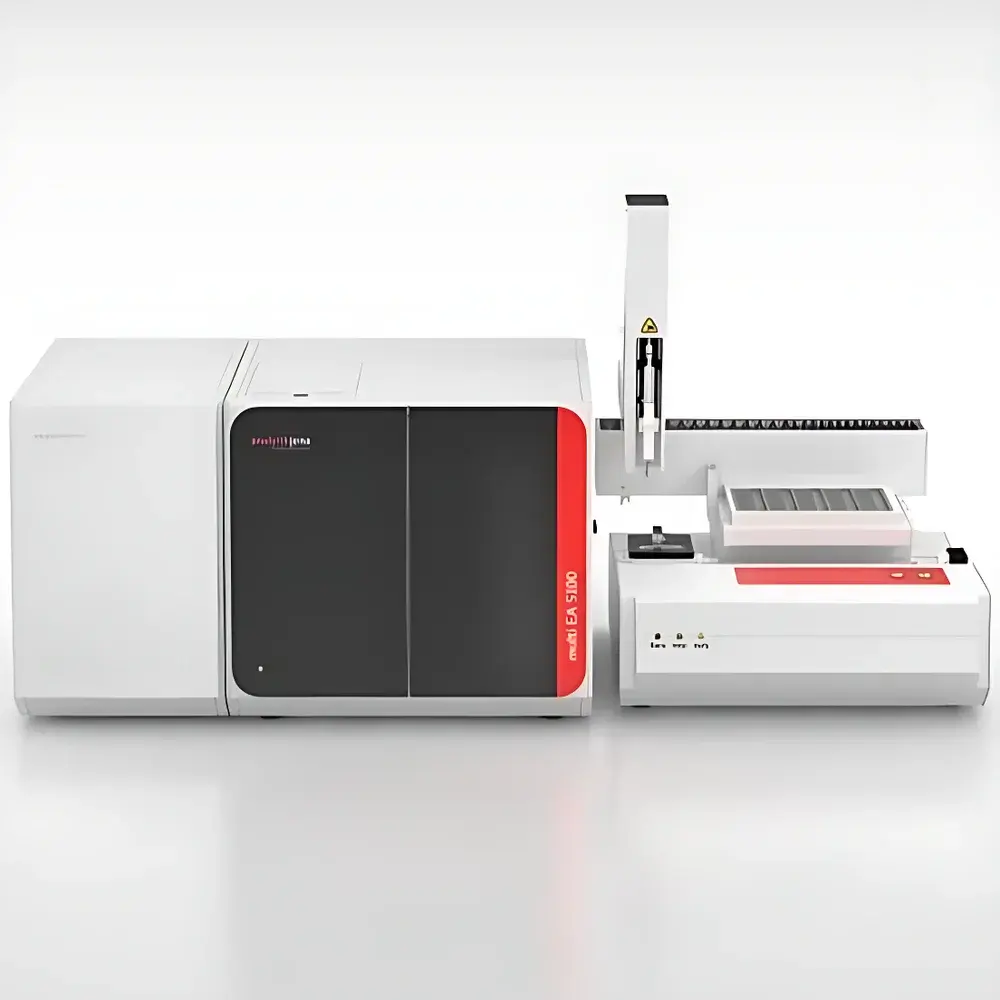
Analytik Jena multi EA 5100 Organic Elemental Analyzer
| Brand | Analytik Jena |
|---|---|
| Origin | Germany |
| Manufacturer | Analytik Jena AG |
| Product Type | Imported Instrument |
| Model | multi EA 5100 |
| Pricing | Available Upon Request |
Overview
The Analytik Jena multi EA 5100 is a high-performance, modular organic elemental analyzer engineered for the simultaneous or sequential quantification of sulfur (S), nitrogen (N), chlorine (Cl), and carbon (C) in gaseous, liquid, and solid matrices. Based on high-temperature catalytic combustion (900–1150 °C) followed by selective detection via microcoulometric titration (for S, Cl, N) and non-dispersive infrared (NDIR) spectroscopy (for C), the instrument delivers trace-level sensitivity, robust reproducibility, and method flexibility across diverse industrial and environmental laboratories. Designed as a universal platform rather than a single-purpose analyzer, the multi EA 5100 integrates dual-furnace architecture—vertical and horizontal—enabling method-optimized thermal decomposition without hardware reconfiguration. Its architecture complies with core principles of ISO 14852 (determination of dissolved organic carbon), ISO 9562 (total organic halogens), ASTM D5176 (TOX in wastewater), and USP (total organic carbon), supporting regulated workflows in pharmaceutical, petrochemical, and environmental compliance labs.
Key Features
- Dual-furnace combustion system: Vertical furnace optimized for low-volume gas and volatile liquid samples (e.g., refinery off-gas, natural gas condensates); horizontal furnace configured for solids, viscous liquids (e.g., bitumen, polymer melts), and heterogeneous matrices requiring extended residence time and controlled oxygen flow.
- Modular detection architecture: Microcoulometric cells for S, Cl, and N (detection limits: ≤0.01 mg/kg for S in liquids; ≤0.02 mg/kg for Cl in solids); NDIR cell for total carbon (linear dynamic range: 0.1–100 mg C per injection).
- Automated method switching: Single-injection analysis for S/N/C; automatic reconfiguration to Cl mode upon method selection—no manual valve changes, detector swaps, or gas-line rerouting required.
- Integrated safety and diagnostics: Real-time self-check of carrier gas pressure, combustion tube integrity, catalyst bed temperature gradients, and detector baseline stability; predictive maintenance alerts based on operational hours and signal drift trends.
- High-pressure liquid/gas handling: Optional accessories support pressurized sampling up to 10 bar for liquefied petroleum gas (LPG), compressed natural gas (CNG), and chlorinated solvents—eliminating need for cryogenic trapping or dilution.
Sample Compatibility & Compliance
The multi EA 5100 accommodates sample forms ranging from sub-milligram solid powders (e.g., coal ash, catalyst residues) to 10 mL liquid injections (e.g., diesel, wastewater extracts) and continuous gas streams (e.g., flue gas, syngas). It supports standardized protocols including ASTM D3120 (S in light distillates), ASTM D4294 (S in petroleum products), ISO 14936 (Cl in plastics), and EPA Method 1650 (AOX in aqueous effluents). All firmware and software modules comply with FDA 21 CFR Part 11 requirements for electronic records and signatures, featuring full audit trail logging, user access controls, and electronic signature capability. Instrument qualification documentation aligns with ICH Q2(R2) guidelines for analytical procedure validation.
Software & Data Management
Controlled via the EA Control Software v3.x, the system provides intuitive method editor with drag-and-drop sequence building, real-time chromatogram overlay, and automated peak integration using adaptive baseline algorithms. Data export conforms to ASTM E1382-compliant .csv and .xml formats; raw data files include full metadata (injection ID, furnace zone temperatures, detector gain settings, calibration curve parameters). Integrated LIMS connectivity supports HL7 and ASTM E1482 messaging. All analysis reports embed instrument status logs, calibration history, and QC check results—fully traceable for GLP/GMP audits.
Applications
- Petrochemical QA/QC: S/N/Cl speciation in crude oil fractions, lubricants, and reformulated gasoline per ASTM D7042 and EN 15470.
- Environmental monitoring: AOX, TOX, and EOX determination in wastewater, soil leachates, and incineration residues per ISO 9562 and DIN 38409-H17.
- Materials science: Halogen screening in flame-retardant polymers, battery electrolytes, and semiconductor precursors.
- Coal and metallurgy: Total sulfur and chlorine content in coking coal, sinter feed, and blast furnace slags—supporting ISO 351 and ISO 1171.
- Pharmaceutical excipients: Residual chloride and total organic carbon in APIs and formulation intermediates under USP and .
FAQ
Can the multi EA 5100 analyze both TOC and AOX in the same run?
No—TOC and AOX require distinct sample preparation (acidification/volatilization vs. adsorption on activated carbon) and separate combustion/detection pathways; however, method templates and shared calibration standards streamline sequential analysis.
Is operator certification required to perform ASTM-compliant analyses?
Yes—users must complete Analytik Jena’s certified training program covering instrument qualification, method validation, and audit-readiness documentation per ISO/IEC 17025.
What maintenance intervals are recommended for the microcoulometric cells?
Electrolyte replacement every 6 months under standard use; cell cleaning and reference electrode verification every 200 injections or quarterly—whichever occurs first.
Does the system support unattended overnight operation?
Yes—equipped with autosampler capacity for up to 120 positions, integrated cooling trap for condensable volatiles, and automatic shutdown upon anomaly detection.
How is data integrity ensured during power interruption?
All active methods and raw data buffers are written to non-volatile memory every 5 seconds; recovery mode resumes analysis from last validated injection point without data loss.
Related Products





