
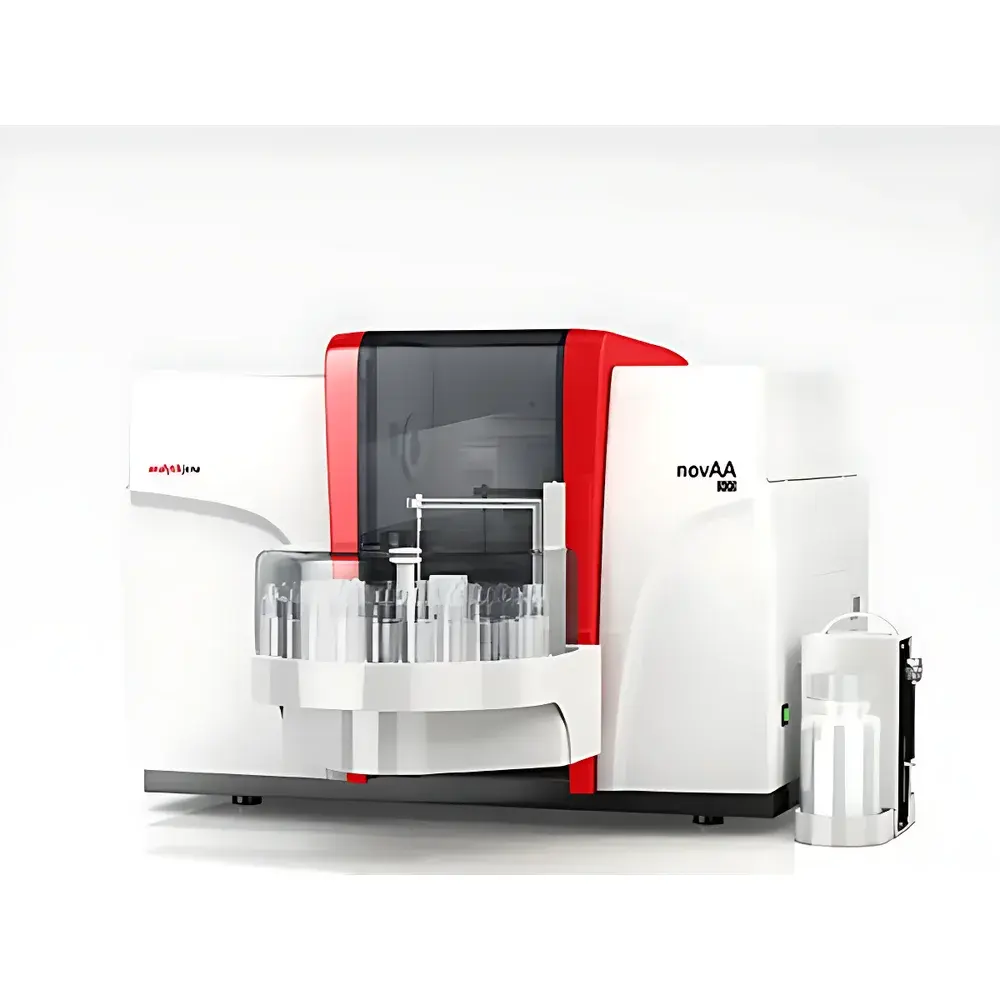
Analytik Jena novAA 800F Flame Atomic Absorption Spectrometer
| Brand | Analytik Jena |
|---|---|
| Origin | Germany |
| Model | novAA 800F |
| Atomization Type | Flame |
| Detector | SiOSens solid-state semiconductor detector |
| Lamp Holder | Integrated 8-position auto-rotating turret with coded lamp recognition |
| Background Correction | Deuterium arc lamp |
| Optical System | Switchable single-beam / double-beam / emission modes |
| Automation Level | Fully automated dual atomizer switching (flame/graphite/hydride), auto-optimization, programmable dilution & autosampling |
Overview
The Analytik Jena novAA 800F is a high-performance flame atomic absorption spectrometer engineered for routine elemental quantification in industrial quality control, environmental monitoring, and academic research laboratories. It operates on the fundamental principle of atomic absorption spectroscopy: ground-state free atoms in a flame absorb characteristic wavelengths of light emitted by element-specific hollow cathode lamps. The magnitude of absorption—measured via Beer–Lambert law—is directly proportional to analyte concentration in the sample solution. Designed as the entry-tier platform within the novAA 800 series, the 800F delivers robust flame-AAS performance with full compatibility for future expansion to graphite furnace (GF-AAS) and hydride generation (HG-AAS) techniques—all housed within a single, space-efficient optical bench architecture. Its modular design supports seamless integration of atomization modules without mechanical realignment, ensuring long-term optical stability and measurement reproducibility across analytical modes.
Key Features
- Integrated 8-position lamp turret with automatic coded lamp recognition—eliminates manual lamp identification and enables rapid multi-element method setup.
- SiOSens solid-state semiconductor detector: provides superior signal-to-noise ratio, extended dynamic range, and immunity to mechanical drift compared to traditional photomultiplier tubes (PMTs).
- Intelligent dual-atomizer system: fully automated switching between flame and optional graphite furnace or hydride generation modules—no manual hardware reconfiguration required.
- Multi-mode optical path: software-selectable single-beam, double-beam, and emission modes—optimized for sensitivity, baseline stability, or direct line intensity measurement.
- Deuterium background correction: accurate compensation for structured molecular absorption and light scattering in complex matrices (e.g., wastewater, digested biological tissues).
- Embedded auto-optimization algorithms: automatically adjust burner head position, gas flow ratios, and lamp current to maximize sensitivity and precision per element.
- Comprehensive safety architecture: integrated flame failure detection, gas leak monitoring, and interlocked access doors compliant with EN ISO 13857 and IEC 61010-1 standards.
Sample Compatibility & Compliance
The novAA 800F accepts aqueous and acid-digested liquid samples (typically 0.1–5 mL volume) introduced via pneumatic nebulization into an air-acetylene or nitrous oxide-acetylene flame. It supports direct analysis of metals at concentration levels ranging from low ppm (e.g., Ca, Mg in water) to mid-ppb (e.g., Cu, Zn in food extracts) when coupled with optimized sample introduction and matrix-matched calibration. The instrument meets essential regulatory requirements for routine testing environments: it is designed and validated in accordance with ISO/IEC 17025 principles for test method validation, supports GLP-compliant audit trails via its software logging framework, and facilitates traceability through electronic signature-ready report generation. While not inherently 21 CFR Part 11–certified, its data management architecture allows configuration to meet FDA-regulated workflows when deployed with validated IT infrastructure and procedural controls.
Software & Data Management
Controlled by the instrument-integrated winAAS software suite, the novAA 800F offers intuitive method development, real-time spectral visualization, and automated calibration curve generation (linear, quadratic, or weighted least-squares). All analytical parameters—including lamp settings, slit width, integration time, and background correction mode—are stored in encrypted method files. Raw absorbance data, peak area/height integrals, and QC metrics (e.g., %RSD of replicates, recovery rates) are timestamped and exportable in CSV, XML, or PDF formats. Audit trail functionality logs operator actions, parameter changes, and instrument status events—enabling full traceability for internal QA reviews or external accreditation audits. Optional LIMS connectivity via ASTM E1384-compliant interfaces ensures seamless integration into enterprise laboratory informatics ecosystems.
Applications
- Environmental analysis: quantification of heavy metals (Pb, Cd, Cr, Ni) in drinking water, surface water, and soil leachates per EPA Method 7000B and ISO 11885.
- Food & beverage quality control: determination of essential (Fe, Zn, Cu) and toxic (As, Pb) elements in raw materials, finished products, and packaging extracts.
- Clinical & pharmaceutical labs: trace metal profiling in biological fluids (serum, urine) and excipient screening per USP and Ph. Eur. 2.4.11.
- Industrial process monitoring: elemental composition verification in catalysts, alloys, plating baths, and battery electrolytes.
- Educational laboratories: hands-on training in atomic spectroscopy fundamentals, calibration strategies, and interference mitigation techniques.
FAQ
Is the novAA 800F capable of graphite furnace analysis?
No—the novAA 800F is configured exclusively for flame atomization. However, the same optical bench and software platform support upgrade to the novAA 800G (graphite furnace) or novAA 800H (hydride generation) variants via module replacement and firmware update.
Does the instrument support compliance with ISO/IEC 17025 requirements?
Yes—its design incorporates metrologically traceable wavelength calibration, documented performance verification protocols, and comprehensive data integrity features aligned with ISO/IEC 17025:2017 Clause 7.7 on result reporting and Clause 7.8 on reporting of results.
What types of background correction are available?
The system implements deuterium arc lamp-based background correction, validated for broad-band and structured background absorption typical in flame AAS applications.
Can the software generate audit-trail-enabled reports for regulated environments?
Yes—winAAS maintains a tamper-evident, time-stamped log of all user interactions and analytical events; reports can be generated with embedded digital signatures when paired with certified PKI infrastructure.
What maintenance intervals are recommended for optimal performance?
Routine maintenance includes weekly nebulizer cleaning, monthly burner head inspection, and annual optical alignment verification using certified holmium oxide reference filters—procedures detailed in the manufacturer’s Service Manual v3.2.
Related Products





