
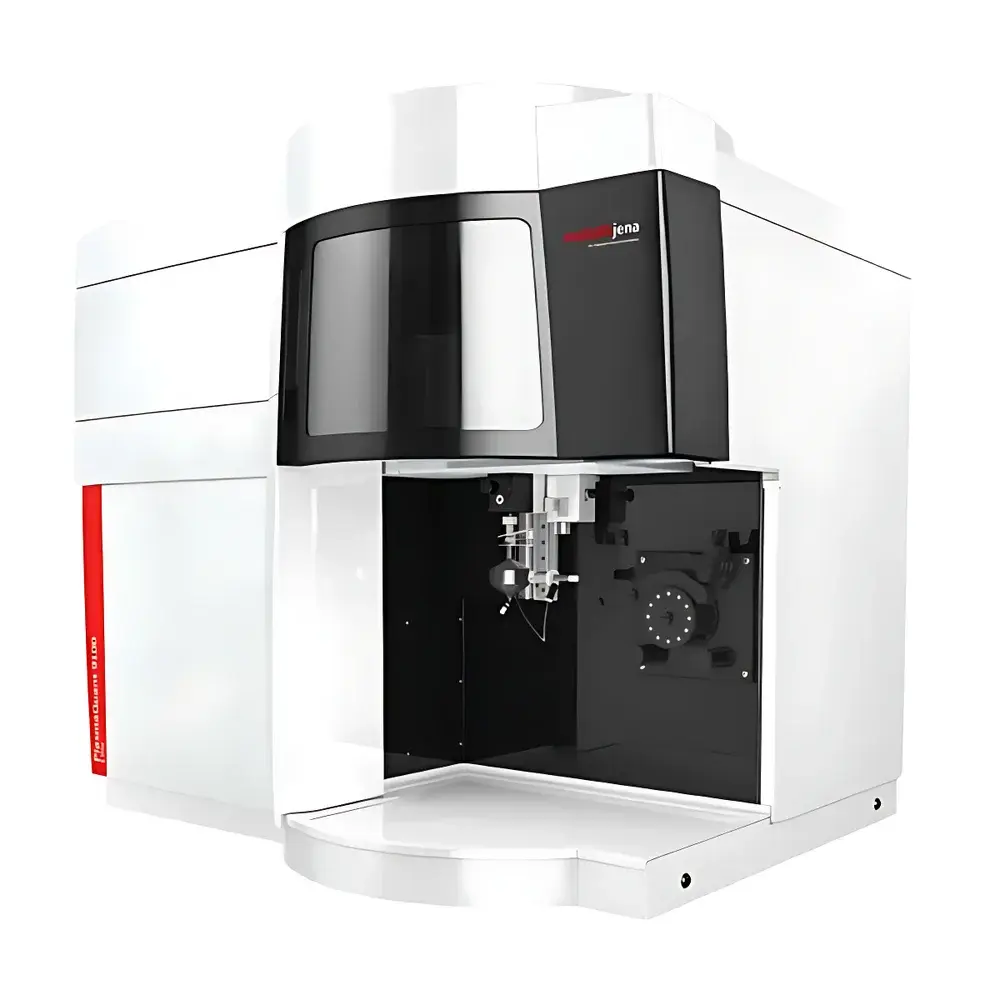
Analytik Jena PlasmaQuant 9100 ICP-OES Spectrometer
| Brand | Analytik Jena |
|---|---|
| Origin | Germany |
| Model | PlasmaQuant 9100 |
| Instrument Type | Laboratory ICP-OES |
| Application Scope | Universal |
| Compliance | ASTM D5185, ISO 11885, USP <232>/<233>, EPA Methods 200.7, 200.8, 6010D, 6020B |
| Optical Resolution | ≤2 pm at 200 nm |
| Wavelength Range | 160–900 nm |
| Detector | High-resolution CCD with 43,000 resolvable emission lines |
| RF Generator | Self-oscillating 40 MHz, 700–1700 W |
| Plasma Observation | Enhanced 2+2 dual-view (axial + radial, with signal attenuation and torch tail-flame suppression) |
| Torch Design | V-Shuttle detachable quartz torch with auto-alignment and argon interlock |
| Warm-up Time | <15 min (cold start to quantitative analysis) |
| Software | PQ 9000 Suite with 21 CFR Part 11 compliance mode, audit trail, electronic signatures |
Overview
The Analytik Jena PlasmaQuant 9100 is a high-performance inductively coupled plasma optical emission spectrometer (ICP-OES) engineered for precision elemental analysis across diverse sample matrices—from ultrapure waters and environmental digests to high-salt brines, organic solvents, metallurgical slags, and geological melts. Operating on the fundamental principle of atomic emission spectroscopy, the instrument atomizes and excites sample aerosols in a robust argon plasma (~6,000–10,000 K), enabling detection of element-specific emission lines across a broad spectral range (160–900 nm). Its core innovation lies in a fully sealed, double monochromator echelle optical system coupled with a high-pixel-density CCD detector—delivering industry-leading spectral resolution (≤2 pm at 200 nm) without mechanical slit adjustment. This architecture ensures minimal spectral overlap, even in complex multi-element matrices where line crowding and polyatomic interferences (e.g., ArO⁺ on Fe 207.8 nm, ClO⁺ on As 193.7 nm) traditionally compromise accuracy. Unlike conventional sequential or low-resolution ICP-OES systems, the PlasmaQuant 9100 acquires full spectral data simultaneously, permitting retrospective reprocessing, interference correction, and dynamic line selection—all critical for GLP/GMP-regulated laboratories requiring method flexibility and data integrity.
Key Features
- Ultra-High-Resolution Echelle Optics: Dual-monochromator design with thermally stabilized optics and real-time neon-lamp wavelength calibration (stability <0.0004 nm), enabling long-term spectral fidelity without recalibration drift.
- Enhanced 2+2 Dual-View Plasma Observation: Independent axial and radial viewing paths—each configurable with automatic signal attenuation—allow simultaneous quantification from sub-ppb to percent-level concentrations in a single run, eliminating manual dilution series and concentration grouping.
- V-Shuttle Detachable Torch System: Fully modular quartz torch with tool-free disassembly of outer, intermediate, and injector tubes; rail-guided insertion with argon interlock and auto-alignment—reducing maintenance downtime and consumable costs by up to 40% versus fixed-torch designs.
- Self-Oscillating 40 MHz RF Generator: Four-winding induction coil delivers stable power delivery (700–1700 W) with rapid impedance matching, sustaining plasma ignition and stability during direct analysis of saturated NaCl solutions, HF-digested silicates, or undiluted kerosene-based fuels.
- Tail-Flame Suppression Technology: Argon backflush eliminates secondary emission from the plasma tail without perturbing central channel stability—critical for accurate determination of refractory elements (e.g., Zr, Nb, Ta) and halogen-sensitive analytes (e.g., As, Se, I).
- Cold-Start Operational Readiness: Full quantitative capability achieved within 15 minutes of cold startup via integrated thermal management and dynamic wavelength referencing—reducing idle time and improving lab throughput.
Sample Compatibility & Compliance
The PlasmaQuant 9100 accommodates aqueous solutions (including seawater, wastewater, and high-TDS industrial effluents), organic solvents (e.g., xylene, MIBK, ethanol), hydrofluoric acid digests, and viscous samples (up to 25 cP) via optional accessories: HF-resistant nebulizers and spray chambers, high-salt peristaltic pump modules, direct organic injection kits, and automated dilution workstations. It meets stringent regulatory requirements for environmental (EPA 200.7/200.8/6010D), pharmaceutical (USP /), and metallurgical (ASTM D5185, ISO 11885) testing. The system supports full 21 CFR Part 11 compliance—including electronic signatures, role-based access control, immutable audit trails, and secure data archiving—ensuring traceability for FDA, EMA, and ISO/IEC 17025-accredited facilities.
Software & Data Management
The PQ 9000 Suite provides intuitive method development, spectral interference assessment, and multivariate calibration (including internal standard correction and matrix-matched standards). All spectra are stored in vendor-neutral formats (e.g., .csv, .asc) alongside metadata (instrument parameters, gas flows, integration times). Batch processing, custom report generation (PDF/Excel), and LIMS integration via ASTM E1384-compliant drivers ensure seamless workflow alignment. Audit trails record every user action—including method edits, result overrides, and calibration events—with timestamps and operator IDs—fully satisfying GLP audit requirements.
Applications
The PlasmaQuant 9100 is deployed in contract testing labs for routine heavy metal screening in drinking water (Pb, Cd, As, Cr); in petrochemical QA/QC for wear metals (Fe, Cu, Al) in lubricants; in mining for multi-element geochemical assays (Li, Be, Sc, Y, REEs); in semiconductor manufacturing for trace contaminant verification in ultrapure chemicals (Cl⁻, F⁻, SO₄²⁻); and in academic research for speciation studies using hydride generation or laser ablation coupling. Its ability to resolve adjacent lines (e.g., Mn 257.610 nm vs. Fe 257.615 nm) enables reliable quantification in steel alloys where traditional ICP-OES fails due to spectral congestion.
FAQ
What distinguishes the PlasmaQuant 9100 from other ICP-OES instruments in terms of spectral resolution?
Its sealed double-monochromator echelle system achieves ≤2 pm resolution at 200 nm—significantly finer than typical Czerny-Turner optics—enabling unambiguous separation of closely spaced emission lines without manual slit optimization.
Can the PlasmaQuant 9100 analyze samples containing hydrofluoric acid?
Yes—when equipped with the optional HF-resistant nebulizer, spray chamber, and peristaltic pump tubing, it safely handles post-digestion HF solutions common in geological and ceramic analysis.
Is method transfer possible between PlasmaQuant 9100 and older ICP-OES platforms?
Spectral data export in ASCII format and standardized calibration protocols (e.g., external standard, internal standard, standard addition) facilitate cross-platform validation and method equivalency studies.
How does the V-Shuttle torch reduce operational cost?
Modular replacement of individual torch components—not the entire assembly—lowers annual consumable expenditure by ~35%, while auto-alignment eliminates technician time previously spent on optical realignment after torch changes.
Does the system support automated sample introduction for high-throughput labs?
Yes—integrated compatibility with XYZ autosamplers (including high-capacity 200+ position racks), robotic dilution modules, and flow-injection preconcentration systems enables unattended 24/7 operation under validated SOPs.
Related Products





