
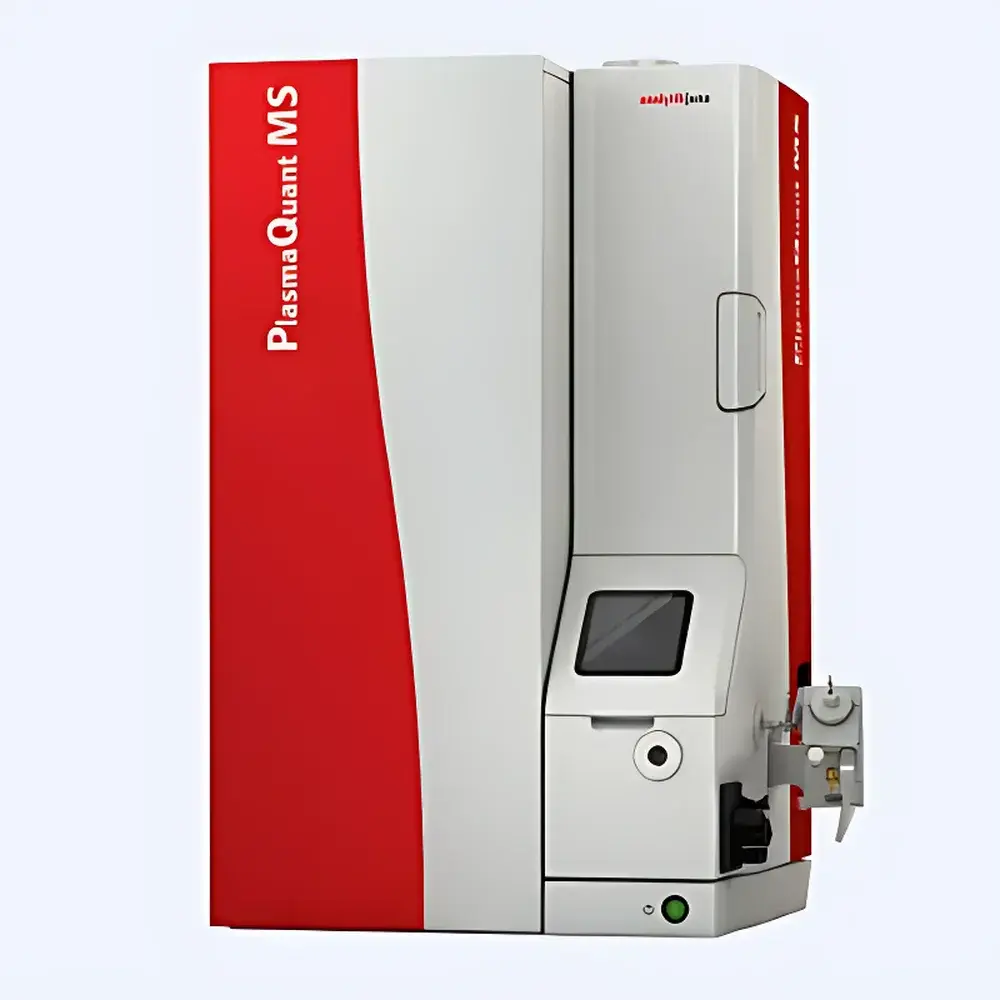
Analytik Jena PlasmaQuant MS High-Sensitivity Inductively Coupled Plasma Mass Spectrometer
| Brand | Analytik Jena |
|---|---|
| Origin | Germany |
| Manufacturer Type | Original Equipment Manufacturer (OEM) |
| Product Category | Imported Instrument |
| Model | PlasmaQuant MS |
| Instrument Type | Quadrupole ICP-MS |
| Application Environment | Laboratory |
| Mass Range (amu) | Not Specified |
| Mass Resolution (Unit Mass Resolution, amu) | Not Specified |
| Detection Limit (ng·L⁻¹) | Not Specified |
| Sensitivity (Mcps/mg·L⁻¹) | Not Specified |
| Short-Term Stability (RSD) | Not Specified |
| Long-Term Stability (RSD) | Not Specified |
Overview
The Analytik Jena PlasmaQuant MS is a high-sensitivity quadrupole-based inductively coupled plasma mass spectrometer (ICP-MS) engineered for trace elemental analysis at sub-picogram-per-liter levels. It operates on the fundamental principle of ionizing sample aerosols in a high-temperature argon plasma (~7,000–10,000 K), followed by mass separation via a radiofrequency-driven quadrupole mass filter and detection using dual-mode (pulse-counting and analog) electronics. Designed for laboratories requiring robust performance in environmental monitoring, geochemical research, clinical trace metal analysis, and semiconductor-grade material certification, the PlasmaQuant MS integrates hardware innovations—including low-power plasma generation, iCRC collision/reaction cell technology, and ReflexION 3D ion optics—to deliver enhanced signal-to-noise ratios without compromising throughput or operational reliability.
Key Features
- Energy-Efficient Plasma Source: Achieves stable, high-temperature plasma ignition and maintenance using approximately 50% less argon gas compared to conventional ICP-MS systems—reducing operational cost and improving long-term plasma stability under variable matrix conditions.
- iCRC Collision/Reaction Cell: A patented integrated collision/reaction cell enabling rapid, software-controlled switching between He, H₂, NH₃, and O₂ gases. Provides selective removal of polyatomic interferences (e.g., 40Ar16O+, 40Ar40Ar+) while preserving analyte transmission efficiency and minimizing memory effects.
- ReflexION 3D Ion Optics: A multi-stage electrostatic ion mirror system that achieves three-dimensional focusing of ion beams prior to quadrupole entry, significantly increasing ion transmission efficiency and delivering up to five-fold higher sensitivity relative to standard axial ion optics configurations.
- High-Frequency Quadrupole Mass Filter: Operates at 3 MHz scanning frequency with dwell times as low as 50 µs per mass channel—enabling high-resolution transient signal capture for laser ablation ICP-MS (LA-ICP-MS) and fast chromatographic coupling applications.
- Dual-Mode Detector Architecture: Combines discrete-dynode electron multiplier (pulse-counting mode) and Faraday cup (analog mode) within a single detector housing. Delivers >11 orders of magnitude linear dynamic range without manual gain switching or detector reconfiguration.
- Optimized Vacuum System: Dual-stage turbomolecular pumping architecture achieves operational base pressure below 1 × 10⁻⁹ mbar within 5 minutes of cold start. Typical pump load remains below 50%, extending mean time between maintenance intervals and ensuring consistent vacuum integrity across extended analytical campaigns.
Sample Compatibility & Compliance
The PlasmaQuant MS supports aqueous solutions, digested solid matrices (e.g., soils, biological tissues, alloys), and laser-ablated particulates via compatible sample introduction modules—including microflow nebulizers, desolvation systems, and optional cleanroom-rated sample handling kits. Its design conforms to ISO/IEC 17025 requirements for testing laboratories and supports audit-ready data workflows compliant with FDA 21 CFR Part 11, EU Annex 11, and GLP/GMP documentation standards when paired with validated instrument control software. All hardware components meet CE marking directives and RoHS-compliant manufacturing specifications.
Software & Data Management
Controlled by the proprietary Qtegra Intelligent Scientific Data Solution™ (ISDS) platform, the PlasmaQuant MS enables method development, real-time spectral visualization, interference correction modeling (including mathematical correction algorithms for isobaric overlaps), and automated calibration curve generation. The software provides full electronic signature support, secure user role management, and comprehensive audit trail logging—including parameter changes, sequence execution history, and raw data file integrity verification. Export formats include ASTM E1382-compliant .csv, .txt, and vendor-neutral .mzML for third-party data reprocessing.
Applications
The system is routinely deployed in regulatory and research settings for ultra-trace quantification of metals and non-metals in drinking water (EPA Method 200.8), isotopic ratio measurements in nuclear safeguards (IAEA guidelines), rare earth element profiling in geological samples (ASTM D5673), and impurity screening in pharmaceutical excipients (USP /). Its flexible configuration supports both routine QC/QA workflows and exploratory studies requiring isotopic fingerprinting, speciation coupling (e.g., HPLC-ICP-MS), and single-cell metalomics.
FAQ
What types of sample introduction systems are compatible with the PlasmaQuant MS?
Standard configurations include concentric glass nebulizers with Scott-type double-pass spray chambers; optional upgrades include desolvating nebulizers (e.g., Aridus III), laser ablation cells (e.g., NWR213), and hydride generation modules.
Does the PlasmaQuant MS support isotope ratio measurements?
Yes—it delivers sufficient mass resolution and stability for high-precision isotope ratio analysis (e.g., Pb, Sr, Nd) when operated in medium-resolution mode with appropriate calibration standards and bracketing protocols.
Is remote diagnostics and service support available?
Analytik Jena provides secure remote access capability through its ServiceLink portal, enabling predictive maintenance alerts, firmware updates, and real-time technical assistance from certified field application scientists.
Can the instrument be integrated into an existing LIMS environment?
Yes—the Qtegra ISDS software supports ASTM E1482-compliant data export and offers configurable ODBC and REST API interfaces for seamless integration with laboratory information management systems.
What vacuum pump maintenance schedule is recommended?
Under typical usage (8 h/day, 5 days/week), the dual turbomolecular pumps require inspection every 12 months and oil-free bearing replacement every 36 months—validated by built-in pump health monitoring and vibration diagnostics.
Related Products





