
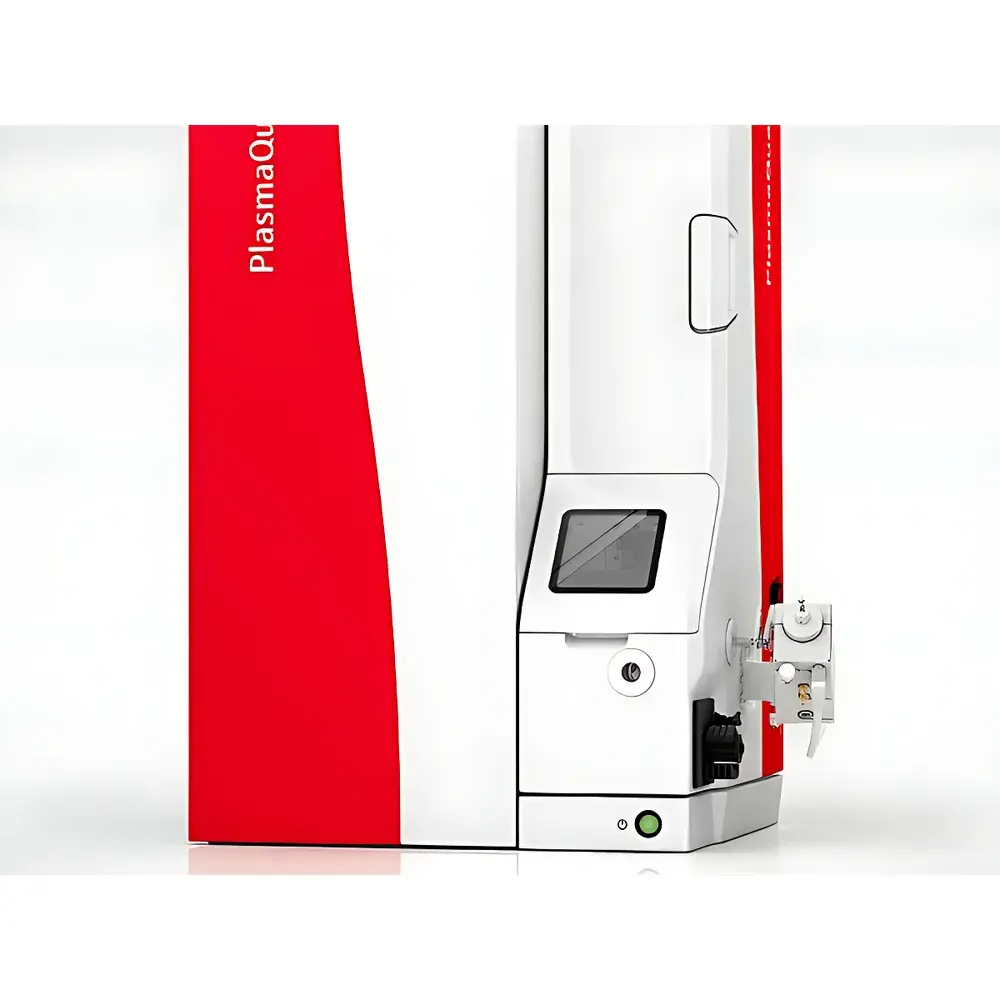
Analytik Jena PlasmaQuant MS Inductively Coupled Plasma Mass Spectrometer
| Brand | Analytik Jena |
|---|---|
| Origin | Germany |
| Model | PlasmaQuant MS |
| Instrument Type | Full-Spectrum Direct-Reading ICP-MS |
| Detection Limits | Be ≤ 0.1 ppt, Co ≤ 0.2 ppt, In ≤ 0.05 ppt, Bi ≤ 0.05 ppt, U ≤ 0.01 ppt |
| Precision (RSD) | < 3% |
| Short-Term Stability | < 3%, Long-Term Stability: < 4% |
Overview
The Analytik Jena PlasmaQuant MS is a high-performance inductively coupled plasma mass spectrometer (ICP-MS) engineered for ultra-trace elemental analysis across diverse sample matrices—from aqueous environmental extracts and industrial effluents to digested biological tissues and direct organic solvent introductions. Operating on the fundamental principle of ionization in a high-temperature argon plasma (~7,000–10,000 K), followed by mass separation via quadrupole mass filtering and detection using a high-gain electron multiplier, the PlasmaQuant MS delivers exceptional sensitivity, isotopic fidelity, and matrix resilience. Its full-spectrum direct-read architecture enables simultaneous acquisition of all masses within a defined range without scanning delays—critical for transient signal analysis (e.g., laser ablation, single-particle ICP-MS) and high-throughput routine monitoring. Designed and manufactured in Jena, Germany, the system integrates robust RF generator stability, low-noise vacuum architecture, and optimized ion optics to sustain sub-ppt detection capability under routine laboratory conditions.
Key Features
- High-efficiency dual-cone interface with active cooling for extended operational uptime and reduced oxide formation (CeO⁺/Ce⁺ < 1.5%)
- RF-powered quartz torch with precision gas flow control (plasma, auxiliary, nebulizer) ensuring stable plasma ignition and minimal drift
- Collision/reaction cell technology with He and H₂ gas modes for polyatomic interference removal (e.g., 40Ar35Cl⁺ on 75As⁺, 40Ar40Ar⁺ on 80Se⁺)
- Integrated autosampler with programmable rinse cycles, wash protocols, and carryover reduction algorithms compliant with ISO 17025 method validation requirements
- Modular vacuum system featuring turbomolecular pumps with real-time pressure monitoring and automatic pump-down sequencing
- Front-panel diagnostic LEDs and embedded firmware self-tests for rapid troubleshooting and preventive maintenance scheduling
Sample Compatibility & Compliance
The PlasmaQuant MS supports direct analysis of liquid samples—including acid-digested environmental solids, filtered wastewater, serum/plasma digests, and diluted organic extracts—via standard pneumatic nebulization. With optional accessories (e.g., ESI-ICP-MS interface, laser ablation module, or HPLC-ICP-MS coupling kit), it extends compatibility to speciated analysis and solid sampling. All hardware and software components are designed to meet international regulatory expectations: instrument operation logs, method parameters, and raw data files are timestamped and user-authenticated in accordance with FDA 21 CFR Part 11 requirements for electronic records and signatures. The system supports audit trail generation, user role-based access control, and electronic signature workflows aligned with GLP and GMP quality systems. Routine performance verification follows ASTM D5673 (for drinking water metals) and ISO/IEC 17025 clause 7.7 (uncertainty estimation for trace element quantification).
Software & Data Management
PlasmaQuant Control software provides a validated, Windows-based platform for instrument control, data acquisition, quantitative calibration (standard addition, internal standard correction, isotope dilution), and QC reporting. It features automated peak integration with deconvolution algorithms for overlapping isotope signals, dynamic background subtraction, and real-time interference diagnostics. Raw data files (.pqd format) are stored in a structured, non-proprietary binary container supporting metadata embedding (sample ID, operator, date/time, instrument settings). Export options include CSV, Excel, and XML formats compatible with LIMS integration (e.g., Thermo Fisher SampleManager, LabVantage). Software versioning, change control documentation, and IQ/OQ/PQ protocol templates are provided to support laboratory accreditation readiness.
Applications
- Environmental monitoring: Quantification of regulated metals (As, Cd, Cr, Pb, U) in surface water, groundwater, and soil leachates per EPA Method 6020B and ISO 17294-2
- Clinical and toxicological research: Multi-element profiling in blood, urine, and tissue homogenates at sub-ng/L levels for biomonitoring studies
- Geochemical fingerprinting: Isotopic ratio measurement (e.g., 87Sr/86Sr, 206Pb/207Pb) with external standard bracketing for provenance analysis
- Materials science: Impurity screening in high-purity semiconductors, battery cathode precursors, and nuclear-grade zirconium alloys
- Food safety: Detection of toxic elements (e.g., inorganic As in rice, Cd in cocoa) against EU Commission Regulation (EC) No 1881/2006 limits
FAQ
What sample introduction systems are compatible with the PlasmaQuant MS?
The base configuration includes a concentric glass nebulizer and Scott-type double-pass spray chamber. Optional configurations support microflow nebulization, desolvating systems (e.g., Aridus III), laser ablation (with NWR imaging platforms), and HPLC-ICP-MS interfaces.
Does the system support isotope ratio measurements for geochemical applications?
Yes—when operated in high-mass-resolution mode with appropriate tuning and external standard bracketing, the PlasmaQuant MS achieves reproducible isotope ratio precision (2SE < 0.05% for 87Sr/86Sr) suitable for geological age dating and tracer studies.
How is data integrity ensured during long-term regulatory compliance audits?
All analytical sequences generate immutable audit trails including operator login/logout timestamps, parameter modifications, calibration history, and raw spectral files—fully traceable and exportable for FDA or ISO 17025 audit submission.
Is remote diagnostics supported for service escalation?
Yes—optional Secure Remote Access (SRA) module enables encrypted, permission-controlled connection for Analytik Jena Field Application Specialists to perform real-time diagnostics and firmware updates without compromising network security policies.



