
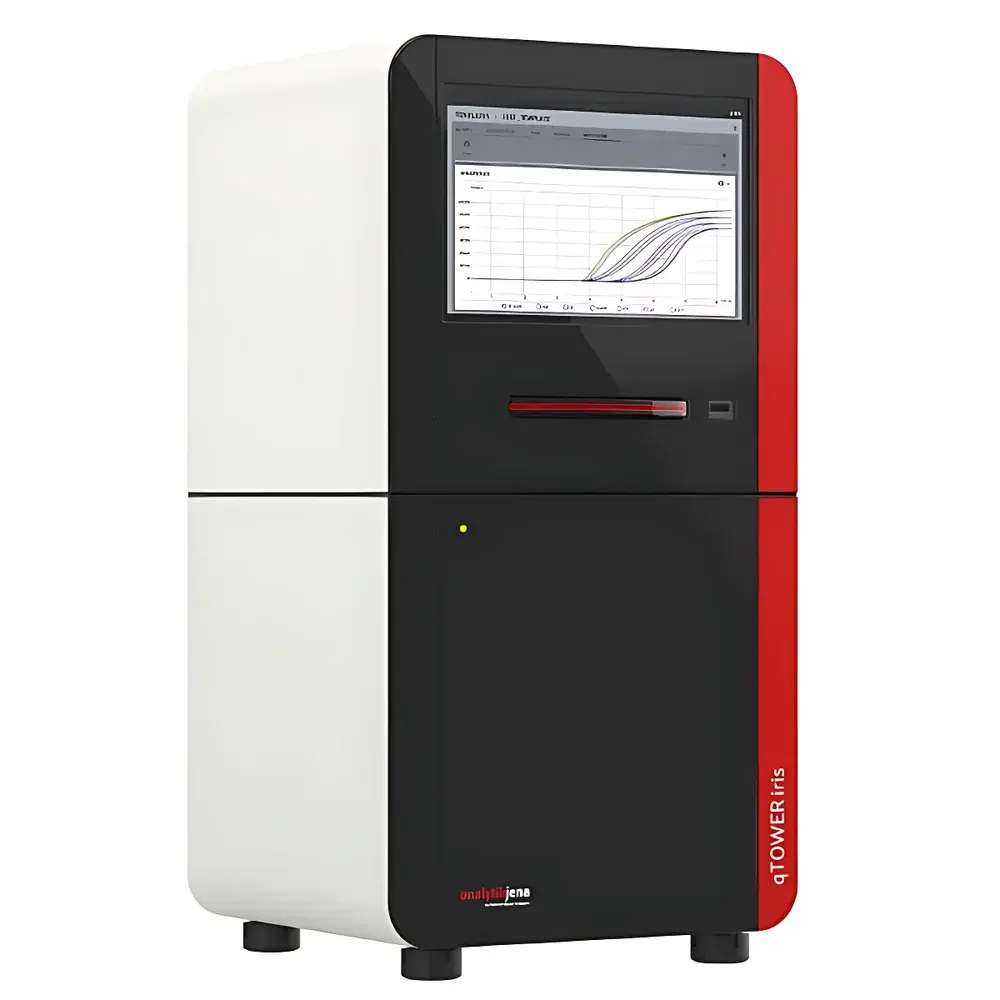
Analytik Jena qTOWER³ iris touch Real-Time Fluorescence Quantitative PCR System
| Brand | Analytik Jena |
|---|---|
| Origin | Germany |
| Manufacturer | Analytik Jena AG |
| Instrument Type | Real-Time Fluorescence Quantitative PCR System |
| Sample Capacity | 96-well format |
| Maximum Heating Rate | 8 °C/s |
| Temperature Accuracy | ±0.1 °C |
| Well-to-Well Temperature Uniformity | ±0.15 °C |
| Excitation Source | 7 high-intensity solid-state LEDs (UV–NIR spectrum) |
| Detection Technology | 8-channel fiber-optic scanning with PMT detector |
| Detection Channels | Configurable 1–6 channels, including dedicated UV and protein-melting filter sets |
| Linear Temperature Gradient | 12-column gradient (spanning up to 40 °C) |
| Thermal Block Material | Gold-plated pure silver |
| Software | qPCRsoft v5.x (MIQE-compliant reporting, audit trail, CFR Part 11-ready configuration options) |
Overview
The Analytik Jena qTOWER³ iris touch is a benchtop real-time fluorescence quantitative PCR system engineered for precision, flexibility, and long-term reliability in molecular biology laboratories. It operates on the principle of sequence-specific nucleic acid amplification coupled with real-time fluorescent signal detection—enabling absolute quantification, relative expression analysis, genotyping, and high-resolution melting (HRM) applications. Unlike conventional systems relying on broadband lamps or limited LED arrays, the qTOWER³ iris touch integrates seven discrete, high-output solid-state LEDs covering a continuous excitation range from 365 nm (near-UV) to 785 nm (near-infrared). This full-spectrum capability ensures optimal excitation of all major qPCR dyes—including SYBR Green I, FAM, HEX, ROX, Cy5, and far-red probes—as well as specialized protein-binding fluorophores such as CPM, ANS, and SYPRO Orange. The system employs an 8-channel fiber-optic scanning architecture with photomultiplier tube (PMT) detection, delivering high signal-to-noise ratios and eliminating inter-well optical path variability—thus removing the need for reference channel calibration or spatial normalization routines.
Key Features
- Gold-plated pure silver thermal block: Provides exceptional thermal conductivity and chemical inertness, enabling rapid heating (up to 8 °C/s) and precise temperature control (±0.1 °C accuracy; ±0.15 °C well-to-well uniformity across all 96 positions).
- 12-column linear temperature gradient: Independently programmable across 12 columns (not rows), allowing empirical optimization of annealing temperatures within a single run—critical for assay development, primer validation, and multiplex reaction tuning.
- Intelligent auto-lid pressure control: Dynamically adjusts lid contact force based on plate type and ambient conditions, minimizing evaporation without manual intervention or consumable-specific lid settings.
- Open consumables platform: Fully compatible with standard 96-well plates (full-skirted, semi-skirted, non-skirted), 0.2 mL 8-tube strips, and individual PCR tubes—no proprietary plate requirements or barcode dependencies.
- Modular optical configuration: Users select filter sets per channel from a library spanning 365–785 nm; configurations support 1–6 simultaneous detection channels, including dedicated UV (365/40 nm) and protein-melting (470/40 nm + 580/30 nm) modules.
- No optical calibration required: Fiber-optic scanning ensures identical excitation/detection geometry for every well—eliminating cross-talk correction, reference channel allocation, and periodic recalibration procedures.
Sample Compatibility & Compliance
The qTOWER³ iris touch accommodates standard ANSI/SLAS-compliant 96-well microplates and low-profile tubes without mechanical adaptation. Its open hardware design supports third-party master mixes, probe chemistries (hydrolysis, hybridization, molecular beacons), and dye formulations—including those used in protein thermal shift assays (e.g., differential scanning fluorimetry). From a regulatory standpoint, the system’s architecture aligns with GLP/GMP laboratory practices: qPCRsoft software supports user-defined roles, electronic signatures, and audit-trail-enabled workflows. When configured with appropriate security policies and backup protocols, it meets documentation requirements outlined in FDA 21 CFR Part 11 for electronic records and signatures. While not certified as a medical device, its performance characteristics conform to ISO 20395:2019 (Biotechnology — Requirements for evaluating qPCR performance) and ASTM E2889-13 (Standard Guide for Real-Time PCR Assay Development).
Software & Data Management
qPCRsoft v5.x serves as the native analysis and instrument control platform. It implements MIQE (Minimum Information for Publication of Quantitative Real-Time PCR Experiments)-compliant metadata capture—including cycling parameters, passive reference settings, baseline definitions, and efficiency estimation methods (LinReg, PCR Miner, or serial dilution-based models). The software provides validated analytical modes: absolute quantification (standard curve), comparative ΔΔCt with efficiency correction, allelic discrimination (SNP calling via cluster analysis), endpoint genotyping, and high-resolution melting curve analysis with derivative peak calling and Tm clustering. All reports are exportable in PDF, Excel, and XML formats; raw fluorescence data (.qpcr files) retain full traceability to instrument firmware version, calibration history, and user session logs. Optional LIMS integration via RESTful API enables automated data ingestion into enterprise laboratory informatics systems.
Applications
This platform supports diverse applications across academic, clinical, and industrial research settings. In gene expression profiling, its six-channel capacity allows simultaneous monitoring of target genes, endogenous controls, and spike-in references—reducing inter-run variability. For pathogen detection, the broad spectral sensitivity enables robust multiplexing of viral/bacterial targets with internal amplification controls under a single thermal profile. In pharmacogenomics, the dedicated UV and visible-range filters facilitate direct detection of DNA-binding dyes in HRM-based variant screening without post-PCR reagent addition. Beyond nucleic acids, the system is routinely applied to protein stability studies: SYPRO Orange–based thermal denaturation curves yield reproducible Tm values for ligand-binding assays, enzyme engineering, and formulation screening. Its thermal precision and gradient functionality also make it suitable for optimizing novel polymerase variants or CRISPR-Cas cleavage kinetics.
FAQ
Does the qTOWER³ iris touch require regular optical recalibration?
No. The fixed-path fiber-optic scanning design ensures identical excitation and emission geometry for every well—eliminating the need for channel-to-channel normalization or periodic lamp alignment.
Can I upgrade from a 4-channel to a 6-channel configuration after purchase?
Yes. Optical modules are field-upgradable via authorized service technicians; no hardware replacement of the main optical engine is required.
Is qPCRsoft compliant with 21 CFR Part 11?
The software includes configurable features supporting Part 11 compliance—including role-based access control, electronic signatures, and immutable audit trails—when deployed in validated environments with documented SOPs.
What is the expected lifetime of the LED excitation sources?
All seven LEDs are rated for >20,000 hours of continuous operation with negligible output decay—effectively eliminating lamp replacement over the instrument’s operational lifespan.
Does the system support fast-cycling protocols using low-volume reactions?
Yes. The gold-plated silver block’s high thermal diffusivity and precise ramp-rate control enable sub-45-minute qPCR runs with 10–20 µL volumes while maintaining specificity and reproducibility.




