
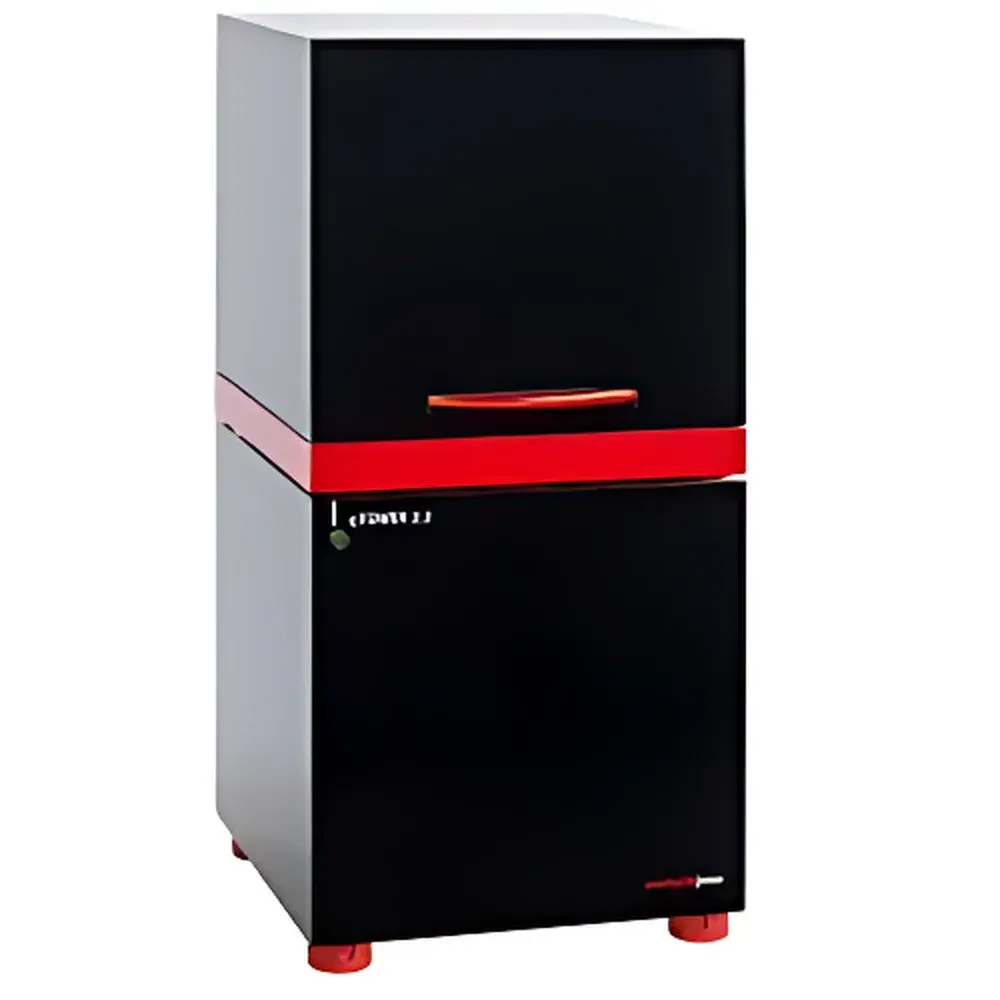
Analytik Jena qTOWER 2.2 Real-Time Gradient PCR System
| Brand | Analytik Jena |
|---|---|
| Origin | Germany |
| Manufacturer | Analytik Jena AG |
| Product Type | Imported |
| Model | qTOWER 2.2 |
| Price | Upon Request |
| Optical Channels | 6 simultaneous detection channels |
| Excitation Sources | 3 high-intensity LEDs (blue, red, white) |
| Detection Technology | Channel-type photomultiplier tube (CPM) |
| Filter Configurations | 10 interchangeable Ex/Em filter sets |
| Sensitivity | 1 nM FAM in 30 µL reaction volume |
| Sample Capacity | 96-well format |
| Max Ramp Rates | 5.5 °C/s (heating), 4.0 °C/s (cooling) |
| Temperature Uniformity | ±0.2 °C at 95 °C |
| Temperature Accuracy | ±0.1 °C |
| Gradient Range | Up to 40 °C |
| Thermal Lid | 110 °C with SPS (Sample Protection System) and auto-adjusting pressure (up to 10 kg/plate) |
| Software | qPCRsoft v4.x for absolute/relative quantification, ΔΔCt, allelic discrimination, PCR efficiency analysis, and FRET applications |
| Interface | USB 2.0 |
| Dimensions (W×H×D) | 275 × 585 × 275 mm |
| Weight | ~25 kg |
Overview
The Analytik Jena qTOWER 2.2 Real-Time Gradient PCR System is a precision-engineered thermal cycler designed for high-fidelity quantitative nucleic acid amplification and detection under controlled thermal gradients. Based on real-time fluorescence monitoring via sequence-specific probes or intercalating dyes, the instrument employs a six-channel optical architecture grounded in solid-state LED excitation and channel-type photomultiplier tube (CPM) detection—enabling multiplexed quantification across up to six distinct fluorophores within a single run. Its core measurement principle relies on kinetic monitoring of fluorescent signal accumulation during exponential amplification phases, permitting accurate determination of threshold cycle (Ct) values under rigorously calibrated thermal conditions. Developed by Analytik Jena—a German manufacturer with over 150 years of expertise in precision optics—the qTOWER 2.2 integrates robust thermal control, programmable gradient functionality, and an open-platform design compatible with industry-standard reagents and consumables. It meets essential regulatory expectations for laboratory instrumentation, including CE marking per Directive 2014/30/EU (EMC) and 2014/35/EU (LVD), and supports audit-ready data handling when operated under GLP-compliant workflows.
Key Features
- Six independent optical detection channels with simultaneous multi-color acquisition, supporting up to six fluorophores in one run
- Three high-output, long-life LEDs (blue, red, white) delivering uniform excitation across the 470–660 nm range without spectral gaps
- Channel-type photomultiplier tube (CPM) detector with optimized quantum efficiency and low-noise signal processing
- Eight-fiber optical scanning system enabling full 96-well readout in just 6 seconds—no inter-channel normalization required
- Configurable excitation/emission filter sets: ten pre-validated Ex/Em combinations covering FAM, SYBR Green I, HEX, VIC, ROX, Texas Red, Cy5, Alexa dyes, and FRET donor–acceptor pairs
- Advanced thermal control architecture featuring dual-mode regulation—block-based and simulated-tube temperature control—for improved reaction fidelity
- SPS (Sample Protection System): thermal lid heats to 110 °C while maintaining sample chamber at ≤20 °C pre-run; auto-adjusting pressure (up to 10 kg/plate) prevents evaporation and condensation in low-volume reactions (10–60 µL)
- Programmable gradient capability with maximum span of 40 °C across the 96-well block, facilitating rapid assay optimization and melting curve validation
- Thermal ramp rates adjustable from 0.1 to 5.5 °C/s (heating) and 0.1 to 4.0 °C/s (cooling), with temperature accuracy of ±0.1 °C and uniformity of ±0.2 °C at 95 °C
Sample Compatibility & Compliance
The qTOWER 2.2 accepts standard 0.2 mL 96-well PCR plates and tubes, fully compatible with commercially available master mixes, hydrolysis probes (e.g., TaqMan), hybridization probes, molecular beacons, and SYBR Green I–based assays. Its open reagent policy eliminates vendor lock-in, allowing integration into existing laboratory workflows without protocol redesign. From a compliance perspective, the system conforms to ISO/IEC 17025 requirements for test equipment verification and supports traceable calibration procedures. While not inherently 21 CFR Part 11–compliant out-of-the-box, qPCRsoft v4.x can be configured with electronic signatures, audit trails, and user access controls to meet GxP documentation standards when deployed in regulated environments (e.g., clinical diagnostics labs operating under CLIA or CAP guidelines). All optical components carry a 10-year limited warranty, reflecting Analytik Jena’s commitment to long-term instrument stability and performance reproducibility.
Software & Data Management
qPCRsoft is a modular, Windows-based application engineered specifically for quantitative PCR data acquisition, visualization, and statistical interpretation. It provides native support for absolute quantification (via standard curves), relative quantification (including ΔΔCt and Pfaffl methods), PCR efficiency calculation using LinRegPCR algorithms, allelic discrimination (cluster analysis), and melt curve derivative profiling. The software includes built-in tools for baseline correction, threshold setting, outlier detection, and inter-run normalization. Raw fluorescence data are stored in vendor-neutral .qpcr binary format, exportable to CSV, Excel, or MIQE-compliant XML for third-party analysis. Audit trail functionality logs all user actions—including parameter changes, result modifications, and file exports—with timestamps and operator IDs, satisfying GLP/GMP record-keeping prerequisites. Data integrity is further reinforced through checksum validation and optional password-protected project locking.
Applications
The qTOWER 2.2 serves as a versatile platform across academic research, clinical diagnostics, biopharmaceutical development, and food safety testing. Typical use cases include gene expression profiling in oncology and immunology studies; pathogen load quantification (e.g., viral RNA/DNA copy number in serum or tissue); SNP genotyping and methylation analysis using methylation-specific PCR; miRNA quantification with stem-loop RT primers; and validation of CRISPR editing efficiency via T7E1 or digital droplet PCR correlation. Its gradient function accelerates primer annealing optimization, touchdown PCR setup, and HRM (high-resolution melting) assay development. The system also supports dual-probe FRET assays for conformational dynamics studies and probe-based multiplexing in limited-sample contexts such as single-cell lysates or FFPE-derived nucleic acids.
FAQ
Does the qTOWER 2.2 support FRET-based assays?
Yes—four predefined FRET configurations are implemented (FRET 1–4), each pairing donor dyes (e.g., FAM, JOE) with corresponding acceptors (e.g., TAMRA, Cy5, Cy5.5) using dedicated Ex/Em filter sets.
Can I upgrade from a 3-channel to a 6-channel configuration post-purchase?
No—optical channel count is hardware-defined at time of manufacture; users must select the desired channel configuration (1–6) when ordering.
Is qPCRsoft validated for use in FDA-regulated laboratories?
qPCRsoft itself is not FDA-cleared, but its configurable audit trail, electronic signature, and data export features enable validation per internal SOPs aligned with 21 CFR Part 11 when deployed in qualified IT infrastructure.
What is the minimum recommended reaction volume?
10 µL is the lower operational limit; volumes below this may compromise thermal transfer consistency and increase evaporation risk—even with SPS enabled.
How often does the optical system require recalibration?
No routine recalibration is needed; the LED–CPM–filter architecture is factory-aligned and stabilized for long-term drift <0.5% per year under normal lab conditions.





