
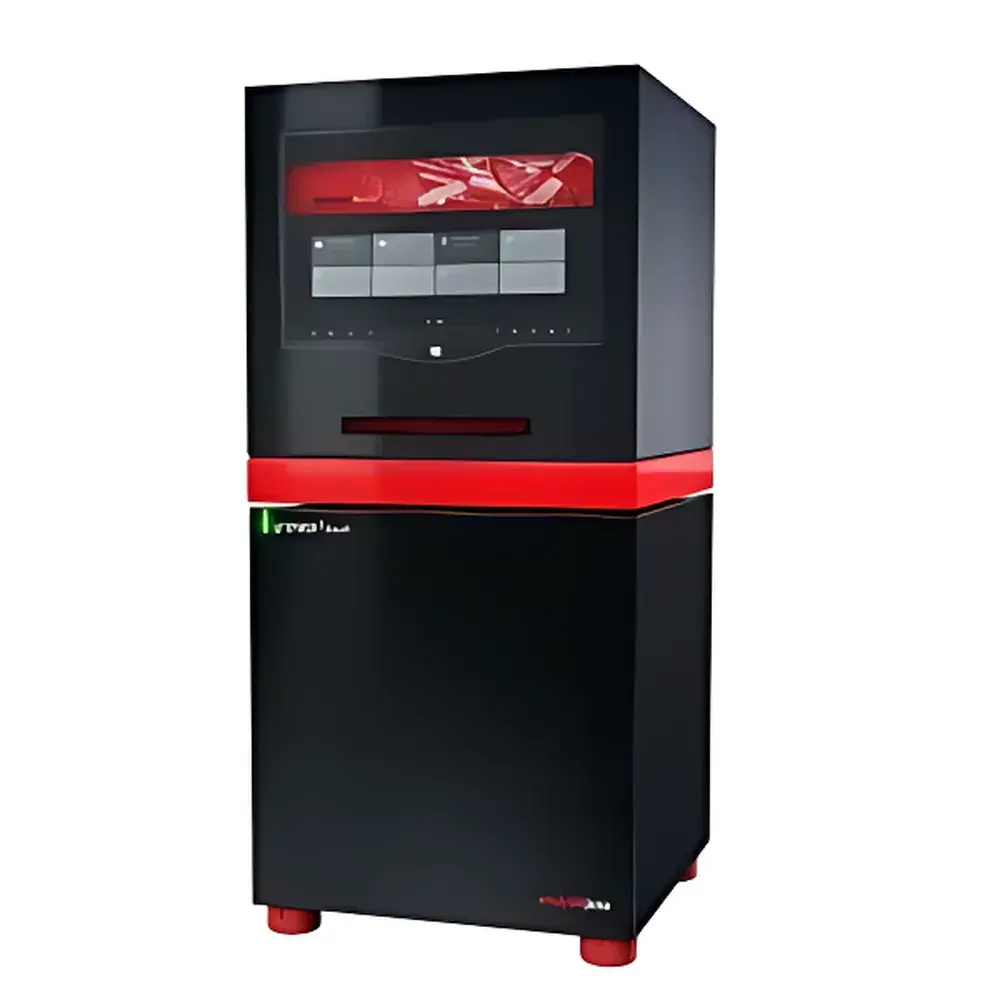
Analytik Jena qTOWER3 G touch Real-Time Fluorescence Quantitative PCR System
| Brand | Analytik Jena |
|---|---|
| Origin | Germany |
| Model | qTOWER3 G touch |
| Instrument Type | Real-Time Fluorescence Quantitative PCR System |
| Sample Capacity | 96-well format |
| Maximum Heating Rate | 8 °C/s |
| Temperature Accuracy | ±0.1 °C |
| Well-to-Well Temperature Uniformity | ±0.10 °C |
| Excitation Source | Four solid-state RGBW LEDs (blue, green, red, white) |
| Detection System | 8-channel fiber-optic scanning with channel-type photomultiplier tube (PMT) |
| Detection Channels | Configurable 1–6 channels |
| Thermal Gradient | 12-column linear gradient (spanning up to 40 °C) |
| Sample Block Material | Gold-plated pure silver block |
| Lid System | Motorized, pressure-regulated heated lid with auto-height adjustment |
| Software | qPCRsoft v5.x compliant with MIQE guidelines, supporting absolute quantification, relative quantification (ΔΔCt & dual standard curve), melting curve analysis, SNP/allelic discrimination, endpoint analysis, amplification efficiency calculation, and audit-trail-enabled reporting per FDA 21 CFR Part 11 requirements |
Overview
The Analytik Jena qTOWER3 G touch is a high-performance real-time fluorescence quantitative PCR system engineered for precision, reproducibility, and operational flexibility in molecular diagnostics, gene expression profiling, pathogen quantification, and SNP genotyping workflows. It operates on the principle of sequence-specific DNA amplification coupled with real-time fluorescent signal detection—enabling kinetic monitoring of amplicon accumulation across up to six independent optical channels. Its core architecture integrates a gold-plated pure silver thermal block for exceptional thermal conductivity and corrosion resistance, combined with a motorized, pressure-regulated heated lid that dynamically adapts to tube height and seal integrity—minimizing evaporation without manual intervention. Designed and manufactured in Jena, Germany, the system adheres to ISO 13485 quality management standards for medical device-related instrumentation and supports GLP/GMP-aligned data integrity through full audit-trail functionality.
Key Features
- Thermal performance: Achieves a maximum heating rate of 8 °C/s and maintains temperature accuracy of ±0.1 °C across the full operating range (typically 0–100 °C); well-to-well uniformity is guaranteed at ±0.10 °C over all 96 positions.
- Optical architecture: Employs four high-intensity, long-life solid-state RGBW LEDs (blue, green, red, white) delivering broad-spectrum excitation without thermal load or lamp replacement—ensuring consistent photon flux and eliminating warm-up drift.
- Detection fidelity: Utilizes an 8-channel fiber-optic scanning system paired with channel-type photomultiplier tubes (PMTs), enabling rapid, synchronous acquisition from all wells without cross-talk or optical path variation.
- No calibration required: The fixed-path fiber-optic design ensures identical excitation and emission geometry for every well—eliminating the need for reference channel allocation or routine optical recalibration.
- Flexible detection configuration: Supports 1–6 programmable detection channels via user-selectable filter sets (12 options total), including dedicated FRET pair combinations and filters optimized for high-resolution protein melting curve analysis.
- Linear thermal gradient: 12-column gradient capability allows precise empirical determination of optimal annealing temperatures across a 40 °C span—critical for assay development and multiplex primer optimization.
Sample Compatibility & Compliance
The qTOWER3 G touch accepts standard consumables without proprietary restrictions: 96-well PCR plates (full-skirted, semi-skirted, or non-skirted), 8-tube strips, and individual PCR tubes (0.1–0.2 mL). Its open-platform design enables compatibility with third-party master mixes, probes (TaqMan®, Molecular Beacons, Scorpions®), intercalating dyes (SYBR® Green I, EvaGreen®), and hydrolysis probe chemistries. The instrument complies with electromagnetic compatibility (EMC) directives (IEC 61326-1), electrical safety standards (IEC 61010-1), and meets CE marking requirements for in vitro diagnostic (IVD) ancillary equipment. Software-generated reports conform to Minimum Information for Publication of Quantitative Real-Time PCR Experiments (MIQE) guidelines and support 21 CFR Part 11–compliant electronic signatures, audit trails, and role-based access control.
Software & Data Management
qPCRsoft v5.x serves as the native control and analysis platform—offering intuitive touchscreen operation (via integrated 7-inch capacitive display) and full PC-based remote management. It provides validated analytical modules for absolute quantification, comparative ΔΔCt analysis with amplification efficiency correction, melting curve deconvolution (including derivative peak analysis), allelic discrimination (cluster-based and threshold-assisted), endpoint fluorescence evaluation, and amplification efficiency estimation using LinRegPCR or similar algorithms. All raw fluorescence data, thermal profiles, and user annotations are stored in vendor-neutral .qpcr binary format with embedded metadata. Export options include CSV, PDF (with customizable templates), and XML for LIMS integration. Data integrity safeguards include encrypted local storage, automatic backup scheduling, and time-stamped operator logs traceable to Windows Active Directory credentials.
Applications
This system is routinely deployed in academic research laboratories for differential gene expression studies under controlled experimental conditions; in clinical microbiology labs for viral/bacterial load quantification (e.g., SARS-CoV-2, HIV, CMV); in biopharmaceutical QA/QC for residual host-cell DNA testing; and in agricultural biotechnology for GMO detection and copy-number variation analysis. Its six-channel capability and FRET-compatible optics support advanced applications such as duplexed miRNA quantification, triplexed pathogen co-detection, and HRM-based methylation screening. The linear gradient function accelerates assay validation cycles during assay transfer between instruments or reagent lots.
FAQ
Is the qTOWER3 G touch compatible with third-party qPCR reagents and consumables?
Yes—it is an open-system platform designed to work with all commercially available qPCR master mixes, probes, dyes, and standard 96-well formats.
Does the system support FDA 21 CFR Part 11 compliance for regulated environments?
Yes—qPCRsoft includes electronic signature capability, audit-trail logging, user role management, and data immutability features required for GLP/GMP and clinical laboratory accreditation.
Can detection channels be upgraded post-purchase?
Yes—channel expansion (up to six) is performed via software license activation and physical installation of additional filter sets; no hardware modification is required.
What is the expected lifetime of the LED excitation sources?
The RGBW solid-state LEDs are rated for >50,000 hours of continuous operation—effectively lifetime maintenance-free under normal usage conditions.
How does the 12-column thermal gradient differ from conventional 2D gradients?
It provides discrete, linear temperature increments across columns only—ideal for systematic annealing temperature optimization without compromising row-wise uniformity needed for replicate testing.



