
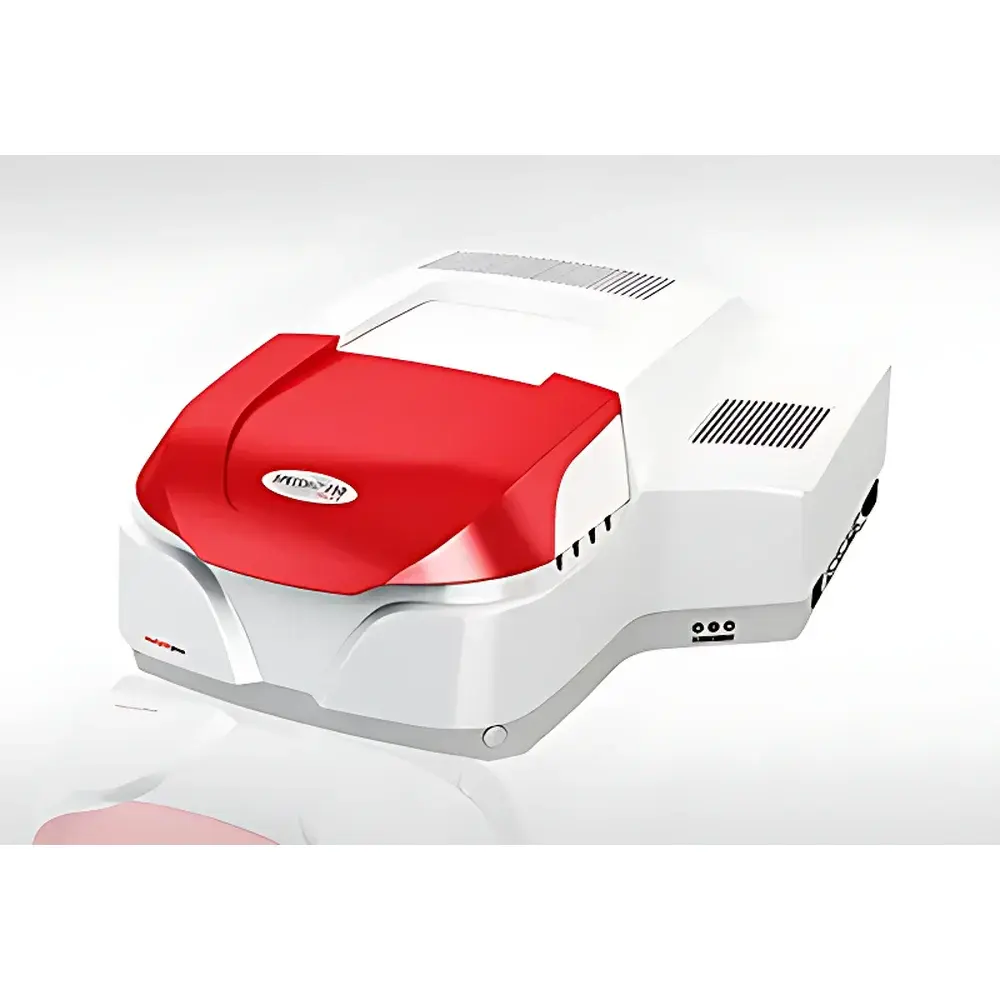
Analytik Jena SPECORD 200 PLUS UV-Vis Spectrophotometer
| Brand | Analytik Jena |
|---|---|
| Origin | Germany |
| Manufacturer | Analytik Jena AG |
| Type | Imported Instrument |
| Model | SPECORD 200 PLUS |
| Optical Design | Double-Beam |
| Detector | Photodiode Array (PDA) |
| Wavelength Range | 190–1100 nm |
| Automation | Motorized Wavelength Scanning |
| Spectral Bandwidth | 1.4 nm |
| Wavelength Accuracy | < ±0.1 nm (full range) |
| Wavelength Repeatability | < ±0.01 nm |
| Stray Light | < 0.005% @ 340 nm (NaNO₂) |
| Baseline Stability | ≤ 0.0001 A (RMS) |
| Photometric Range | –5 to +5 A |
| Scan Speed | 12,000 nm/min |
| Light Sources | Deuterium Lamp + Tungsten-Halogen Lamp (automatically switched) |
Overview
The Analytik Jena SPECORD 200 PLUS is a high-performance double-beam UV-Vis spectrophotometer engineered for precision absorbance, transmittance, and reflectance measurements across the ultraviolet, visible, and near-infrared spectral regions (190–1100 nm). Its optical architecture integrates Zeiss-designed optics—including high-efficiency holographic gratings, ultra-low-aberration mirrors, and thermally stabilized optical mounts—ensuring exceptional photometric accuracy, long-term baseline stability (≤ 0.0001 A RMS), and minimal stray light (< 0.005% at 340 nm, measured with NaNO₂). The real-time double-beam design continuously corrects for source drift and environmental fluctuations by simultaneously measuring sample and reference beams, eliminating the need for manual referencing and enhancing measurement reproducibility in regulated environments. As a product of Analytik Jena AG—the successor to the analytical instrumentation division of Carl Zeiss—the SPECORD 200 PLUS embodies decades of German optical engineering rigor and metrological traceability.
Key Features
- Zeiss-certified optical train: All critical optical components—including concave holographic grating, collimating/focusing mirrors, and beam-splitting optics—are manufactured to Zeiss specifications, delivering maximum photon throughput and minimal polarization dependence.
- Photodiode array (PDA) detection: Enables simultaneous acquisition of full spectra without mechanical scanning, supporting rapid kinetic monitoring and high-throughput screening applications.
- Automated wavelength calibration: Integrated holmium oxide filter enables self-validation and correction of wavelength scale per ASTM E275 and ISO 6223 standards; performed automatically during startup or on demand.
- Intelligent dual-lamp management: Software-controlled automatic switching between deuterium (UV) and tungsten-halogen (Vis/NIR) sources ensures optimal spectral continuity and extends lamp service life.
- High-speed spectral acquisition: Up to 12,000 nm/min scan rate supports time-resolved studies, including enzymatic kinetics, photochemical reaction monitoring, and dissolution profiling.
- Large-volume sample compartment: Accommodates up to 100 mm pathlength cells, integrating accessories such as temperature-controlled cuvette holders, solid-sample reflectance stages, fiber-optic probes, and automated liquid handlers.
Sample Compatibility & Compliance
The SPECORD 200 PLUS supports quantitative and qualitative analysis of liquid, solid, and gaseous samples through interchangeable accessories compliant with ISO/IEC 17025 and GLP/GMP laboratory practices. It meets key pharmacopeial requirements—including USP , EP 2.2.25, and JP 17—specifically for bandwidth verification (1.4 nm nominal), stray light assessment, and wavelength accuracy validation. When coupled with dissolution testing systems (e.g., Hanson SR8-Plus or Distek 2500), its dedicated software module acquires, aligns, and processes release profiles in real time, generating audit-trail-enabled reports compliant with FDA 21 CFR Part 11. All hardware diagnostics—including lamp status, detector saturation, and optical alignment—are logged with timestamps and user IDs for full traceability.
Software & Data Management
WinASPECT software provides a validated, modular platform supporting method development, instrument control, data processing, and report generation. Preconfigured application modules cover food safety (AOAC, ISO 22000), pharmaceutical QC (ICH Q2(R2)), water quality (EPA 4500-NO₃⁻, ISO 7027), and materials characterization (ASTM D1003). The software includes built-in SCS (Self-Check System) diagnostics that verify detector linearity, lamp intensity, and optical path integrity before each run. Data files are stored in vendor-neutral ASCII formats (CSV, TXT) and proprietary .spc files with embedded metadata (instrument ID, operator, date/time, calibration history). Audit trail functionality records all user actions—including parameter edits, curve fitting selections, and report exports—with immutable timestamps and electronic signatures.
Applications
- Pharmaceutical QA/QC: Active pharmaceutical ingredient (API) assay, excipient identification, dissolution testing, and cleaning validation per ICH guidelines.
- Environmental analysis: Nitrate/nitrite quantification in drinking water, COD determination, and heavy metal complexation studies.
- Food & beverage: Colorimetric analysis of anthocyanins, chlorophyll, carotenoids; ethanol content via NIR absorption; turbidity measurement per ISO 7027.
- Life sciences: Protein quantification (Bradford, Lowry, BCA), nucleic acid purity (A260/A280), enzyme kinetics (NADH/NADPH oxidation), and cell culture density monitoring.
- Materials science: Thin-film thickness calculation via interference fringes, bandgap estimation of semiconductors, and pigment dispersion analysis.
FAQ
Does the SPECORD 200 PLUS support 21 CFR Part 11 compliance?
Yes—WinASPECT software offers role-based access control, electronic signatures, and a tamper-evident audit trail for all instrument operations and data manipulations.
Can it measure solid samples directly?
Yes—when equipped with the optional integrating sphere or specular reflectance stage, it performs absolute reflectance, diffuse transmittance, and colorimetric analysis per CIE 15:2018.
What is the minimum detectable absorbance change?
With baseline stability ≤ 0.0001 A (RMS) and noise level < 0.0002 A (peak-to-peak), it reliably resolves ΔA ≥ 0.0005 in high-sensitivity modes.
Is method transfer possible between SPECORD models?
Yes—WinASPECT methods (.mth files) are fully compatible across the SPECORD S600, 200 PLUS, and 250 PLUS platforms, enabling seamless scalability from R&D to production QC.
How often is wavelength calibration required?
The built-in holmium oxide filter allows daily verification; formal recalibration per ISO/IEC 17025 is recommended every 6 months or after major maintenance.







