
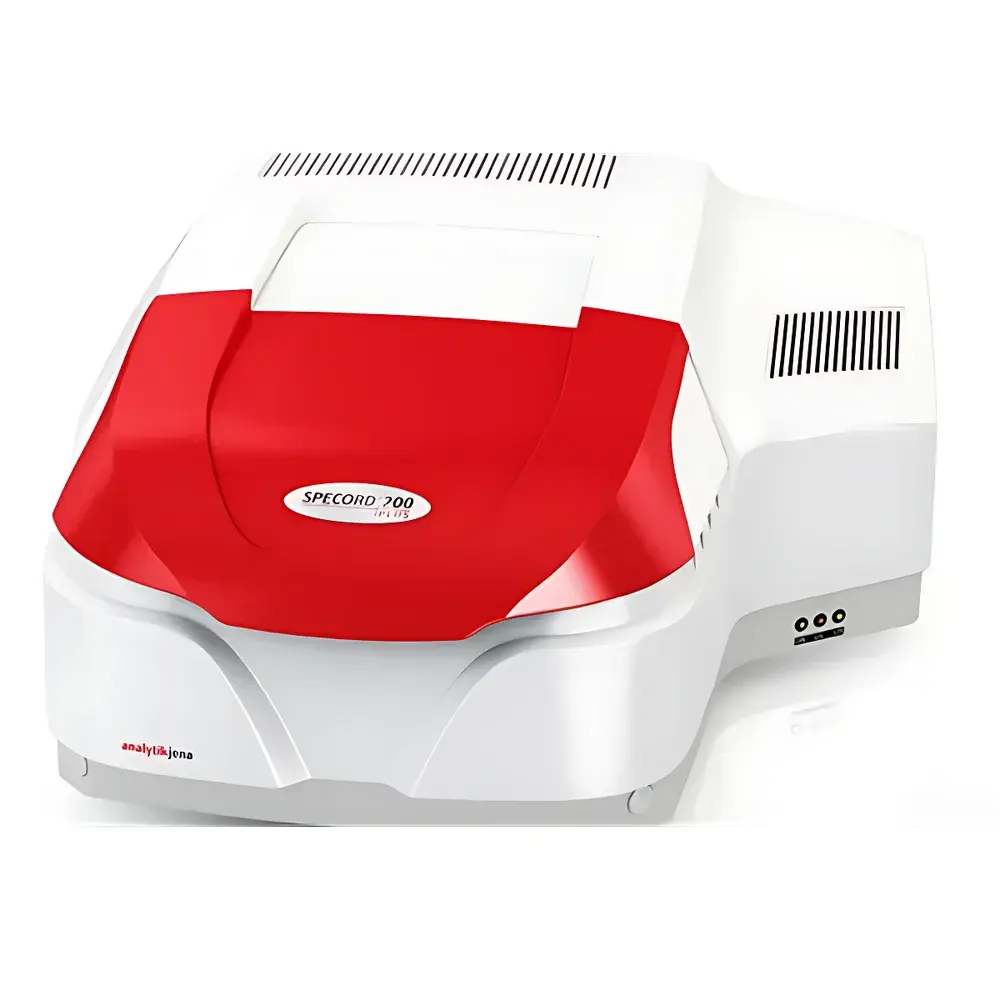
Analytik Jena SPECORD 200 PLUS UV/Vis Spectrophotometer
| Brand | Analytik Jena |
|---|---|
| Origin | Germany |
| Instrument Type | Double-Beam |
| Model | SPECORD 200 PLUS |
| Optical Design | Holographic Grating Monochromator |
| Detector | Dual-Thermostatted Photodiode Array |
| Wavelength Range | 190–1100 nm |
| Spectral Resolution | ≤1.2 nm (FWHM) |
| Photometric Accuracy | ±0.002 A (at 0.5 A, 1.0 A) |
| Stray Light | <0.0005% T at 220 nm |
| Beam Geometry | True Simultaneous Double-Beam |
| Wavelength Calibration | Pre-aligned Holmium Oxide Filter |
| Compliance | USP <857>, Ph. Eur. 2.2.25, FDA 21 CFR Part 11 (Audit Trail, Electronic Signatures, User Access Control) |
Overview
The Analytik Jena SPECORD 200 PLUS is a high-performance double-beam ultraviolet-visible spectrophotometer engineered for precision quantitative and qualitative analysis across pharmaceutical, academic, environmental, and industrial laboratories. Operating on the fundamental principle of Beer–Lambert law-based absorbance measurement, it employs a true simultaneous double-beam optical architecture—where sample and reference beams are measured concurrently using a single monochromator and dual thermostatted photodiode array detectors. This design eliminates temporal drift and compensates for source intensity fluctuations in real time, ensuring exceptional photometric stability over extended acquisition periods. The instrument integrates a holographic grating monochromator with optimized aberration-corrected quartz-coated aspheric optics, delivering high light throughput, minimal stray light (<0.0005% T at 220 nm), and consistent spectral fidelity across its full 190–1100 nm range. Its mechanically robust construction features minimal moving parts—only the wavelength drive mechanism and automated cuvette changer (if installed)—enhancing long-term reliability and signal-to-noise ratio.
Key Features
- True simultaneous double-beam optics for real-time differential measurement, eliminating baseline drift and enabling stable kinetic and long-duration scans
- Holographic grating monochromator with aberration-corrected quartz-coated aspheric mirrors for high optical efficiency and reduced higher-order diffraction artifacts
- Dual thermostatted photodiode array detector system maintaining thermal equilibrium at ±0.1 °C, critical for low-noise spectral acquisition and inter-day reproducibility
- Integrated holmium oxide filter for fully automated, traceable wavelength calibration compliant with ISO 6326-1 and USP
- Pre-aligned, voltage-stabilized deuterium and tungsten-halogen lamps with automatic lamp switching and lifetime monitoring
- Modular hardware architecture supporting optional accessories including Peltier-controlled cuvette holders, fiber-optic probes, integrating spheres, and solid-sample reflectance units
Sample Compatibility & Compliance
The SPECORD 200 PLUS accommodates a broad spectrum of sample formats—including clear and turbid liquids (in standard 10 mm or micro-volume cuvettes), powders (via diffuse reflectance accessories), thin films, and gases (with sealed gas cells). Its optical path design supports measurements under ambient or controlled temperature conditions, and optional accessories enable transmission, absorption, reflectance, and transmittance quantification per ASTM E275, ISO 7010, and Ph. Eur. 2.2.25. From a regulatory perspective, the system meets essential requirements for GxP environments: hardware components are designed to minimize mechanical hysteresis and thermal drift; firmware implements secure user authentication, role-based access control, and immutable audit trails. When paired with the optional SPECORD Software Suite (v4.x), the platform achieves full compliance with FDA 21 CFR Part 11—including electronic signatures, operation logging, data integrity safeguards, and version-controlled method storage.
Software & Data Management
Controlled via the Windows-native SPECORD Software Suite, the instrument provides intuitive workflow navigation without compromising analytical depth. The interface supports method-driven operation, with pre-configured templates for pharmacopoeial assays (e.g., assay of paracetamol per USP , impurity profiling per ICH Q2(R2)), enzyme kinetics, DNA/RNA quantification, and colorimetric assays. All spectral data are stored in vendor-neutral, metadata-rich .spc files compatible with third-party chemometric tools (e.g., MATLAB, Unscrambler). Raw and processed datasets include embedded calibration history, instrument configuration snapshots, and operator identity tags. Audit trail functionality records timestamped events—including parameter changes, calibration executions, and report generation—with write-protection and export capability in PDF/A format for archival compliance.
Applications
This spectrophotometer serves as a foundational tool in quality control laboratories performing routine release testing of active pharmaceutical ingredients (APIs) and finished dosage forms. It supports dissolution profile comparison (USP Apparatus II), excipient compatibility studies, and stability-indicating assays where spectral resolution ≤1.2 nm enables discrimination of closely spaced peaks in degradation product mixtures. In academic research, it facilitates ligand-binding studies via UV-Vis titration, nanoparticle size estimation through surface plasmon resonance modeling, and chlorophyll/carotenoid quantification in plant extracts. Environmental labs utilize its low-stray-light performance for nitrate/nitrite analysis in wastewater per EPA Method 353.2, while materials scientists employ reflectance modules for thin-film thickness determination using interference fringe analysis.
FAQ
Does the SPECORD 200 PLUS support GLP-compliant data handling?
Yes—when configured with the validated SPECORD Software Suite and appropriate IT infrastructure, it fulfills core GLP requirements including electronic signature implementation, audit trail retention, and secure data archiving.
Can the instrument perform quantitative analysis of turbid samples?
Yes—its high photometric accuracy (±0.002 A) and optimized optical path enable reliable absorbance measurements of moderately turbid suspensions when used with matched quartz cuvettes and appropriate baseline correction protocols.
Is wavelength recalibration required between analyses?
No—automated holmium oxide filter-based calibration is performed during startup or on-demand; no manual alignment or external standards are needed for routine operation.
What validation documentation is supplied with the system?
Each unit ships with Factory Acceptance Test (FAT) reports, IQ/OQ documentation templates aligned with ISO/IEC 17025, and a Certificate of Conformance traceable to NIST standards.
Are software updates provided post-purchase?
Yes—Analytik Jena offers subscription-based software maintenance including security patches, regulatory updates (e.g., new 21 CFR Part 11 features), and minor version releases for the duration of the support contract.
Related Products






