
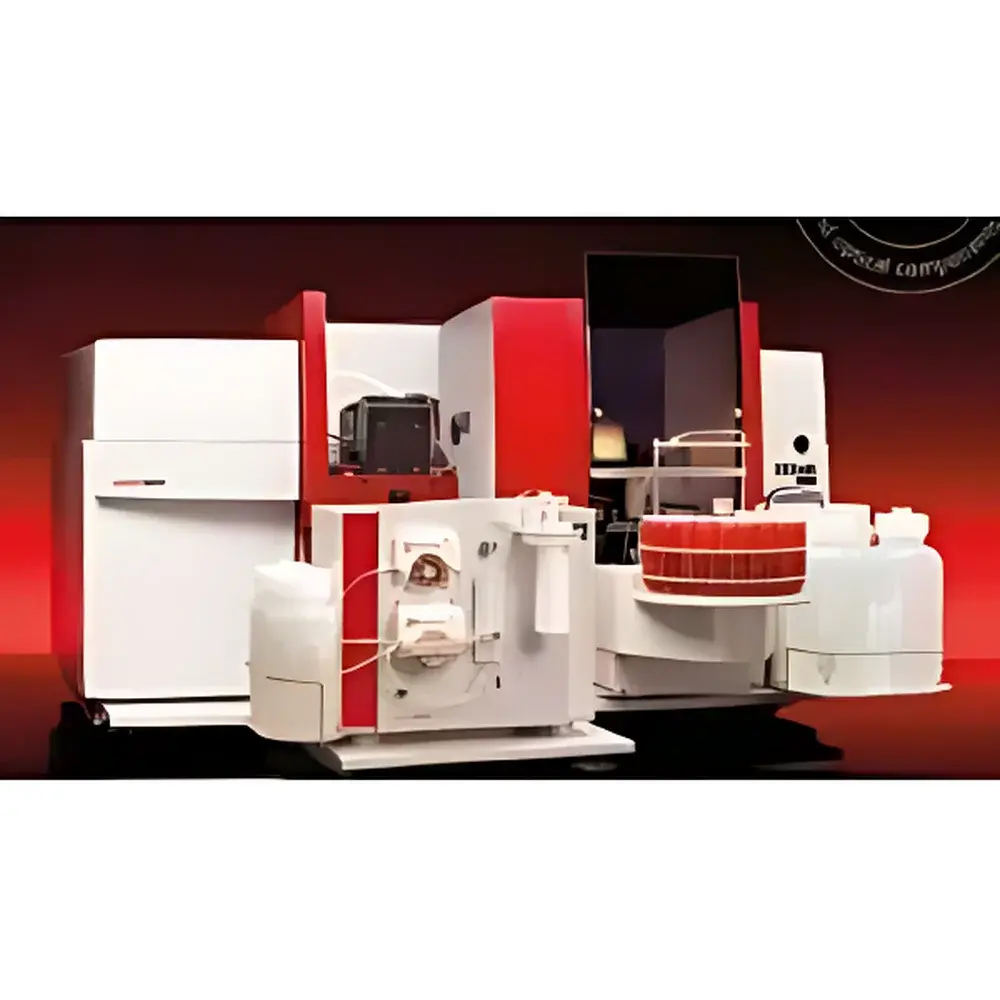
Analytik Jena ZEEnit 700P Flame and Graphite Furnace Atomic Absorption Spectrometer
| Brand | Analytik Jena |
|---|---|
| Origin | Germany |
| Model | ZEEnit 700P |
| Instrument Type | Flame and Graphite Furnace AAS |
| Monochromator | Concave holographic grating (1800 grooves/mm) |
| Optical System | Dual-beam with automatic single/dual-beam switching |
| Detector | Photomultiplier tube (PMT) |
| Background Correction | Deuterium lamp + Triple-magnetic-field Zeeman effect |
| Graphite Furnace | Transversely heated, temperature range: room temp to 3000 °C, max heating rate: 3000 °C/s |
| Autosampler | 108-position, programmable |
| Dimensions | 1200 × 480 × 600 mm |
Overview
The Analytik Jena ZEEnit 700P is a high-performance, dual-atomization atomic absorption spectrometer engineered for trace elemental analysis across diverse sample matrices. It integrates flame and graphite furnace atomization within a single, space-efficient optical platform—eliminating mechanical atomizer switching and ensuring seamless method transition without realignment or recalibration. The instrument operates on the fundamental principle of atomic absorption spectroscopy: quantifying ground-state free atoms in the gaseous phase by measuring attenuation of element-specific hollow cathode lamp radiation at characteristic wavelengths. Its dual-beam optical architecture compensates for source drift and lamp intensity fluctuations, while the Czerny–Turner monochromator—equipped with a high-efficiency 1800-line/mm concave holographic grating—delivers optimal spectral resolution and photometric accuracy. Designed for laboratory environments requiring regulatory compliance and long-term measurement stability, the ZEEnit 700P supports rigorous QA/QC protocols in environmental monitoring, clinical toxicology, food safety, and pharmaceutical impurity testing.
Key Features
- Integrated flame and graphite furnace atomization in one compact chassis—no moving parts or manual reconfiguration required
- Transversely heated graphite furnace (THGA) with precise temperature control from ambient to 3000 °C and programmable ramp rates up to 3000 °C/s, minimizing analyte loss and matrix interference
- Dual-mode background correction: deuterium lamp for broad-band correction and triple-magnetic-field Zeeman effect for high-precision, line-specific correction; magnetic field adjustable from 0.1 to 1.0 T with selectable 2-field or 3-field Zeeman configurations
- Automated 8-lamp turret with motorized alignment and spectral identification—enabling rapid multi-element method setup
- 108-position autosampler with integrated syringe-based dispensing, programmable dilution, and automated residue removal between runs
- Intelligent dilution algorithm extends linear dynamic range by up to two orders of magnitude without manual intervention
- Direct solid/semi-solid sampling capability via dedicated accessories, supporting certified reference materials (CRMs) and heterogeneous samples without full digestion
- Hydride generation–graphite furnace coupling (HG-GF-AAS) ready, enabling ultra-trace As, Se, Sb, Bi, Te, and Hg analysis with sub-pg detection capability
Sample Compatibility & Compliance
The ZEEnit 700P accommodates aqueous solutions, digested biological tissues, acid-leached soils, filtered air particulates, and directly analyzed solids—including powders, filters, and thin films—when equipped with appropriate accessories. Its hardware and software architecture comply with key international standards including ISO/IEC 17025:2017 (general requirements for competence of testing and calibration laboratories), ASTM D396–22 (standard specification for fuel oils), and USP <231> (heavy metals). The system supports 21 CFR Part 11–compliant audit trails when operated with optional secure software modules, and its background correction performance meets the precision and specificity requirements outlined in ISO 11170 and EN 14802 for environmental water analysis.
Software & Data Management
Controlled via the fully integrated ASpect software suite, the ZEEnit 700P provides method-driven workflow automation—from lamp selection and wavelength optimization to furnace temperature programming and background correction mode assignment. All analytical parameters are stored with full metadata (operator ID, timestamp, instrument configuration, calibration history), and raw absorbance/time profiles are retained for retrospective reprocessing. Data export adheres to ASTM E1382-compliant formats (CSV, XML, PDF), and integration with LIMS is supported via ODBC and HL7 interfaces. Audit trail functionality logs all user actions—including parameter modifications, calibration events, and report generation—with immutable timestamps and digital signature options.
Applications
- Environmental: Quantification of Pb, Cd, Cr, Ni, and Cu in drinking water per EPA Method 200.9 and ISO 17294-2
- Clinical: Measurement of Zn, Fe, Cu, and Mn in serum and whole blood using validated GF-AAS protocols aligned with CLIA and CAP guidelines
- Food & Agriculture: Multi-element screening of As, Cd, and Pb in rice, infant formula, and spices per EU Commission Regulation (EU) No 2023/915
- Geochemical: Direct analysis of geological CRMs (e.g., NIST SRM 2711a) via slurry sampling and THGA
- Pharmaceutical: Residual catalyst metal (Pd, Pt, Rh) determination in APIs per ICH Q2(R2) validation principles
FAQ
Does the ZEEnit 700P require separate optical alignments when switching between flame and graphite furnace modes?
No—the instrument features a fixed, co-aligned optical path shared by both atomizers, eliminating the need for mechanical realignment or recalibration during mode transitions.
What is the purpose of the triple-magnetic-field Zeeman configuration?
It extends the linear dynamic range by approximately one order of magnitude compared to conventional 2-field Zeeman systems and prevents signal inversion (“Zeeman flip”) during high-absorbance measurements, especially critical for complex matrices.
Can the autosampler perform on-board dilutions and standard additions?
Yes—the 108-position autosampler executes programmable serial dilutions, matrix-matched standard additions, and internal standard spiking with sub-microliter precision.
Is solid sampling supported out-of-the-box?
Solid sampling requires optional accessories (e.g., solid sampling kit with laser-assisted ablation or direct insertion probe), but the firmware and furnace control logic are natively compatible with such workflows.
How does the system ensure data integrity for regulated environments?
When configured with ASpect Secure Edition, it enforces role-based access control, electronic signatures, and tamper-evident audit trails compliant with FDA 21 CFR Part 11 and EU Annex 11 requirements.





