
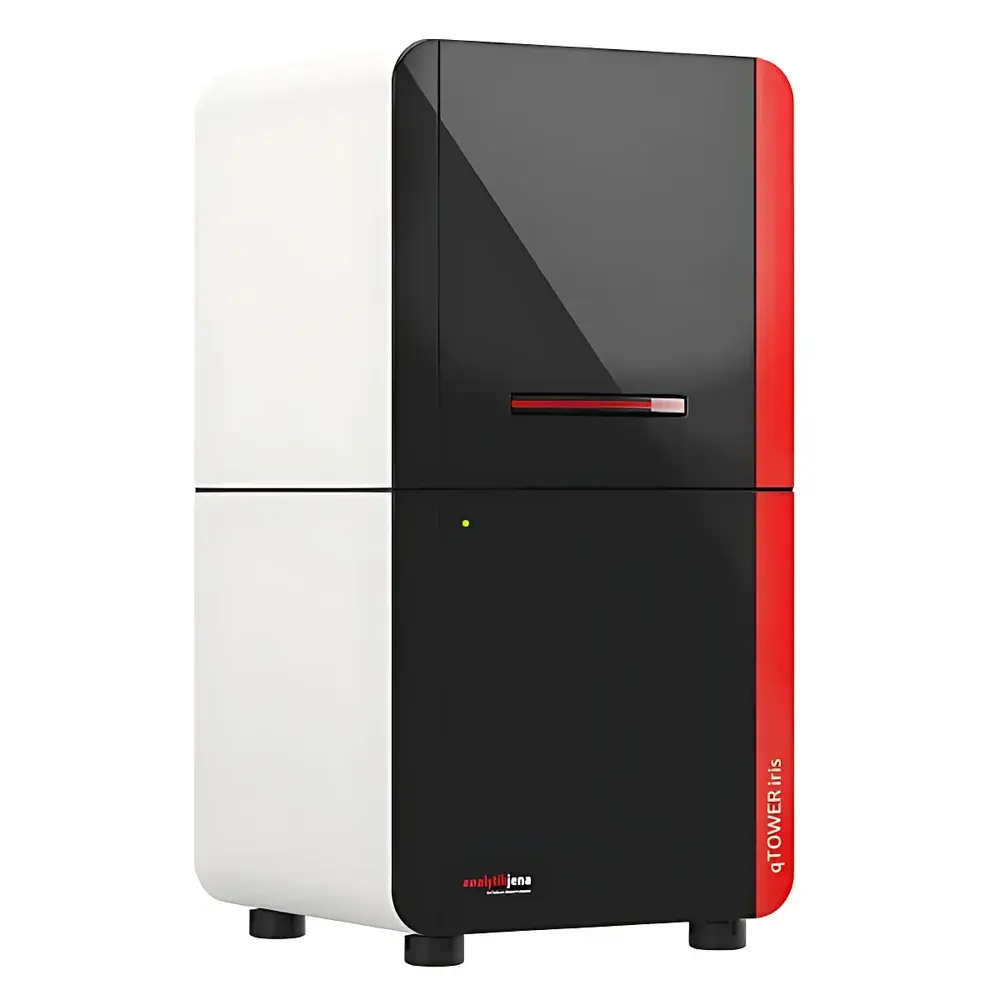
analytikjena qTOWER³ iris 384 High-Throughput Full-Spectrum Real-Time Fluorescence Quantitative PCR System
| Brand | analytikjena |
|---|---|
| Origin | Germany |
| Manufacturer | analytikjena GmbH |
| Type | Real-Time Fluorescence Quantitative PCR Instrument |
| Sample Capacity | 384-well |
| Heating Rate | 4 °C/s |
| Temperature Accuracy | ±0.1 °C |
| Well-to-Well Temperature Uniformity | ±0.15 °C |
| Optical Channels | Up to 6 independent excitation/emission channels |
| Light Source | 7 high-intensity, long-life LEDs (UV–NIR spectrum) |
| Detector | High-sensitivity photomultiplier tube (PMT) |
| Scanning Method | 16-channel fiber-optic simultaneous detection |
| Detection Sensitivity | Single-copy DNA template resolution |
| Dynamic Range | 10 logs |
| Gradient Function | 24-column linear temperature gradient |
| Thermal Block | Peltier-based, corrosion-resistant |
| Lid Temperature | Up to 110 °C with auto-adjusting pressure (max. 30 kg/plate) |
| Software | qPCR analysis suite compliant with MIQE guidelines |
| Connectivity | USB, LIMS-compatible |
| Noise Level | ≤60 dB(A) |
Overview
The analytikjena qTOWER³ iris 384 is a purpose-built, high-throughput real-time fluorescence quantitative PCR system engineered for precision, reproducibility, and scalability in demanding molecular diagnostics, genomics, and translational research laboratories. Unlike retrofitted conventional PCR instruments, the qTOWER³ iris 384 features an integrated optical–thermal architecture optimized exclusively for quantitative amplification kinetics. Its measurement principle relies on synchronous multi-channel fluorescence detection during thermal cycling, where target-specific probe or dye signals are captured in real time using a 16-channel fiber-optic scanning system. This design eliminates well-to-well signal lag and ensures kinetic fidelity across all 384 positions. The instrument employs a Peltier-driven thermal block with active thermal gradient control—enabling precise, programmable 24-column linear temperature gradients for rapid empirical optimization of annealing conditions. With temperature accuracy of ±0.1 °C and inter-well uniformity of ±0.15 °C, it meets stringent requirements for assay validation under ISO/IEC 17025 and CLIA-aligned workflows.
Key Features
- Full-spectrum optical architecture: Seven independently addressable, long-life LEDs cover 365–785 nm, enabling UV-excitable dyes (e.g., SYBR® Gold), standard FAM/HEX probes, and near-infrared reporters (e.g., Cy5, Alexa Fluor® 750) without lamp replacement or alignment.
- Modular channel configuration: Supports 1–6 excitation/emission channel combinations via field-upgradable filter sets—including dedicated UV and protein-labeling channels—ensuring adaptability to evolving assay panels.
- High-fidelity detection: Photomultiplier tube (PMT)-based detection delivers low-noise signal acquisition with single-copy DNA sensitivity and quantification linearity over 10 orders of magnitude (1–10¹⁰ copies).
- True 384-well performance: 16-channel parallel fiber-optic scanning acquires data from 16 wells simultaneously per cycle—no ROX normalization required, though internal reference correction remains optional.
- Thermal precision engineering: Patented Peltier module with gold-plated, corrosion-resistant surface achieves 4 °C/s ramp rates and maintains ±0.1 °C absolute accuracy across the full 4–99 °C range.
- Intelligent thermal lid: Motorized lid applies consistent 30 kg force per plate at temperatures up to 110 °C, minimizing evaporation and ensuring seal integrity for low-volume reactions (2–30 μL).
Sample Compatibility & Compliance
The qTOWER³ iris 384 accepts standard ANSI/SBS-compliant 384-well plates, including low-profile, skirted, and barcoded formats. It supports all major qPCR chemistries—hydrolysis probes (TaqMan®), intercalating dyes (SYBR® Green I), molecular beacons, scorpions, and digital PCR partitioning plates (with appropriate adapter). The system complies with ISO 13485 manufacturing standards and is validated for use in GLP and GMP environments. All thermal and optical calibrations are traceable to NIST-certified references. Data integrity is assured through audit-trail-enabled software meeting FDA 21 CFR Part 11 requirements for electronic records and signatures. Experimental metadata—including instrument ID, calibration status, user credentials, and thermal profiles—is embedded in every exported dataset to support MIQE-compliant reporting.
Software & Data Management
Controlled via the cross-platform qPCRsoft suite, the system provides native Windows/macOS/Linux support with unlimited installation rights and lifetime free updates. The software implements absolute quantification, dual-standard-curve relative quantification, efficiency-corrected ΔΔCt analysis, high-resolution melt (HRM) profiling, SNP/allele discrimination, endpoint genotyping, and amplification efficiency modeling. All analyses generate MIQE-compliant PDF reports containing raw fluorescence curves, Cq confidence intervals, PCR efficiency plots, and metadata logs. Built-in LIMS integration uses ASTM E1467-compliant XML export and direct USB-connected database synchronization. Audit trails record every parameter change, user action, and calibration event with timestamp, IP address, and operator ID—fully compliant with ISO/IEC 17025 clause 7.10 and CAP checklist GEN.41720.
Applications
The qTOWER³ iris 384 serves as a core platform for high-stakes applications requiring statistical rigor and regulatory readiness: clinical pathogen load monitoring (e.g., SARS-CoV-2, HIV, CMV), multiplexed oncology biomarker panels (BRAF, EGFR, KRAS), GMO screening in food safety, microbiome quantification via 16S rRNA gene targets, CRISPR editing efficiency assessment, and reference material certification. Its UV channel enables direct detection of unlabeled oligonucleotides and protein–nucleic acid interactions, extending utility beyond classical nucleic acid quantification. The 24-column gradient function accelerates assay development for difficult templates (e.g., GC-rich promoters or secondary structures), reducing optimization cycles by >60% compared to single-point gradient instruments.
FAQ
Is the optical system field-upgradable to additional channels?
Yes—channel count can be increased from 1 to 6 via certified filter set installation and firmware activation, without hardware replacement.
Does the system require ROX passive reference dye?
No—16-channel fiber-optic scanning ensures intrinsic signal normalization; however, ROX or other passive dyes may be used optionally for cross-platform data harmonization.
What validation documentation is provided for regulated environments?
Each unit ships with a Factory Calibration Certificate (traceable to NIST), IQ/OQ protocols, and a complete 21 CFR Part 11 compliance package including electronic signature implementation guides and audit trail specifications.
Can the software interface with enterprise LIMS without middleware?
Yes—native ASTM E1467 XML export, ODBC connectivity, and configurable webhooks enable direct integration with Thermo Fisher SampleManager, LabVantage, and STARLIMS platforms.
Is maintenance required for the LED light source or PMT detector?
No—both components are rated for >50,000 hours of operation with no scheduled replacement or recalibration needed under normal laboratory use conditions.



