
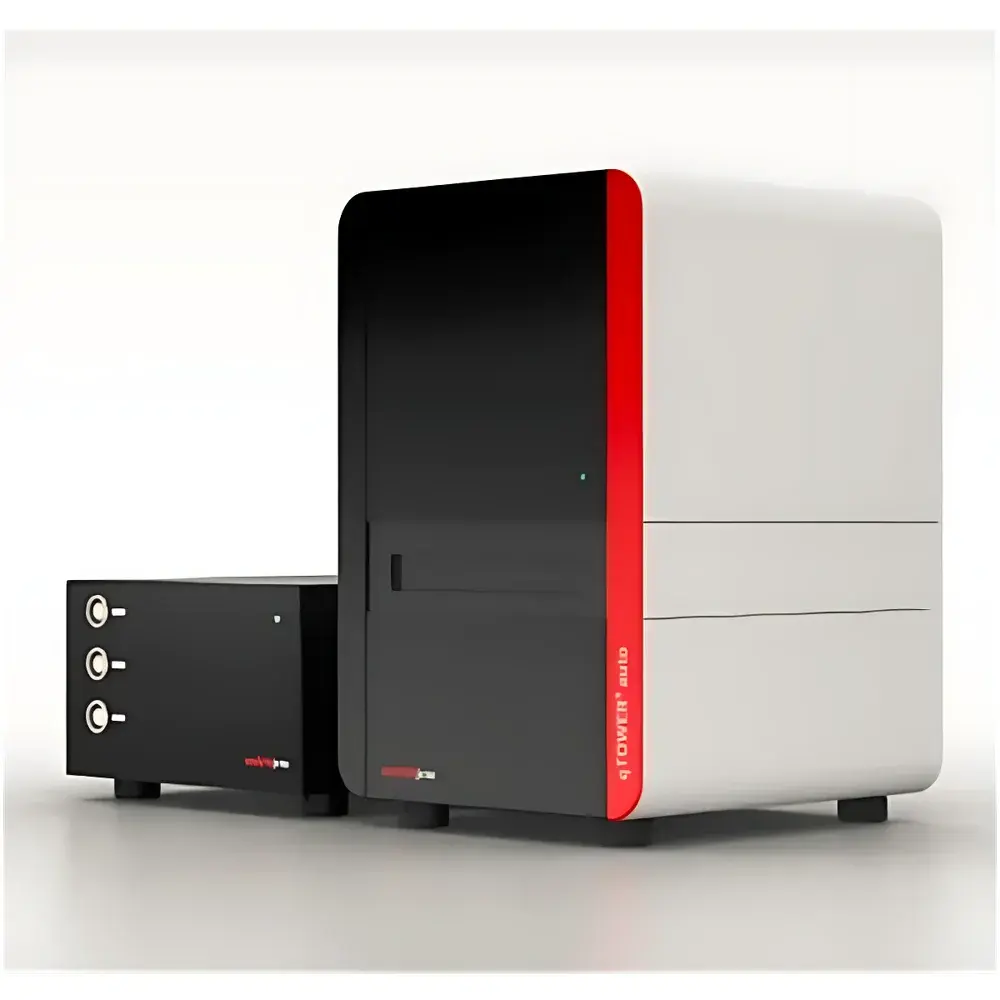
analytikjena qTOWER3 auto Real-Time Fluorescence Quantitative PCR System
| Brand | analytikjena |
|---|---|
| Origin | Germany |
| Manufacturer | analytikjena GmbH & Co. KG |
| Type | Real-Time Fluorescence Quantitative PCR Instrument |
| Sample Capacity | 96-well format |
| Heating Rate | 8 °C/s |
| Temperature Accuracy | ±0.1 °C |
| Well-to-Well Temperature Uniformity | ±0.15 °C |
| Optical Channels | 4–6 configurable |
| Excitation/Detection Filter Sets | 12 interchangeable combinations (including FRET-mismatched and protein melting-specific configurations) |
| Light Source | RGBW high-intensity LEDs (blue, green, red, white) |
| Detector | High-sensitivity photomultiplier tube (PMT) |
| Detection Method | 8-channel fiber-optic scanning system |
| Dynamic Range | 10 orders of magnitude |
| Sample Volume Range | 5–100 µL |
| Sample Block Material | Gold-plated pure silver thermal block |
| Lid Temperature Range | 30–110 °C with auto-adjusting contact pressure (up to 30 kg/plate) |
| Software | Free lifetime-upgradable qPCR analysis suite supporting absolute quantification, dual-standard-curve relative quantification, ΔΔCt with amplification efficiency correction, melting curve analysis, allelic discrimination/SNP genotyping, endpoint analysis, and efficiency calculation |
| Acoustic Noise Level | ≤45 dB(A) |
| Compliance | Designed and manufactured in accordance with ISO 13485, CE-IVD (where applicable), and GLP/GMP-aligned documentation practices |
Overview
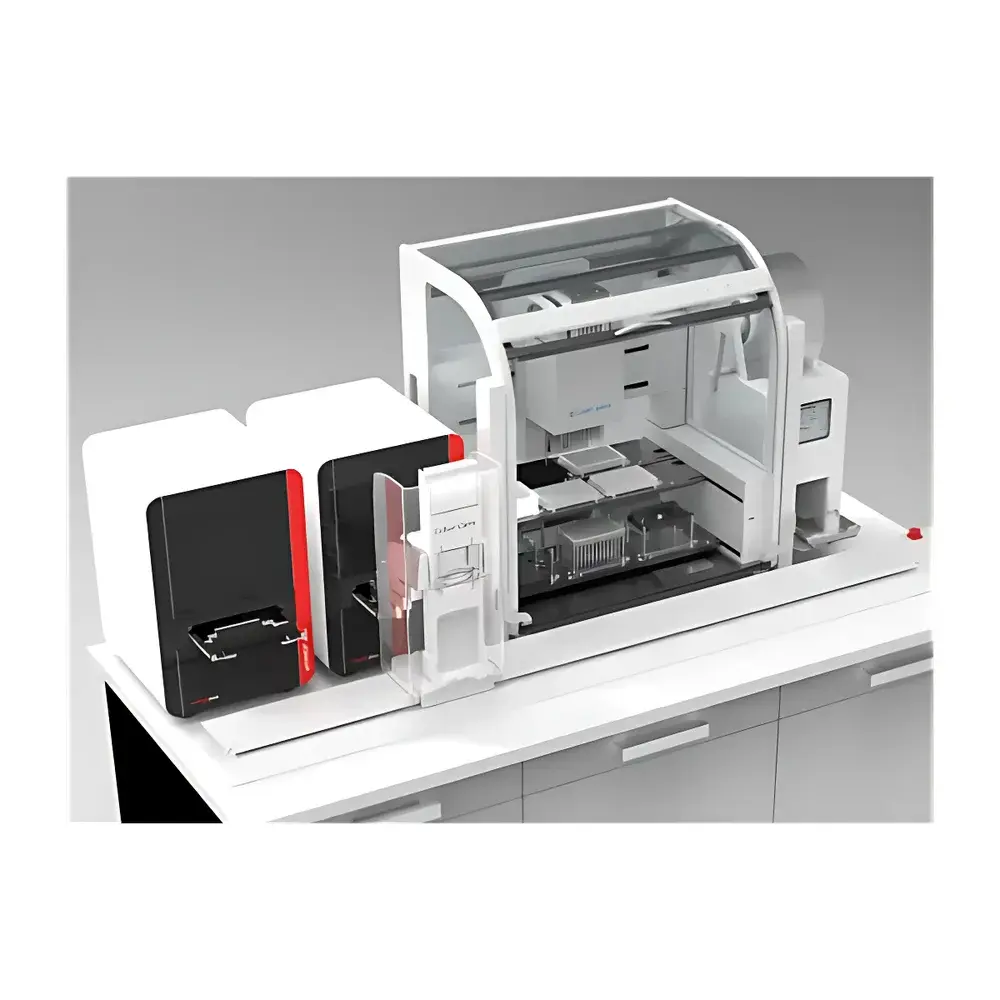
The analytikjena qTOWER3 auto is a purpose-built, fully integrated real-time fluorescence quantitative PCR system engineered for high-throughput, walk-away operation within automated nucleic acid workflows. Unlike retrofitted conventional PCR instruments, the qTOWER3 auto features a native architecture optimized from inception for seamless integration into end-to-end liquid handling platforms—enabling unattended transition from magnetic-bead-based nucleic acid extraction through master mix dispensing and thermal cycling to fluorescence data acquisition. Its core measurement principle relies on synchronous detection of sequence-specific fluorescent signals (SYBR Green, hydrolysis probes, hybridization probes, molecular beacons) during exponential amplification, with precise thermal control and optical fidelity ensuring reproducible Cq determination across biological replicates and inter-laboratory studies.
Key Features
- Native automation-ready design: Equipped with standardized robotic interface protocols (RS-232, Ethernet, and optional LabAutomation API support) for direct integration into third-party workstations (e.g., QIAGEN QIAgility, Tecan Freedom EVO, Hamilton STAR).
- Modular optical architecture: Factory-configurable 4- to 6-channel detection with field-upgradeable channel expansion—eliminating hardware replacement when assay multiplexing requirements evolve.
- 12-user-selectable excitation/emission filter sets: Includes dedicated configurations for FRET-based assays (e.g., TaqMan® MGB probes with spectral offset), protein thermal shift analysis (e.g., SYPRO Orange), and dual-labeled hydrolysis probes requiring narrow-band separation.
- RGBW LED illumination system: Four independently controlled, thermally stable light sources deliver uniform intensity across 450–700 nm without IR emission or thermal load—ensuring long-term photometric stability and eliminating lamp replacement cycles.
- High-fidelity signal acquisition: 8-channel fiber-optic scanning collects fluorescence from all 96 wells in parallel per cycle; eliminates well-to-well timing skew and obviates passive reference dyes (ROX) while retaining optional ROX normalization for legacy protocol compatibility.
- Gold-plated pure silver thermal block: Achieves rapid heat transfer (8 °C/s ramp rate) and exceptional spatial uniformity (±0.15 °C across 96 wells) at setpoints from 4 °C to 99 °C, validated per ISO 15197 and ASTM E2500-13.
Sample Compatibility & Compliance
The qTOWER3 auto accepts standard 0.2 mL 96-well plates and tubes (including low-profile and skirted formats), accommodating reaction volumes from 5 µL to 100 µL. Its thermal lid applies programmable, force-regulated pressure (up to 30 kg/plate) across the full temperature range (30–110 °C), preventing condensation and evaporation in low-volume reactions. The system complies with IEC 61010-1 for laboratory equipment safety and meets electromagnetic compatibility standards EN 61326-1. For regulated environments, audit trails, electronic signatures, and 21 CFR Part 11–compliant software modules are available under analytikjena’s GxP Support Package—supporting validation activities aligned with FDA, EMA, and PMDA expectations.
Software & Data Management
Controlled via the intuitive, Windows-based qPCRsoft platform (included at no additional cost), the qTOWER3 auto delivers comprehensive analytical capabilities: absolute quantification using external or internal standards; dual-standard-curve and ΔΔCt methods incorporating user-defined or algorithmically derived amplification efficiencies; high-resolution melting (HRM) analysis with cluster classification for SNP genotyping; and endpoint fluorescence evaluation for digital PCR endpoint confirmation. All software updates—including new analysis algorithms, regulatory compliance patches, and instrument firmware—are provided free of charge for the instrument’s operational lifetime. Raw data (.eds files) are stored in vendor-neutral HDF5 format, enabling interoperability with third-party bioinformatics pipelines and LIMS integration via ODBC or RESTful API.
Applications
The qTOWER3 auto serves as a core platform in clinical diagnostics laboratories performing infectious disease testing (e.g., SARS-CoV-2, HPV, HBV viral load), oncology biomarker monitoring (e.g., BCR-ABL1, EGFR mutations), and transplant rejection surveillance (e.g., donor-derived cell-free DNA). In research settings, it supports gene expression profiling under MIAME-compliant workflows, CRISPR editing efficiency assessment via T7E1 or RFLP-qPCR, and host-pathogen interaction studies requiring multi-target co-detection. Its sensitivity (detecting ≤10 copies/reaction) and dynamic range (10⁰–10¹⁰ copies) make it suitable for both low-abundance transcript analysis and high-titer pathogen quantification.
FAQ
Is the qTOWER3 auto compatible with third-party reagents and master mixes?
Yes—the system imposes no proprietary chemistry restrictions and has been verified with major commercial kits including Thermo Fisher TaqPath, Bio-Rad SsoAdvanced, and Roche LightCycler 480 Probes Master.
Can the instrument perform high-resolution melting (HRM) analysis?
Yes—its precise temperature ramping (0.01–0.5 °C/s) and continuous fluorescence acquisition enable sub-degree resolution for distinguishing heteroduplex variants in SNP and methylation studies.
What documentation is provided for IQ/OQ/PQ validation?
analytikjena supplies a complete qualification toolkit including test protocols, acceptance criteria, blank forms, and traceable calibration certificates compliant with ISO/IEC 17025 and EU Annex 15.
Does the system support remote monitoring and control?
Yes—via secure HTTPS-enabled web interface and optional VPN integration, allowing real-time status checks, queue management, and result review from off-site locations.
How is thermal calibration performed and how often is it required?
Factory-calibrated using NIST-traceable platinum resistance thermometers; annual recalibration is recommended and supported by certified service engineers globally.



