
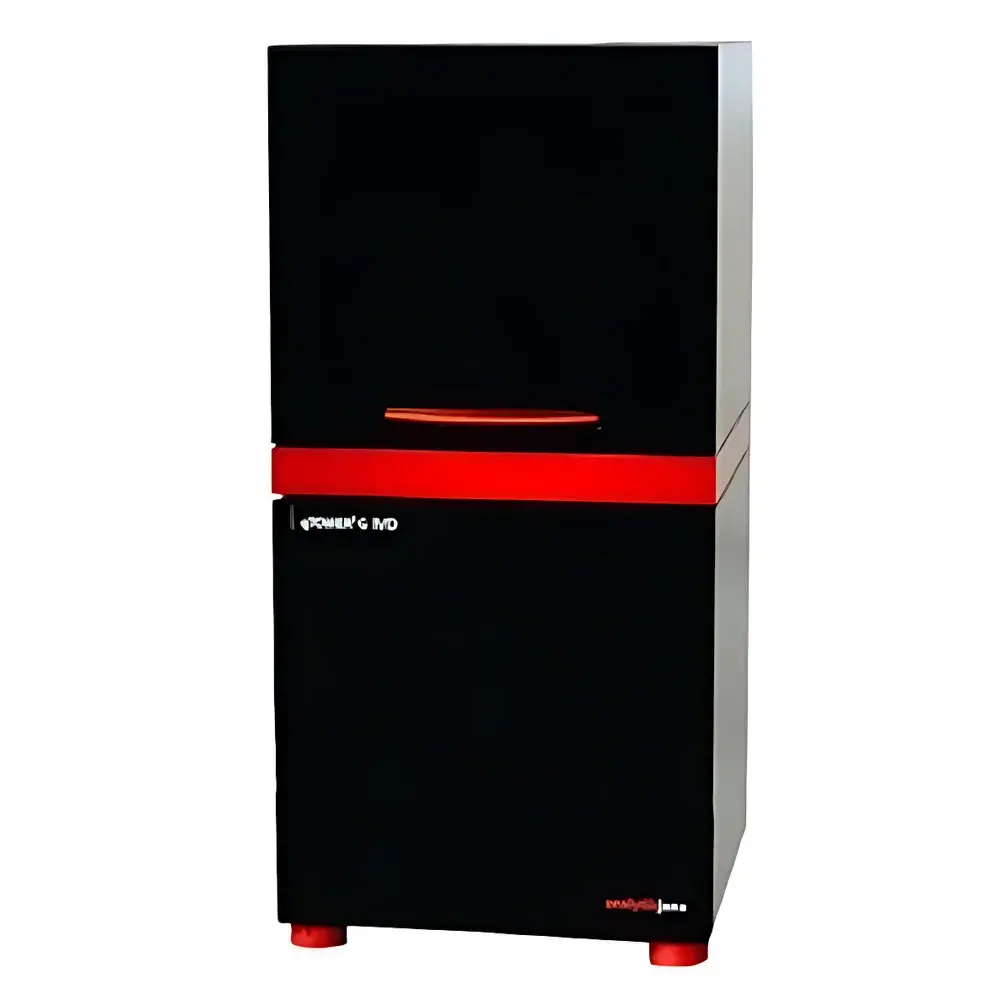
analytikjena qTOWER3 G IVD Real-Time Fluorescence Quantitative PCR System
| Brand | analytikjena |
|---|---|
| Origin | Germany |
| Model | qTOWER3 G IVD |
| Instrument Type | Real-Time Fluorescence Quantitative PCR System |
| Sample Capacity | 96-well format |
| Heating Rate | 8 °C/s |
| Temperature Accuracy | ±0.1 °C |
| Well-to-Well Temperature Uniformity | ±0.15 °C |
| Thermal Gradient | 12-column linear gradient |
| Excitation Sources | Four solid-state RGBW LEDs (blue, green, red, white) |
| Detection System | Channel-type Photomultiplier Tube (CPMT) |
| Software Interface | Bilingual (English & Chinese) |
| Regulatory Designation | IVD-certified per EU IVDR (Regulation (EU) 2017/746) |
Overview
The analytikjena qTOWER3 G IVD is a CE-IVDR–certified real-time fluorescence quantitative polymerase chain reaction (qPCR) system engineered for high-precision nucleic acid quantification in clinical diagnostics and regulated laboratory environments. It operates on the principle of sequence-specific amplification coupled with real-time fluorescent signal detection—enabling absolute or relative quantification of DNA targets across up to four spectral channels simultaneously. Designed and manufactured in Jena, Germany, the instrument integrates a thermally optimized 96-well silver-gold plated sample block, Peltier-based rapid thermal cycling, and a fiber-optic scanning detection architecture to ensure uniform excitation and collection efficiency across all wells. Its compliance with IVDR requirements—including traceable calibration, audit-ready software logs, and defined performance verification protocols—supports routine use in ISO 15189-accredited medical laboratories and GMP-aligned diagnostic development workflows.
Key Features
- Rapid thermal cycling: Achieves heating rates up to 8 °C/s and cooling rates up to 6 °C/s via high-efficiency Peltier elements and a thermally conductive silver-gold plated block—reducing total run time without compromising amplification fidelity.
- Exceptional thermal precision: Maintains temperature accuracy within ±0.1 °C and well-to-well uniformity within ±0.15 °C across the full 96-well plate—critical for reproducible Cq determination and inter-run comparability.
- 12-column linear thermal gradient: Enables systematic evaluation of annealing temperatures across 12 discrete columns in a single run—accelerating assay optimization while preserving sample integrity.
- Four-channel RGBW LED excitation: Utilizes long-life, non-thermal solid-state light sources covering 450–650 nm; eliminates warm-up delay, minimizes photobleaching, and ensures consistent intensity across FAM, HEX/VIC, ROX, Cy5, and other common dyes.
- Channel-type photomultiplier tube (CPMT) detection: Delivers high quantum efficiency and low-noise signal acquisition—supporting detection of low-abundance targets (e.g., 10⁷).
- Auto-adjusting pressure-controlled hot lid: Dynamically regulates contact force and temperature (up to 110 °C) to prevent evaporation and condensation—ensuring reaction volume stability throughout extended cycling protocols.
Sample Compatibility & Compliance
The qTOWER3 G IVD accepts standard 96-well PCR plates (full-skirted, semi-skirted, or unskirted), 8-tube strips, and individual PCR tubes—compatible with all major commercial qPCR master mixes and probe-based or intercalating dye chemistries. As an IVD-class device under Regulation (EU) 2017/746, it includes built-in instrument qualification tools (IQ/OQ/PQ templates), electronic signature support per FDA 21 CFR Part 11, and audit-trail functionality for GLP/GMP environments. Its design conforms to IEC 61010-1 (safety) and IEC 61326-1 (EMC), and its optical performance meets ISO 20387:2018 requirements for biobanking-related nucleic acid quantification.
Software & Data Management
Controlled by the qPCRsoft IVD software suite (v5.x), the system provides bilingual (English/Chinese) graphical interface, automated baseline and threshold setting, multiplate analysis, and MIQE-compliant reporting. Raw fluorescence data (Rn values) and normalized reporter signals are exportable in CSV, Excel, and RDML formats. The software supports user-defined analysis pipelines—including ΔΔCt, standard curve, and efficiency-corrected quantification—and maintains immutable records of instrument settings, calibration events, and operator actions for regulatory review. Optional LIMS integration is available via HL7 or RESTful API.
Applications
- Clinical molecular diagnostics: Viral load monitoring (e.g., SARS-CoV-2, HIV, HBV), pathogen identification, antimicrobial resistance gene detection.
- In vitro diagnostic kit validation: Performance verification of CE-IVD and FDA EUA assays under controlled thermal and optical conditions.
- Gene expression profiling: High-throughput relative quantification in translational research and biomarker discovery studies.
- NGS library quantification: Accurate assessment of adapter-ligated DNA fragments prior to sequencing.
- Quality control in biomanufacturing: Residual host-cell DNA testing and vector copy number determination in cell and gene therapy processes.
FAQ
Is the qTOWER3 G IVD compliant with EU IVDR requirements?
Yes—it carries CE marking under Regulation (EU) 2017/746 and includes documentation packages for technical file submission, post-market surveillance, and UDI assignment.
Does the system require optical calibration before each run?
No—its fiber-optic scanning architecture ensures identical excitation/detection path lengths for every well, eliminating the need for channel normalization or reference dye compensation during routine operation.
Can third-party reagents and consumables be used?
Yes—the platform is fully open; no proprietary chemistry or locked consumables are required. All standard 96-well plates and certified qPCR master mixes are supported.
What is the expected lifetime of the LED excitation sources?
Rated for >50,000 hours of continuous operation with negligible output drift—effectively eliminating scheduled lamp replacement over the instrument’s service life.
How is temperature uniformity verified during installation and maintenance?
The system includes integrated PT1000 sensors at multiple block positions and supports external validation using NIST-traceable thermal mapping probes per ISO/IEC 17025 guidelines.




