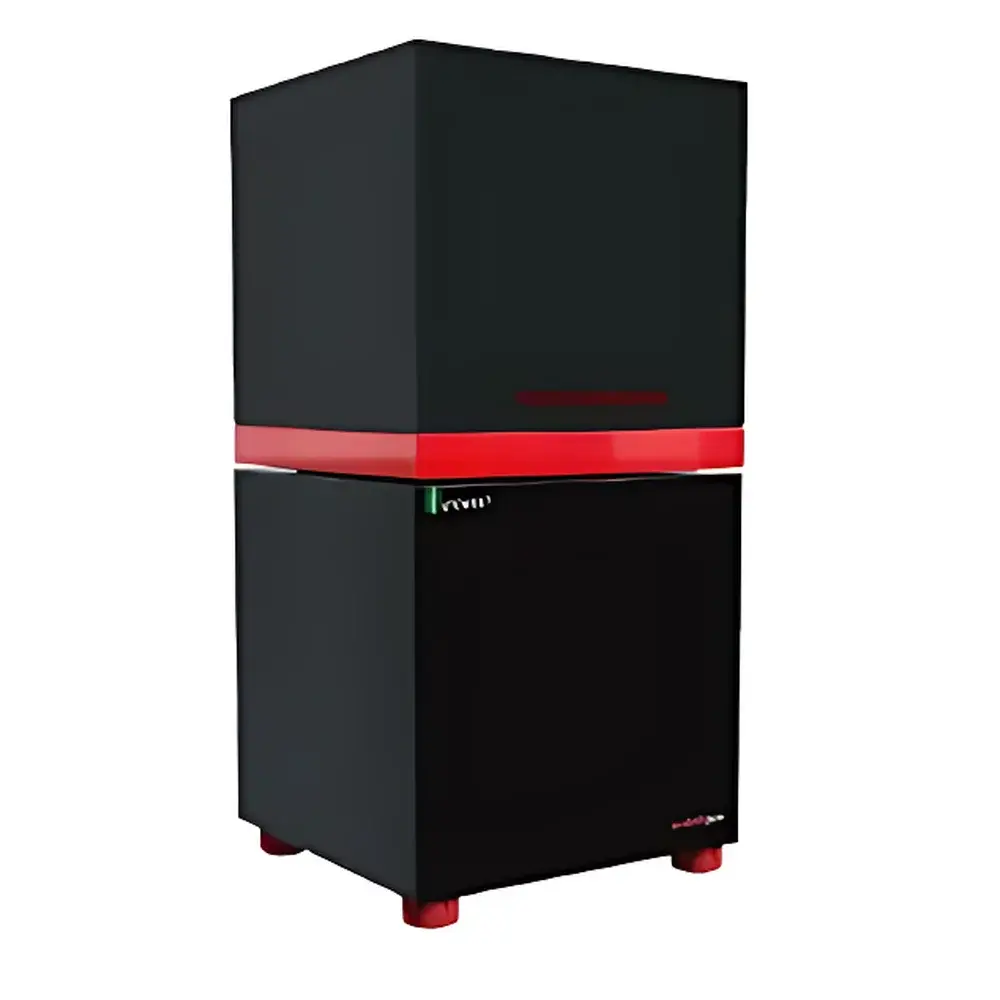
analytikjena qTOWER3 G Real-Time Fluorescence Quantitative Gradient PCR System
| Brand | analytikjena |
|---|---|
| Origin | Shanghai, China |
| Model | qTOWER3 G |
| Instrument Type | Real-Time Fluorescence Quantitative PCR System |
| Sample Capacity | 96-well format |
| Max Heating Rate | 8 °C/s |
| Temperature Accuracy | ±0.1 °C |
| Inter-Well Temperature Uniformity | ±0.15 °C |
| Cooling Rate | 6 °C/s |
| Gradient Range | 1–40 °C (linear or random mode, 12-column configuration) |
| Optical Channels | Up to 6 independently configurable fluorescence detection channels |
| Excitation/Detection Filter Sets | 12 interchangeable combinations including FRET-mismatched and protein melting-optimized sets |
| Light Source | RGBW high-intensity long-life LEDs (blue, green, red, white) |
| Detector | High-sensitivity channel-type photomultiplier tube (PMT) |
| Detection Method | 8-channel fiber-optic scanning (8 wells simultaneously) |
| Sensitivity | Single-copy DNA detection capability |
| Dynamic Range | 10 logs |
| Recommended Reaction Volume | 10–80 µL |
| Thermal Block | Gold-plated pure silver Peltier module |
| Software | MIQE-compliant analysis suite with unlimited free installation and lifetime updates |
| Noise Level | ≤45 dB(A) |
| Connectivity | USB, RS232, Ethernet |
| Dimensions (W×H×D) | 275 × 585 × 275 mm |
| Weight | ~30 kg |
Overview
The analytikjena qTOWER3 G is a purpose-built real-time fluorescence quantitative PCR system engineered for precision, reproducibility, and experimental flexibility in nucleic acid quantification and genotyping applications. Unlike retrofitted conventional PCR instruments, the qTOWER3 G features an integrated optical and thermal architecture optimized exclusively for quantitative amplification kinetics. Its core measurement principle relies on synchronous fluorescence signal acquisition during thermal cycling—capturing target-specific probe hydrolysis (e.g., TaqMan), intercalating dye incorporation (e.g., SYBR Green), or hybridization-based resonance energy transfer (FRET)—with real-time kinetic modeling of amplification efficiency, threshold cycle (Ct), and melt transition profiles. The system supports both absolute quantification via standard curves and relative quantification using ΔΔCt or dual-standard curve methods incorporating experimentally determined amplification efficiencies. Designed for compliance-driven environments, it meets foundational requirements for GLP-aligned workflows and provides traceable data structures compatible with ISO/IEC 17025 and FDA 21 CFR Part 11 readiness when deployed with appropriate IT infrastructure and audit trail configurations.
Key Features
- Modular six-channel optical system: Configurable from 1 to 6 detection channels at any time; no hardware replacement required for future expansion.
- Twelve programmable excitation/emission filter sets: Enables flexible assay design—including mismatched FRET pairs for SNP discrimination and dedicated filters for high-resolution protein thermal shift assays (TSA).
- RGBW LED light source: Delivers uniform spectral irradiance across 450–650 nm without thermal drift; eliminates lamp aging effects and requires zero maintenance over instrument lifetime.
- Channel-type photomultiplier tube (PMT) detection: Provides superior signal-to-noise ratio compared to CCD or CMOS alternatives, enabling reliable single-copy template detection and robust low-abundance target quantification.
- 8-channel fiber-optic scanning: Simultaneous acquisition from eight wells per scan cycle ensures temporal synchronization and eliminates well-to-well timing artifacts; ROX normalization is optional but not mandatory.
- Gold-plated pure silver Peltier thermal block: Achieves ±0.1 °C temperature accuracy and ±0.15 °C inter-well uniformity across all 96 positions, validated per ASTM E2545 and ISO 13485 thermal mapping protocols.
- Dual-mode gradient functionality: Supports both linear and randomized temperature gradients across 12 columns (1–40 °C range), facilitating empirical optimization of annealing conditions without reconfiguration.
- Intelligent auto-lid system: Dynamically adjusts pressure and height to accommodate varying tube geometries (0.2 mL plates, 8-tube strips, individual tubes), minimizing evaporation and ensuring seal integrity throughout 40-cycle runs.
Sample Compatibility & Compliance
The qTOWER3 G accepts standard 96-well PCR plates, 8-strip tubes, and individual 0.2 mL tubes—compatible with all major commercial master mixes and probe chemistries (hydrolysis probes, molecular beacons, scorpions, LNA-enhanced primers). Reaction volumes between 10 and 80 µL are supported, with optimal performance observed at 20–50 µL. The system’s thermal architecture complies with IEC 61010-1 safety standards for laboratory equipment and has been validated for use in clinical research settings under CLIA-equivalent quality frameworks. While not an IVD device, its software output structure aligns with MIQE (Minimum Information for Publication of Quantitative Real-Time PCR Experiments) guidelines, generating structured metadata-rich reports suitable for peer-reviewed publication and internal SOP documentation.
Software & Data Management
The included qPCRsoft suite operates on Windows platforms and offers unrestricted local installation across institutional networks. Core analytical modules include absolute quantification, comparative ΔΔCt analysis with efficiency correction, high-resolution melt curve profiling (HRM), allelic discrimination (SNP genotyping), endpoint fluorescence evaluation, and PCR efficiency calculation via LinRegPCR or similar algorithms. All analyses generate timestamped, user-attributed, and instrument-logged datasets. Audit trail functionality records parameter changes, run initiation/termination events, and file export actions—supporting alignment with GLP/GMP documentation practices when paired with networked storage and role-based access controls. Export formats include CSV, Excel, PDF, and RDML (Real-time PCR Data Markup Language) v1.2 for cross-platform interoperability.
Applications
The qTOWER3 G serves diverse applications across academic, pharmaceutical, and diagnostic research domains: viral load monitoring (e.g., SARS-CoV-2, HIV, HBV), gene expression profiling in oncology and immunology studies, pathogen detection in food and environmental samples, GMO screening, CRISPR editing efficiency validation, microRNA quantification, and thermal stability assessment of engineered proteins. Its dual-gradient capability makes it especially valuable for primer annealing optimization and multiplex assay development. The system is routinely employed in preclinical biomarker discovery pipelines where quantitative reproducibility across multi-site studies is essential.
FAQ
Is the qTOWER3 G certified as an IVD device?
No—it is designated as a research-use-only (RUO) instrument and is not CE-IVD or FDA 510(k) cleared.
Can the software be installed on virtual machines or cloud-hosted desktops?
Yes, provided the host OS is Windows 10/11 and the virtual environment supports USB passthrough for instrument communication.
Does the system support passive reference dyes such as ROX?
Yes—ROX can be enabled as a normalization channel, though the optical design and PMT sensitivity render it optional for most applications.
What is the expected lifetime of the LED light sources?
Rated for >50,000 hours of continuous operation with negligible intensity decay; no scheduled replacement required.
How is temperature calibration verified during routine operation?
Users may perform in situ verification using NIST-traceable thermocouple probes inserted into empty wells; factory calibration certificates are provided with each unit and remain valid for two years under normal usage conditions.
Related Products