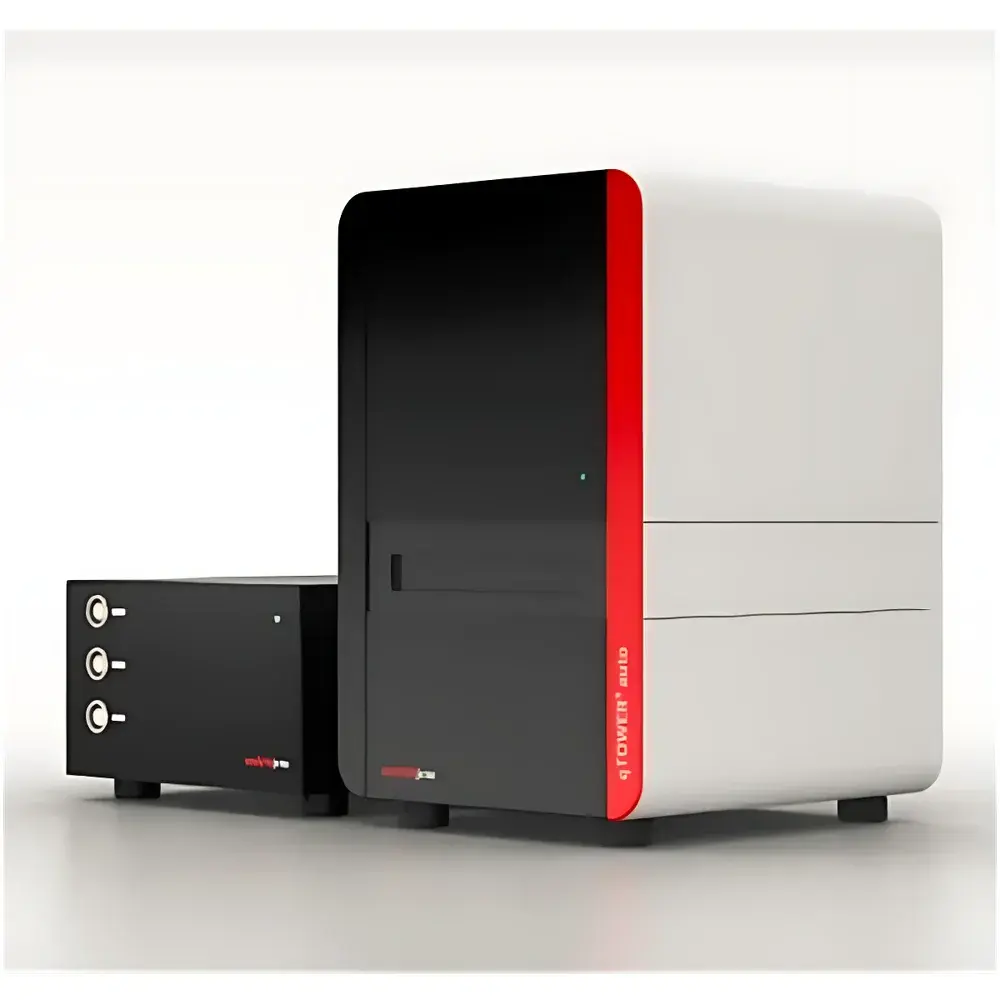
analytikjena qTOWER384 auto Real-Time Fluorescence Quantitative PCR System
| Brand | analytikjena |
|---|---|
| Origin | Germany |
| Manufacturer | analytikjena GmbH |
| Type | Real-Time Fluorescence Quantitative PCR Instrument |
| Sample Capacity | 384-well format |
| Heating Rate | 4 °C/s |
| Temperature Accuracy | ±0.1 °C |
| Well-to-Well Temperature Uniformity | ±0.15 °C |
| Optical Channels | 4–6 configurable |
| Excitation/Detection Filter Sets | 12 interchangeable combinations including FRET-mismatched and protein melting-specific configurations |
| Light Source | RGBW high-intensity LEDs (blue, green, red, white) |
| Detector | High-sensitivity photomultiplier tube (PMT) |
| Detection Method | 16-channel fiber-optic scanning system |
| Dynamic Range | 10 orders of magnitude |
| Reaction Volume | 2–30 µL |
| Heat Lid Temperature Range | 30–110 °C with auto-adjusting contact pressure up to 30 kg/plate |
| Software | Free lifetime-upgradable analysis suite supporting absolute quantification, dual-standard-curve relative quantification, ddCt with amplification efficiency correction, melting curve analysis, SNP/allele discrimination, endpoint analysis, and efficiency calculation |
| Acoustic Noise Level | ≤45 dB(A) |
Overview
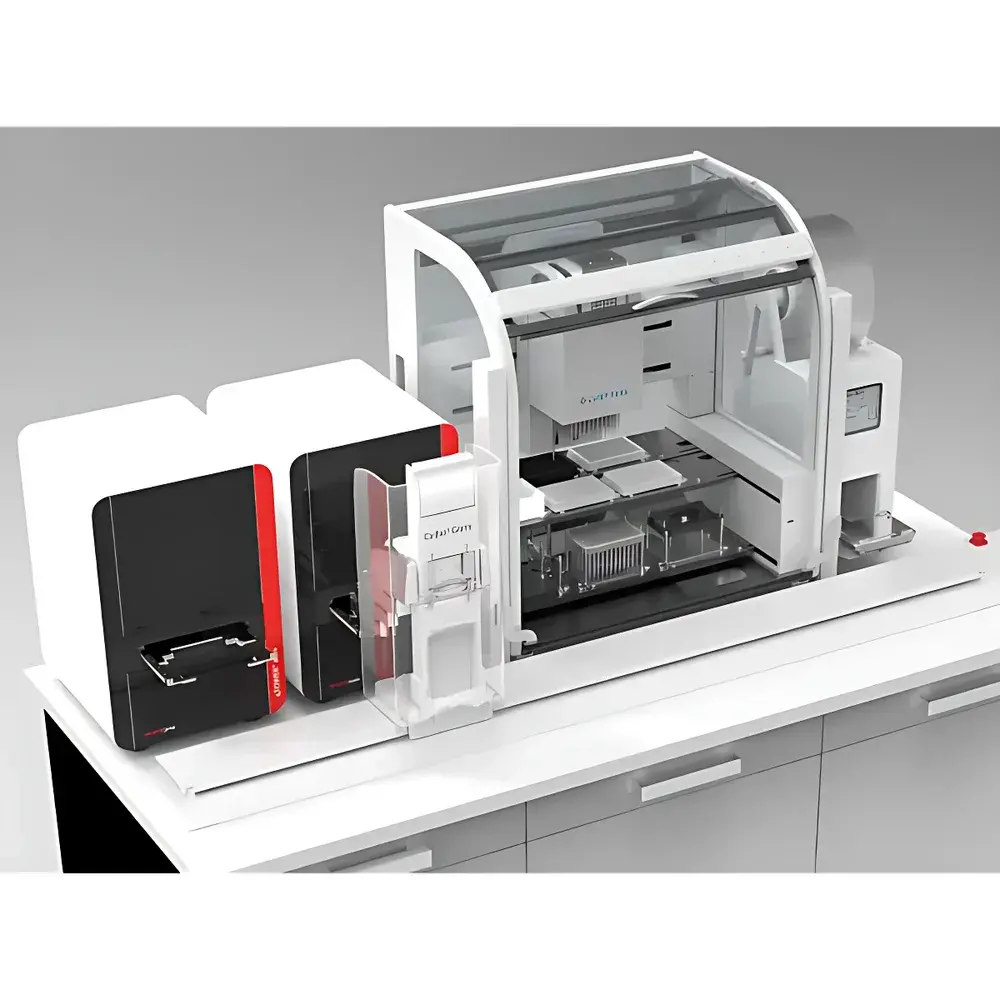
The analytikjena qTOWER384 auto is a purpose-built, fully integrated real-time fluorescence quantitative PCR system engineered for high-throughput, high-precision nucleic acid quantification in regulated and research-intensive laboratory environments. Unlike retrofitted thermal cyclers, this instrument features a monolithic architecture optimized from the ground up for quantitative performance—combining rapid thermal ramping (up to 4 °C/s), exceptional thermal uniformity (±0.15 °C across all 384 wells), and sub-0.1 °C temperature accuracy. Its core measurement principle relies on synchronous excitation and emission detection during exponential amplification, enabling precise cycle threshold (Ct) determination across a dynamic range spanning ten orders of magnitude (10⁰–10¹⁰ copies). Designed for seamless integration into end-to-end automated workflows, the qTOWER384 auto interfaces directly with liquid handling platforms for unattended nucleic acid extraction, reaction setup, and qPCR execution—reducing manual intervention and minimizing inter-operator variability.
Key Features
- Native 384-well optical block with thermally optimized aluminum alloy construction ensuring consistent thermal transfer and minimal edge effects
- RGBW LED light source delivering stable, spectrally broad excitation without thermal load—eliminating lamp degradation and enabling >50,000-hour operational lifetime
- 12-user-selectable excitation/emission filter sets, including dedicated configurations for FRET-based probe assays (e.g., TaqMan® MGB, Molecular Beacons) and protein thermal shift assays (e.g., SYPRO Orange-based DSF)
- 16-channel fiber-optic scanning system acquiring fluorescence data simultaneously across 16 wells per cycle—enabling full-plate readout in under 3 seconds without ROX normalization (though ROX referencing remains optionally supported)
- Automated pressure-regulated heat lid with programmable contact force (up to 30 kg/plate) and temperature range 30–110 °C—preventing evaporation across diverse reaction volumes (2–30 µL)
- Acoustically damped chassis achieving ≤45 dB(A) during operation—suitable for open-plan labs and ISO Class 5 cleanroom-adjacent installations
Sample Compatibility & Compliance
The qTOWER384 auto supports standard 384-well PCR plates (full-skirted, semi-skirted, and low-profile), as well as compatible microfluidic cards and custom array formats meeting ANSI/SBS dimensional specifications. All thermal and optical calibrations are traceable to NIST-certified reference materials. The system complies with IEC 61010-1 (safety), IEC 61326-1 (EMC), and meets essential requirements of the EU In Vitro Diagnostic Medical Devices Regulation (IVDR) Annex I for instruments used in clinical molecular testing. When operated with analytikjena’s validated reagent kits and documented SOPs, the platform supports GLP and GMP-aligned workflows—including full audit trail generation, electronic signature support, and 21 CFR Part 11-compliant software configuration (available upon request with IQ/OQ documentation package).
Software & Data Management
Control and analysis are performed via the free, locally installed qPCRsoft software—licensed perpetually with no subscription or activation fees. The software implements a modular architecture with role-based access control (RBAC), version-controlled protocol templates, and automated metadata tagging (instrument ID, user, timestamp, plate map, thermal profile). Analytical modules include: absolute quantification using serial dilution standards; dual-standard-curve relative quantification for multi-gene expression panels; ddCt analysis incorporating per-assay amplification efficiency calculated via LinRegPCR or sigmoidal fitting; high-resolution melting (HRM) with cluster classification and Tm deviation reporting; and endpoint genotyping with automatic allele calling confidence scoring. Raw fluorescence data (FAM, HEX, ROX, Cy5, etc.) are stored in vendor-neutral .csv and MIQE-compliant .rdml formats.
Applications
This system serves as a core analytical platform across translational research, clinical diagnostics, biopharma QC, and food safety testing. Typical use cases include: multiplexed viral load monitoring (e.g., SARS-CoV-2, HIV, HBV); host-pathogen interaction studies requiring simultaneous detection of 4–6 targets per well; CRISPR editing efficiency assessment via T7E1 or RFLP-coupled qPCR; mRNA vaccine stability profiling using degradation kinetics modeling; and pharmacodynamic biomarker quantification in Phase I–III clinical trial samples. Its FRET-capable optics also support non-nucleic-acid applications such as real-time monitoring of protease activity or ligand-binding kinetics in purified protein systems.
FAQ
Is the qTOWER384 auto compatible with third-party 384-well plates?
Yes—provided plates conform to ANSI/SBS-1-2004 dimensions and exhibit ≤±15 µm warpage tolerance. analytikjena provides a certified compatibility list covering major suppliers (e.g., Bio-Rad, Thermo Fisher, Eppendorf).
Can the optical channels be upgraded post-purchase?
Yes—hardware-ready 4-channel base units support field-installable 5- or 6-channel upgrades via authorized service engineers, requiring only firmware update and filter set installation.
Does the system support remote monitoring or cloud data export?
Local network monitoring is supported via HTTP API (RESTful endpoints for status polling and job initiation); cloud export requires on-premise middleware (e.g., LabArchives, Benchling) integration—no direct vendor cloud storage is provided.
What validation documentation is available for regulated environments?
IQ/OQ protocols, temperature mapping reports (per ASTM E2297), optical uniformity validation data, and 21 CFR Part 11 readiness assessment documentation are available under NDA upon request.
Is maintenance required for the LED light source or PMT detector?
No scheduled maintenance is required—the RGBW LEDs and PMT are rated for >50,000 hours of operation and are covered under analytikjena’s 2-year comprehensive warranty, extendable to 5 years.