
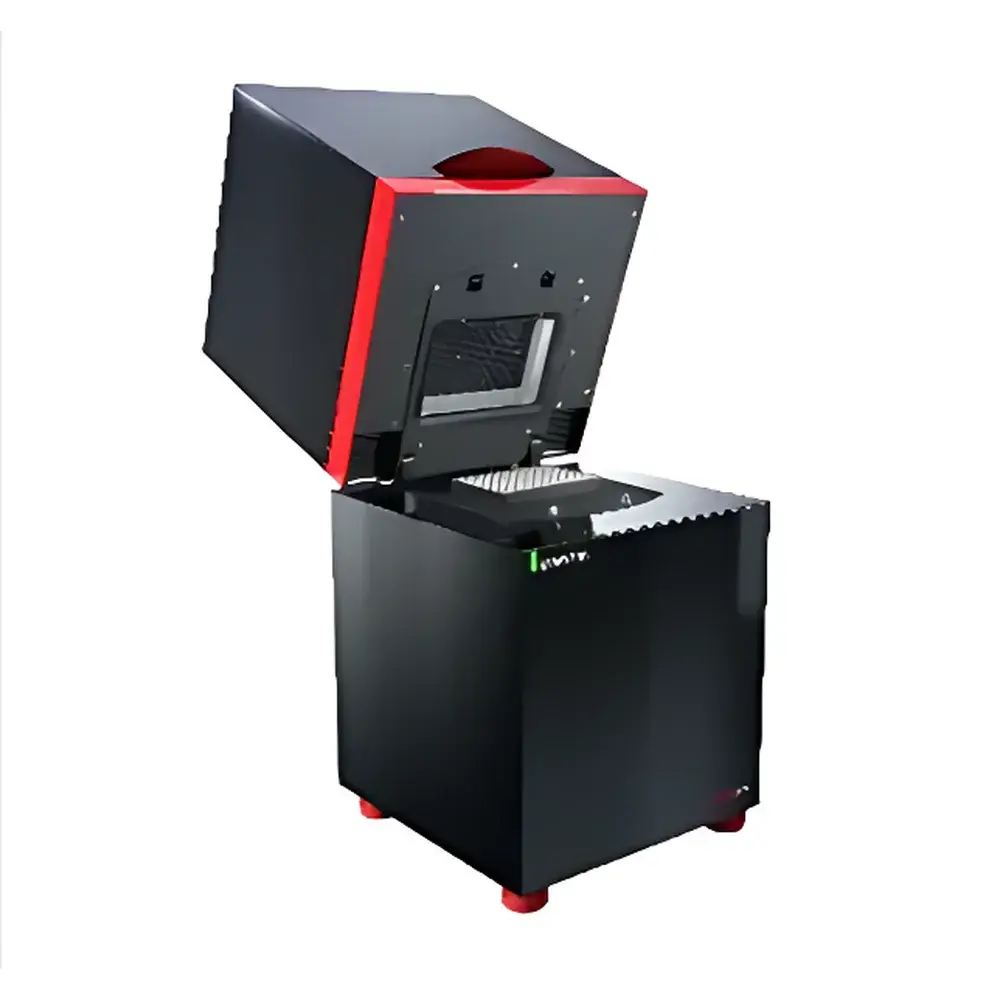
analytikjena qTOWER384G Real-Time Fluorescence Quantitative PCR System
| Brand | analytikjena |
|---|---|
| Origin | Shanghai, China |
| Model | qTOWER384G |
| Instrument Type | Real-Time Fluorescence Quantitative PCR System |
| Sample Throughput | 384-well |
| Temperature Accuracy | ±0.1 °C |
| Inter-Well Temperature Uniformity | ±0.15 °C |
| Heating Rate | 4 °C/s |
| Optical Channels | Up to 6 independent detection channels |
| Excitation/Detection Filter Sets | 12 configurable combinations including FRET-mismatched and protein melting-specific sets |
| Light Source | RGBW high-intensity long-life LEDs (blue, green, red, white) |
| Detector | High-sensitivity channel-type photomultiplier tube (PMT) |
| Detection Method | 16-channel fiber-optic scanning |
| Sensitivity | Single-copy DNA detection |
| Dynamic Range | 10 logs |
| Recommended Reaction Volume | 2–30 µL |
| Thermal Gradient | 24-column linear gradient |
| Thermal Block | Peltier-based, corrosion-resistant |
| Lid Temperature | Up to 110 °C with auto-adjusting pressure (up to 30 kg/plate) |
| Noise Level | ≤45 dB(A) |
| Connectivity | USB |
| Software | MIQE-compliant reporting, unlimited free installation & lifetime updates |
Overview
The analytikjena qTOWER384G is a purpose-built, high-throughput real-time fluorescence quantitative PCR system engineered for precision, reproducibility, and scalability in molecular diagnostics, genomics research, and quality-controlled bioproduction environments. Unlike retrofitted conventional PCR instruments, the qTOWER384G features an integrated optical and thermal architecture grounded in solid-state LED excitation and channel-type photomultiplier detection—enabling robust quantification across the full dynamic range of nucleic acid targets. Its core measurement principle relies on synchronous fluorescence signal acquisition during thermal cycling, where target amplification is monitored in real time via sequence-specific probes (e.g., hydrolysis, hybridization, or intercalating dyes) under tightly controlled thermal gradients and uniform well-to-well temperature profiles. Designed for compliance-critical workflows, the system supports traceable assay validation and meets foundational requirements for GLP-aligned gene expression studies, viral load monitoring, and SNP genotyping.
Key Features
- Six-channel modular optical system: Configurable from 1 to 6 detection channels at any time—no hardware replacement required—supporting future expansion without instrument downtime.
- Twelve interchangeable excitation/emission filter sets: Including dedicated configurations for FRET-based assays (e.g., TaqMan® MGB probes) and protein thermal shift analysis (e.g., SYPRO Orange-based melt profiling).
- RGBW solid-state LED light source: Delivers stable, spectrally broad illumination (450–650 nm) with negligible thermal output, eliminating lamp aging effects and enabling >50,000-cycle operational lifetime without recalibration.
- High-gain channel-type photomultiplier tube (PMT): Provides superior signal-to-noise ratio over CCD or CMOS alternatives, particularly critical for low-abundance target detection and early-cycle Ct determination.
- 16-channel fiber-optic scanning: Simultaneously acquires fluorescence from 16 wells per scan cycle—ensuring kinetic fidelity and eliminating well-order bias—without requirement for passive ROX normalization (though optional reference dye correction remains supported).
- 24-column linear thermal gradient: Enables empirical annealing temperature optimization across a single run (e.g., 50–65 °C in 0.5 °C increments), accelerating assay development and reducing optimization iterations.
- Peltier-driven thermal block with corrosion-resistant surface finish: Ensures rapid heat transfer (<4 °C/s ramp rate), ±0.1 °C absolute accuracy, and ±0.15 °C inter-well uniformity—validated per ISO 13485 Annex A and ASTM E1534 calibration protocols.
Sample Compatibility & Compliance
The qTOWER384G accepts standard ANSI/SBS-compliant 384-well PCR plates and supports reaction volumes from 2 to 30 µL—optimized for minimal reagent consumption while maintaining thermal homogeneity. Its thermal lid applies programmable contact force (up to 30 kg/plate) and self-leveling height adjustment, ensuring consistent evaporation control across plate batches and lot numbers. The system complies with IEC 61010-1 safety standards and electromagnetic compatibility (EMC) Class B limits. All software-generated reports conform to Minimum Information for Publication of Quantitative Real-Time PCR Experiments (MIQE) guidelines—including mandatory metadata fields for primer efficiency, PCR efficiency calculation, and inter-run calibration tracking—facilitating audit readiness for ISO/IEC 17025-accredited laboratories and FDA-regulated bioanalytical labs operating under 21 CFR Part 11.
Software & Data Management
qPCRsoft v5.x provides a validated, multi-user desktop application with native support for Windows OS and seamless integration into enterprise LIMS via standardized USB HID and CSV/JSON export interfaces. Core analytical modules include absolute quantification (standard curve), comparative ΔΔCt analysis with user-defined amplification efficiency correction, high-resolution melt (HRM) curve deconvolution, allelic discrimination clustering (for SNP and CNV calling), and endpoint fluorescence thresholding. Audit trail functionality records all parameter changes, user logins, and data exports with timestamped, non-erasable entries. Software licenses are perpetual and unrestricted: installations may be deployed across unlimited local workstations without dongles, subscription fees, or activation locks—and all minor and major version upgrades are delivered free of charge for the instrument’s operational lifetime.
Applications
- High-sensitivity pathogen quantification (e.g., SARS-CoV-2 RNA, HIV proviral load, HBV DNA)
- Gene expression profiling in pharmacodynamic and toxicogenomic studies
- Copy number variation (CNV) analysis in oncology biomarker panels
- Residual host cell DNA (HCD) testing in biopharmaceutical manufacturing
- NGS library quantification prior to sequencing platform loading
- Protein thermal stability screening via dye-based thermal shift assays
- Validation of CRISPR editing efficiency using T7E1 or RFLP-coupled qPCR
FAQ
Is the qTOWER384G compliant with 21 CFR Part 11 for electronic records and signatures?
Yes—the software includes role-based access control, electronic signature capture, and immutable audit trails meeting FDA requirements for regulated environments.
Can the system perform multiplex assays across all six channels simultaneously?
Yes—each of the six optical channels operates independently with dedicated excitation/detection filters, enabling true 6-plex detection without spectral crosstalk compensation.
Does the instrument require routine optical recalibration?
No—solid-state LED stability and factory-calibrated PMT gain eliminate scheduled optical recalibration; only annual thermal verification per ISO/IEC 17025 is recommended.
Is third-party LIMS integration supported out-of-the-box?
Yes—USB-HID mode enables plug-and-play connectivity; custom API scripting (via Python SDK) is available upon request for advanced middleware integration.
What is the warranty coverage and service response time?
Standard 2-year comprehensive warranty includes next-business-day on-site support in mainland China; extended service plans available globally through analytikjena certified partners.



