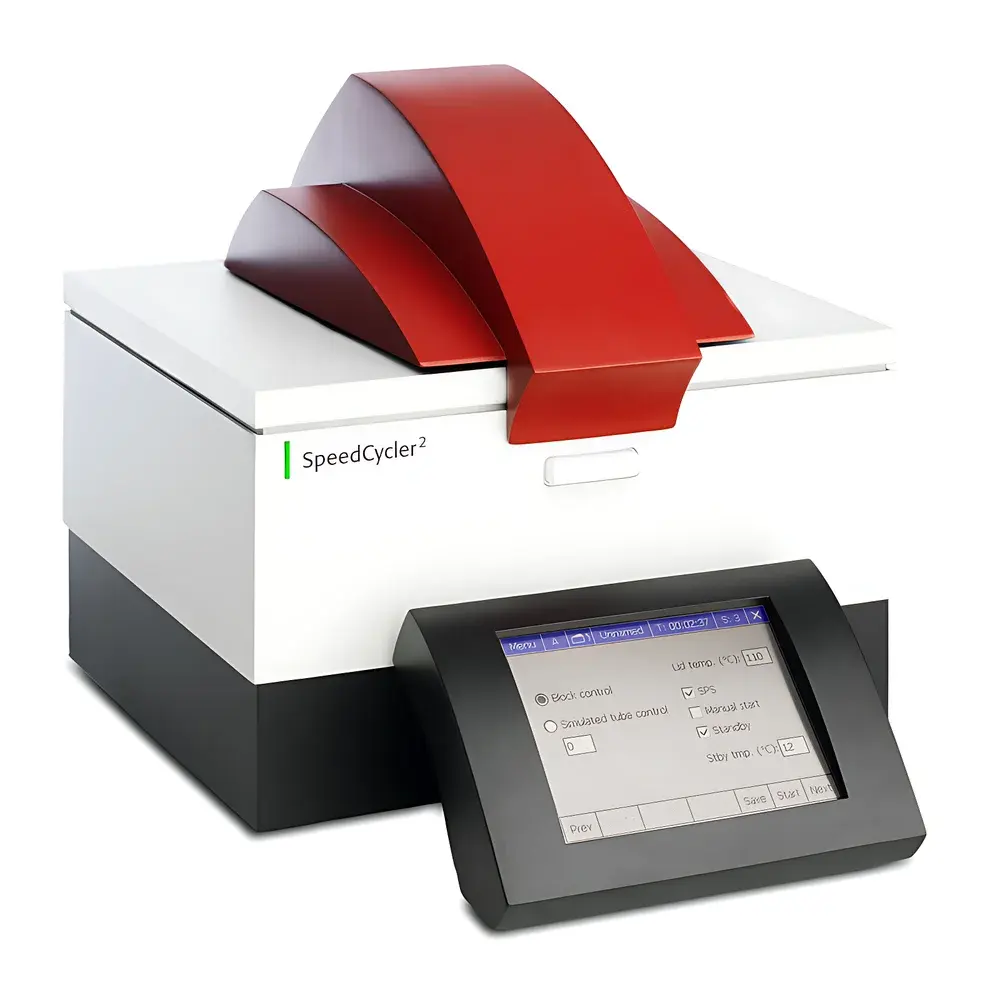
analytikjena SpeedCycler2 High-Speed Thermal Cycler
| Brand | analytikjena |
|---|---|
| Origin | Germany |
| Manufacturer | analytikjena GmbH & Co. KG |
| Model | SpeedCycler2 |
| Module Options | 96-well LPR (20 µL), 96-well SPR (0.2 mL), 96-well SP (0.2 mL) |
| Max Heating Rate | 15 °C/s (LPR module) |
| Max Cooling Rate | 10 °C/s (LPR module) |
| Temperature Range | 4–105 °C |
| Temperature Accuracy | < ±0.2 °C at 72 °C |
| Temperature Uniformity | < ±0.3 °C at 72 °C |
| Heat Lid Temp | up to 120 °C |
| Control Interface | HID-Pro 320 5.7" color touchscreen or PC via Windows CE-based software |
| Program Storage | 500 protocols on device |
| Dimensions (W×H×D) | 280 × 290 × 250 mm |
| Weight | 12 kg |
Overview
The analytikjena SpeedCycler2 is a high-performance thermal cycler engineered for rapid, precise, and reproducible polymerase chain reaction (PCR) amplification. Built upon a proprietary Peltier-based thermoelectric architecture with gold-plated pure silver heating blocks, the instrument delivers exceptional thermal conductivity and long-term corrosion resistance. Its core operational principle relies on direct, high-efficiency heat transfer between the block and sample tubes—enabled by adaptive thermal control algorithms and hardware-level synchronization of lid engagement and module ramping. Unlike conventional cyclers relying on passive thermal mass, the SpeedCycler2 achieves sub-second temperature transitions through optimized thermal inertia management and real-time block-to-sample thermal modeling. This enables routine 30–30–60 s cycling profiles to be compressed into 2–2–10 s formats without compromising fidelity—reducing total run time for standard 35-cycle PCR to under 8 minutes. The system operates across a validated temperature range of 4–105 °C, supporting not only standard endpoint PCR but also advanced protocols requiring stringent thermal precision, such as hot-start activation, touchdown PCR, and gradient-based optimization.
Key Features
- Ultra-Fast Thermal Cycling: Maximum heating rate of 15 °C/s and cooling rate of 10 °C/s (with 96-well LPR module), enabled by high-conductivity gold-plated silver Peltier elements and low-thermal-mass block design.
- SAC Adaptive Energy Management: Self-Adaptive Cycling (SAC) technology dynamically adjusts power delivery to maintain >90% thermal energy utilization, minimizing overshoot and stabilizing dwell times at target temperatures.
- SPS Sample Protection System: Smart Pressure-Synchronized lid actuation ensures the heated lid (up to 120 °C) engages only after reaching setpoint—preventing premature evaporation in low-volume reactions (down to 5 µL).
- Hardware-Based Hot Start: Rapid initial ramp to denaturation temperature (>95 °C within seconds) suppresses non-specific primer binding during reaction setup, eliminating need for antibody-mediated or chemical hot-start reagents.
- Multi-Module Flexibility: Interchangeable 96-well modules—including LPR (low-profile, 20 µL), SPR (standard-profile, 0.2 mL, open consumables), and SP (standard-profile, 0.2 mL)—support diverse assay formats and tube compatibility requirements.
- Dual-Control Architecture: Standalone operation via the HID-Pro 320 5.7″ capacitive touchscreen interface (running embedded Windows CE OS), or full remote control and protocol management via PC-connected software with audit-trail-capable logging.
Sample Compatibility & Compliance
The SpeedCycler2 accommodates standard 0.2 mL thin-wall PCR tubes and 96-well plates across all module variants. The SPR module supports open-consumables workflows, enabling use of third-party tubes and plates compliant with ANSI/SLAS standards. Temperature accuracy (< ±0.2 °C at 72 °C) and uniformity (< ±0.3 °C at 72 °C) are verified per ISO/IEC 17025-accredited calibration procedures. The instrument’s firmware and PC software support GLP/GMP-aligned data integrity practices, including user access control, electronic signatures, and immutable protocol versioning. While not pre-certified for FDA 21 CFR Part 11 out-of-the-box, the system architecture permits configuration for regulated environments—including timestamped audit logs, cycle-by-cycle parameter recording, and exportable raw thermal trace files compatible with analytical validation packages.
Software & Data Management
Control and analysis are managed through analytikjena’s dedicated thermal cycler software suite, built on a Windows CE framework for deterministic real-time performance. The HID-Pro 320 controller stores up to 500 user-defined protocols locally; external USB storage extends capacity indefinitely while preserving folder hierarchies and metadata tagging. Software features include gradient setup (for annealing optimization), stepwise temperature/time incrementing (±0.1 °C or ±0.1 s per cycle), and automatic calculation of Tm-adjusted touchdown ramps. All runs generate timestamped .csv and .xml log files containing full thermal trajectory data, cycle counters, error flags, and operator IDs—enabling traceability in QC/QA documentation and regulatory submissions. Export formats comply with MIAME and MIAPE reporting guidelines for nucleic acid amplification experiments.
Applications
- Routine genomic DNA amplification for cloning, sequencing library prep, and genotyping
- High-throughput screening in diagnostic development and clinical research labs
- Time-sensitive applications including pathogen detection (e.g., SARS-CoV-2, influenza), where rapid turnaround informs triage decisions
- Optimization of multiplex PCR assays requiring precise annealing control and minimal extension time
- Validation studies requiring thermal profile reproducibility across instruments and sites
- Education and training platforms where intuitive interface and visual feedback reduce operator dependency
FAQ
What is the difference between the LPR, SPR, and SP modules?
The LPR (Low Profile) module is optimized for ultra-fast cycling using 20 µL low-volume tubes with minimal thermal mass; the SPR (Standard Profile, Open) supports standard 0.2 mL tubes and accepts third-party consumables; the SP (Standard Profile) is a fixed-format variant designed for maximum compatibility with legacy tube geometries.
Does the SpeedCycler2 support gradient PCR?
Yes—the instrument allows user-defined temperature gradients across the block (e.g., 55–65 °C in 1 °C increments) for empirical annealing optimization, with independent verification of each column’s actual temperature.
Can I recover a run after a power failure?
Yes—the system implements non-volatile cycle-state memory: upon power restoration, it resumes from the exact denaturation step of the interrupted cycle, preserving thermal history and minimizing off-target amplification.
Is the software compatible with LIMS integration?
Raw data exports (.csv, .xml) and metadata schemas are structured for automated ingestion into common LIMS platforms; API-level integration requires custom middleware development per site-specific infrastructure.
What maintenance is required for long-term calibration stability?
Annual verification using NIST-traceable reference probes is recommended; no routine recalibration is needed between validations due to the drift-compensated Peltier control architecture.
Related Products