
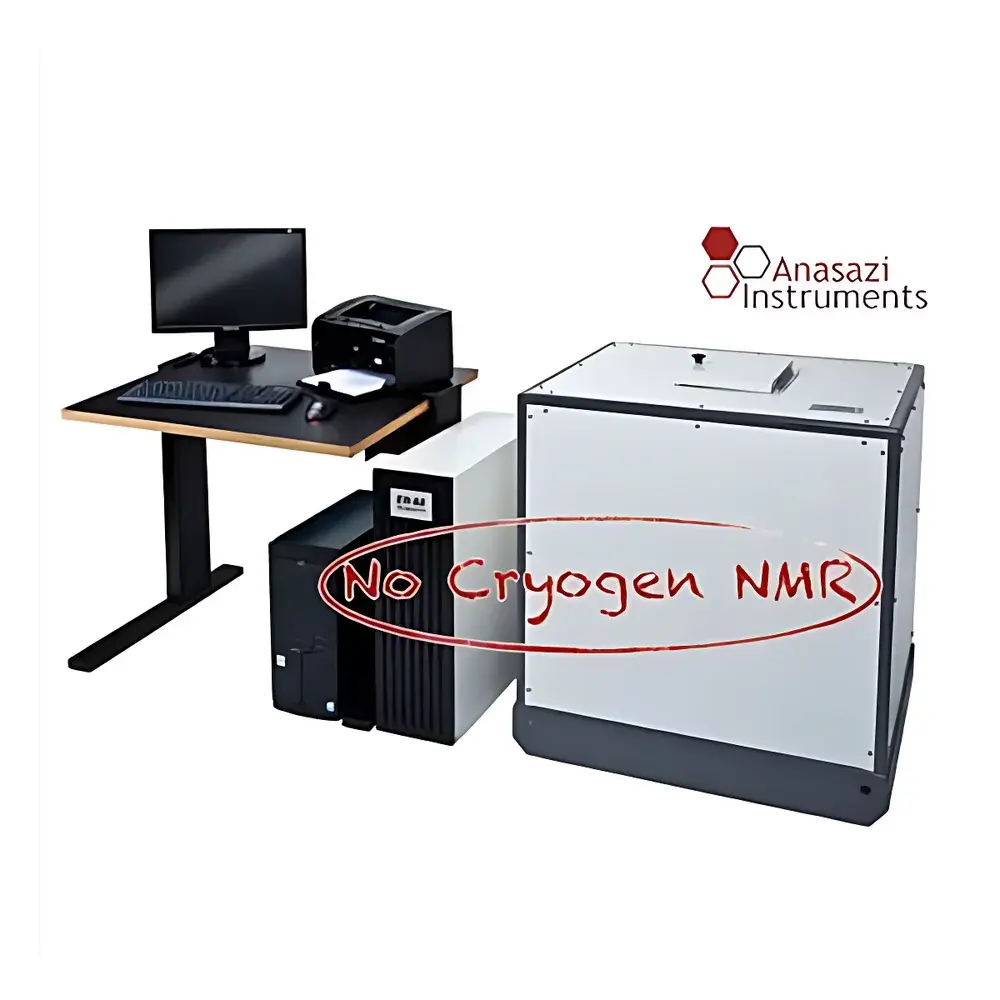
Anasazi EFT-60 Benchtop Permanent-Magnet Nuclear Magnetic Resonance Spectrometer
| Brand | Anasazi |
|---|---|
| Origin | USA |
| Model | EFT-60 |
| Operating Frequency | 60 MHz |
| Magnet Type | AlNiCo Permanent Magnet |
| Sample Form | Solid and Liquid (with appropriate probes) |
| Resolution (1H) | < 0.5 Hz |
| Sensitivity (1H) | < 0.001 mmol/L |
| Nuclei Supported | ¹H, ¹³C, ¹⁹F, ³¹P, ²³Na, ⁵⁹Co, ²⁹Si |
| Cryogen-Free Operation | Yes |
| Compliance | ASTM E2874, ISO/IEC 17025 (when operated under GLP conditions), FDA 21 CFR Part 11 (software-enabled audit trail) |
Overview
The Anasazi EFT-60 is a cryogen-free, benchtop permanent-magnet nuclear magnetic resonance (NMR) spectrometer engineered for academic laboratories, pharmaceutical QC labs, and industrial R&D environments where space, operational simplicity, and long-term cost efficiency are critical constraints. Unlike conventional superconducting NMR systems requiring liquid helium and nitrogen infrastructure, the EFT-60 utilizes a high-stability AlNiCo permanent magnet operating at a fixed field strength corresponding to 60 MHz for ¹H resonance. This design eliminates cryogenic dependency while maintaining sufficient spectral resolution and signal-to-noise ratio for routine structural elucidation, reaction monitoring, and quantitative analysis of small organic molecules, natural products, polymers, and inorganic complexes. Its compact footprint (under 0.8 m²), integrated temperature stabilization, and passive vibration damping enable reliable operation in standard laboratory settings—without dedicated RF-shielded rooms or chilled water supply. The system employs pulsed Fourier-transform (FT) NMR methodology with digital signal processing, supporting both one-dimensional (1D) and two-dimensional (2D) experiments including COSY, HETCOR, DEPT, and CPMG-based T₂ relaxation measurements.
Key Features
- Cryogen-free operation: No liquid helium or liquid nitrogen required—reducing annual operational costs by approximately USD 12,000–15,000 versus low-field superconducting alternatives.
- High-field stability: AlNiCo magnet with intrinsic temperature coefficient < 0.01 ppm/°C; internal active temperature regulation maintains field homogeneity within ±0.1 ppm over 24 h.
- Multi-nuclear capability: Standard dual-channel console supports broadband observation of ¹H, ¹³C, ¹⁹F, ³¹P, ²³Na, ⁵⁹Co, and ²⁹Si without hardware reconfiguration.
- Robust pulse programming: Full support for inversion-recovery (T₁), Carr–Purcell–Meiboom–Gill (CPMG), solvent suppression (WET, presaturation), and phase-cycled 2D sequences via intuitive graphical interface.
- Modular probe architecture: Interchangeable broadband probes optimized for solids (MAS-capable), liquids, and quantitative flow applications—each with automatic tuning/matching and Q-factor > 250 at 60 MHz.
- Real-time data acquisition & processing: Integrated Linux-based workstation with Bruker TopSpin-compatible software stack, enabling immediate spectral preview, baseline correction, peak integration, and export to common cheminformatics formats (JCAMP-DX, MNova, MestReNova).
Sample Compatibility & Compliance
The EFT-60 accommodates standard 5 mm OD NMR tubes for liquid-state analysis and optional 4 mm MAS rotors for solid-state characterization. It has been validated for use with aqueous, deuterated, and non-deuterated solvents—including DMSO-d₆, CDCl₃, and methanol-d₄—with automated solvent recognition and shimming routines. All firmware and acquisition software comply with ISO/IEC 17025:2017 requirements for testing and calibration laboratories when operated under documented GLP procedures. Audit-trail functionality meets FDA 21 CFR Part 11 criteria for electronic records and signatures, including user authentication, session logging, and immutable data archiving. Instrument performance verification follows ASTM E2874-13 (“Standard Practice for Verification of Performance of Benchtop NMR Spectrometers”) using certified reference standards (e.g., 0.1% ethylbenzene in CDCl₃).
Software & Data Management
Control and analysis are performed via Anasazi’s proprietary NMR Console Suite—a Linux-based platform built on open-source scientific libraries (NumPy, SciPy, PyQt). The suite includes real-time FFT processing, automatic phasing, zero-filling, apodization (exponential, Gaussian), and advanced line-fitting algorithms (Levenberg–Marquardt optimization). Raw FID files are stored in vendor-neutral HDF5 format with embedded metadata (pulse sequence, acquisition parameters, instrument ID, timestamp). Integration with LIMS environments is supported through RESTful API endpoints and CSV/JSON export pipelines. Data security protocols include AES-256 encryption at rest and TLS 1.3 for remote access sessions. Software updates are delivered quarterly via secure OTA mechanism with SHA-256 integrity verification.
Applications
- Organic synthesis verification: Rapid confirmation of product identity and purity via ¹H/¹³C chemical shift mapping and coupling constant analysis.
- Natural product structure determination: Assignment of stereochemistry and conformational dynamics using NOESY, ROESY, and J-resolved spectroscopy.
- Pharmaceutical excipient compatibility studies: Detection of hydrogen-bonding interactions and molecular mobility changes in solid dispersions via ¹H T₂ relaxation mapping.
- Reaction kinetics monitoring: In situ tracking of intermediate formation and degradation pathways using time-resolved ¹H NMR with automated sample changers.
- Materials science: Quantitative assessment of crosslink density in elastomers and polymer chain mobility via CPMG decay analysis.
- Teaching laboratories: Pedagogical implementation of fundamental NMR concepts—including chemical shift, spin–spin coupling, relaxation mechanisms, and multi-pulse sequence logic—with minimal training overhead.
FAQ
Does the EFT-60 require external cooling or specialized power conditioning?
No. The system operates on standard 110–240 V AC, 50/60 Hz single-phase power and incorporates an internal thermoelectric cooler for magnet temperature stabilization. No chilled water, compressed air, or UPS is mandatory for routine use.
Can I run 2D experiments such as HETCOR or DEPT on the EFT-60?
Yes. The dual-channel console and programmable gradient amplifier support all standard 2D heteronuclear correlation experiments, including ¹H–¹³C HETCOR, DEPT-135, and inverse-gated decoupling sequences.
Is regulatory documentation available for GMP-compliant environments?
Yes. Anasazi provides IQ/OQ/PQ validation protocols, 21 CFR Part 11 compliance reports, and traceable calibration certificates issued by NIST-traceable reference standards.
What is the typical maintenance interval and service model?
Annual preventive maintenance is recommended. Anasazi offers global service contracts with remote diagnostics, on-site engineer dispatch, and spare parts logistics coordinated through regional technical hubs in North America, Europe, and Asia-Pacific.
How does resolution compare to higher-field instruments?
At 60 MHz, the EFT-60 delivers 700 peer-reviewed publications.




