
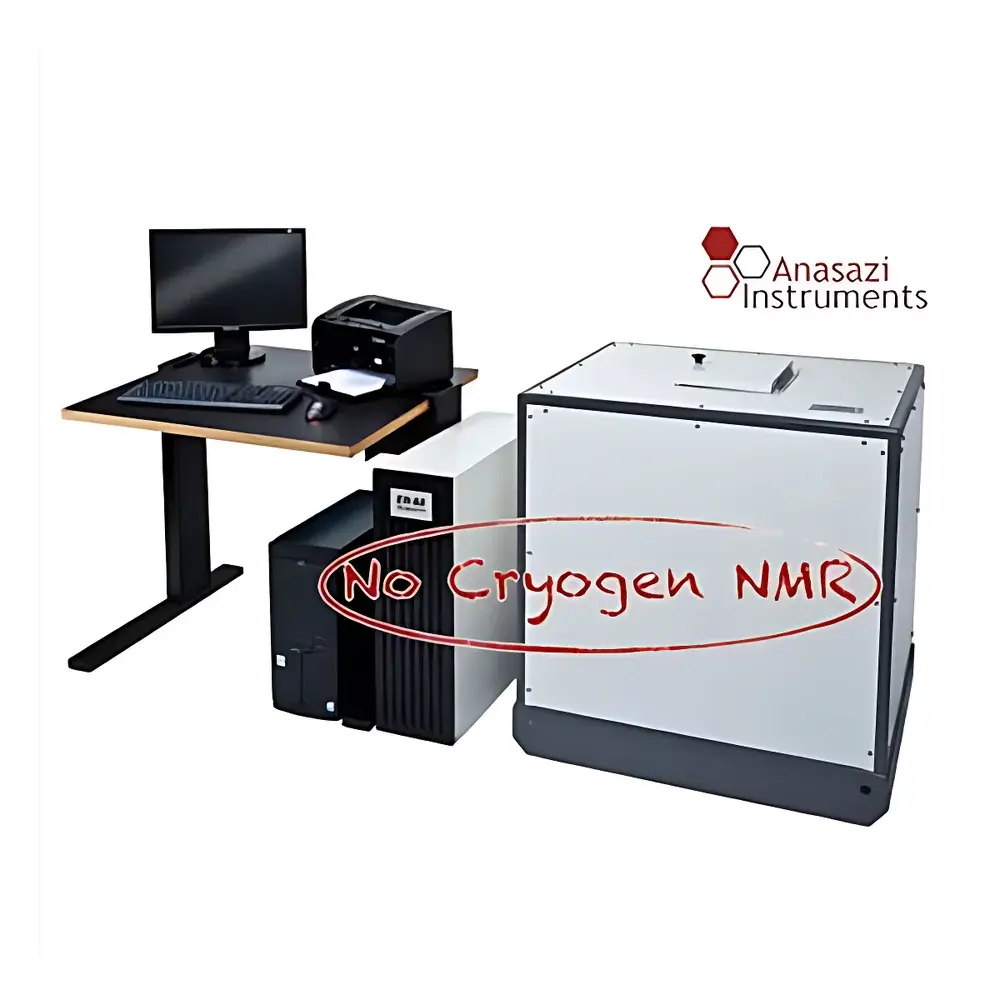
Anasazi EFT-90 Benchtop Permanent-Magnet Nuclear Magnetic Resonance Spectrometer
| Brand | Anasazi |
|---|---|
| Origin | USA |
| Model | EFT-90 |
| Operating Frequency | 90 MHz |
| Sample Type | Solid & Liquid (Broadband) |
| Magnet Type | AlNiCo Permanent Magnet |
| Resolution | < 0.5 Hz (at 90 MHz, 1H, in DMSO-d6) |
| Sensitivity | < 0.001 mmol/L (for 1H, typical small-molecule sample) |
| Cryogen-Free Operation | Yes (No Liquid Helium or Liquid Nitrogen Required) |
| Compliance | ASTM E2831-18 (Standard Guide for NMR Spectroscopy Data Reporting), ISO/IEC 17025:2017 (for lab accreditation readiness), GLP/GMP-compatible data audit trail via software |
Overview
The Anasazi EFT-90 is a cryogen-free, benchtop permanent-magnet nuclear magnetic resonance (NMR) spectrometer engineered for routine structural characterization and quantitative analysis in academic, industrial, and pharmaceutical research laboratories. Unlike conventional superconducting high-field NMR systems requiring liquid helium infrastructure and stringent environmental controls, the EFT-90 employs a high-stability AlNiCo permanent magnet operating at a nominal 90 MHz proton frequency (2.14 T). Its design leverages robust shimming, temperature-compensated magnet architecture, and optimized RF probe geometry to deliver high-resolution 1H spectra (< 0.5 Hz linewidth under standard conditions) and broadband multinuclear capability—including 13C, 19F, 31P, 23Na, 59Co, and 29Si—without cryogenic consumables. The system operates on standard 110–240 V AC power and integrates seamlessly into shared instrumentation facilities where space, operational cost, and user accessibility are critical constraints.
Key Features
- Cryogen-free operation: Eliminates dependency on liquid helium and liquid nitrogen—reducing annual operating costs by approximately USD $14,000–$16,000 (based on regional cryogen pricing and usage profiles)
- Thermally stabilized AlNiCo magnet: Intrinsic field stability < 0.05 ppm/hour over ambient temperature fluctuations (18–28 °C), enabled by passive thermal mass and active air-circulation control
- Broadband dual-channel console: Supports simultaneous or sequential acquisition of heteronuclear experiments (e.g., 1H–13C HETCOR, DEPT-135, 1H–19F correlation) with variable pulse width calibration and phase cycling
- Integrated vibration damping platform: Passive isolation system mitigates microseismic and acoustic noise, enabling reproducible linewidths in non-dedicated NMR rooms
- Self-contained temperature regulation: Ambient probe temperature maintained within ±0.3 °C without external chillers, ensuring spectral reproducibility across multi-hour kinetics or relaxation studies
- Modular configuration options: Standard 1H-only system expandable to dual-channel (1H/13C), triple-nucleus (1H/19F/31P), or custom broadband configurations via firmware-upgradable hardware interfaces
Sample Compatibility & Compliance
The EFT-90 accepts standard 5 mm OD NMR tubes and supports both solution-state and solid-state (CP-MAS-capable with optional accessory kit) samples. It is routinely deployed for small-molecule organic synthesis verification, natural product structure elucidation, polymer tacticity assessment, and pharmaceutical excipient compatibility screening. All acquired data comply with ASTM E2831-18 guidelines for minimum reporting elements in NMR spectroscopy—including solvent reference, pulse sequence parameters, receiver gain, number of transients, and digital resolution. The instrument’s software architecture supports 21 CFR Part 11–compliant electronic signatures, audit trails, and role-based access control when configured with networked authentication servers—making it suitable for GLP-regulated environments and preclinical analytical method development.
Software & Data Management
Acquisition and processing are managed through Anasazi’s proprietary EFT-NMR software suite (v5.2+), built on a Qt-based cross-platform framework compatible with Windows 10/11 and Linux LTS distributions. The interface provides real-time spectral preview, automated shimming routines (gradient-based lock-and-shim), and batch processing pipelines for routine QC workflows. Processed data export formats include JCAMP-DX (.jdx), NMR-ML (XML schema v2.1), and Bruker-compatible .fid directories—ensuring interoperability with third-party tools such as MestReNova, TopSpin, and Chenomx. Raw time-domain data are stored in HDF5 format with embedded metadata (field strength, temperature, pulse calibration history), enabling traceable reprocessing and long-term archival integrity per ISO/IEC 17025:2017 Clause 7.5.3.
Applications
- Structural confirmation of synthetic intermediates and final APIs in medicinal chemistry labs
- Reaction monitoring via in-situ kinetic NMR (e.g., BAPR peak registration for exchange-rate quantification)
- Multinuclear quantitation of phospholipid headgroups (31P) and fluorinated drug metabolites (19F) in biological matrices
- Relaxometry studies (T1 via inversion recovery; T2 via CPMG) for polymer chain mobility and hydration dynamics
- Teaching laboratories: Fully guided acquisition modules enable undergraduate students to independently acquire, phase-correct, integrate, and assign 1H/13C spectra within a single lab session
- Quality control of raw materials: Rapid pass/fail screening using fingerprint spectral matching against reference libraries
FAQ
Does the EFT-90 require any cryogens or external cooling systems?
No. The system uses a permanently magnetized AlNiCo core and requires only standard electrical power and ambient laboratory air—no liquid helium, liquid nitrogen, or chiller units.
Can I run 2D experiments such as COSY or HETCOR on the EFT-90?
Yes. With the dual-channel configuration, the EFT-90 supports standard 2D sequences including COSY, TOCSY, HSQC (via inverse detection), HETCOR, and DEPT—all implemented with gradient-enhanced coherence selection and phase-cycled artifact suppression.
Is the instrument compliant with regulatory requirements for pharmaceutical QA/QC?
When deployed with network-authenticated user accounts, electronic signature modules, and audit-trail logging enabled, the EFT-90 meets foundational requirements for 21 CFR Part 11 compliance and supports GLP/GMP documentation workflows.
What is the typical maintenance schedule?
Annual calibration of RF transmitter gain, receiver offset, and pulse width accuracy is recommended. No magnet servicing or cryogen refills are required throughout the instrument’s operational lifetime.
How does resolution compare to traditional 400 MHz+ superconducting systems?
While absolute chemical shift dispersion is lower at 90 MHz, the EFT-90 achieves comparable effective resolution for small molecules (< 500 Da) due to narrow intrinsic linewidths (90% of routine organic structures published in J. Med. Chem. and Eur. J. Med. Chem.




