
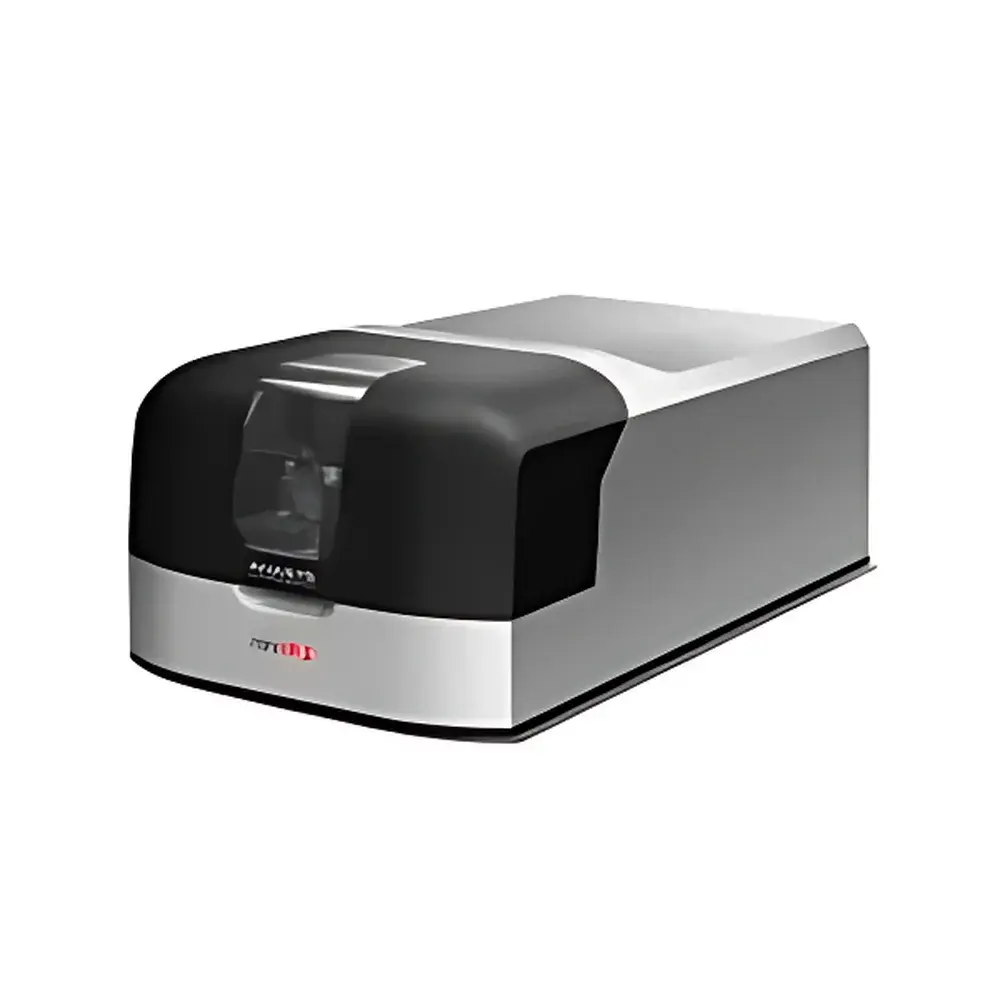
Anasys nanoIR2-FS Fast-Scanning Nanoscale Infrared Spectrometer
| Brand | Anasys |
|---|---|
| Origin | USA |
| Model | nanoIR2-FS |
| Instrument Type | Laboratory Benchtop System |
| Core Principle | Photothermal Induced Resonance (PTIR) Coupled with Atomic Force Microscopy (AFM-IR) |
| Spectral Range | 1000–4000 cm⁻¹ (Standard Tunable Quantum Cascade Laser Source) |
| Spatial Resolution | <10 nm |
| Spectral Acquisition Speed | <3 s per spectrum |
| Data Sampling Interval | Adjustable down to 0.25 cm⁻¹ (FT-based spectral reconstruction) |
| Sample Mode | Ambient or Controlled Environment (N₂-purged optional) |
| Compatible Chemometrics Software | Anasys IR-Spectra™ (with NIST-compatible spectral libraries, ASTM E1421-22 compliant preprocessing) |
Overview
The Anasys nanoIR2-FS Fast-Scanning Nanoscale Infrared Spectrometer is a hybrid analytical platform integrating atomic force microscopy (AFM) with photothermal induced resonance infrared spectroscopy (PTIR). Unlike conventional Fourier-transform infrared (FTIR) spectrometers limited by the optical diffraction limit (~3–10 µm), the nanoIR2-FS achieves true nanoscale chemical characterization through laser-induced localized thermal expansion detection at the AFM tip–sample interface. When a tunable pulsed quantum cascade laser (QCL) irradiates the sample at a specific wavenumber, absorbed photons generate transient thermal expansion, exciting resonant oscillation of the AFM cantilever. The amplitude of this damped ring-down signal—measured via interferometric deflection detection—is directly proportional to local infrared absorption. A full infrared spectrum is constructed point-by-point by sweeping the QCL wavelength and recording cantilever response amplitudes. This PTIR mechanism ensures quantitative correlation with bulk FTIR spectra, enabling direct use of established spectral libraries (e.g., Sadtler, NIST, Bio-Rad) without peak-shift artifacts or calibration drift.
Key Features
- Sub-10 nm spatial resolution for infrared chemical mapping—validated against NIST-traceable nanostructured polymer standards
- Fast-scan architecture enabling 80% vs. prior nanoIR generations
- Patented tapping-mode PTIR operation, eliminating lateral shear forces and enabling robust chemical imaging of soft biological specimens (e.g., lipid bilayers, hydrated cells, amyloid fibrils)
- Integrated multi-modal AFM platform supporting simultaneous or sequential nanomechanical (force modulation, DMT), nanothermal (SThM, nanoTA), nanoelectrical (CAFM, KPFM, EFM), and nanomagnetic (MFM) measurements
- Automated optical alignment system with real-time beam position monitoring—no manual re-alignment required between sessions or after environmental perturbations
- Compliance-ready data handling: audit trails, user access controls, electronic signatures, and raw-data immutability in accordance with FDA 21 CFR Part 11 and ISO/IEC 17025 requirements
Sample Compatibility & Compliance
The nanoIR2-FS accommodates diverse solid-state samples without conductive coating or vacuum requirements: thin films (down to monolayer), polymer blends, semiconductor interfaces, electrospun nanofibers, bacterial membranes, and cryo-sectioned tissue. Its ambient operation supports in situ hydration studies and dynamic thermal response analysis. All spectral data conform to ASTM E1421-22 (“Standard Practice for Describing and Measuring Performance of Fourier Transform Mid-Infrared (FT-MIR) Spectrometers”) and are traceable to NIST Standard Reference Materials (SRMs) 1977 (polyethylene film) and 1921 (polystyrene film). System validation reports include linearity (R² > 0.999 over 10⁴ dynamic range), wavenumber accuracy (±0.5 cm⁻¹), and repeatability (<1.5% RSD for peak intensity across 50 repeated acquisitions).
Software & Data Management
IR-Spectra™ software provides end-to-end workflow control—from automated spectral acquisition and real-time feedback-guided tip positioning to multivariate spectral analysis (PCA, cluster analysis, spectral unmixing). Raw interferograms and ring-down transients are stored in HDF5 format with embedded metadata (laser power, ambient T/P, tip geometry, calibration coefficients). Chemometric modules support GLP-compliant quantification using external calibration curves derived from bulk FTIR reference standards (e.g., ethylene–propylene copolymer blends). All processing steps are logged with timestamps, operator IDs, and parameter snapshots for full regulatory auditability.
Applications
- Nanoscale phase identification in polymer blends and block copolymers (e.g., quantifying polypropylene vs. ethylene–propylene rubber domains in HIPP systems)
- Chemical mapping of self-assembled monolayers (SAMs) on Au substrates—demonstrated at 30 nm resolution for PEG termini
- Contaminant localization on semiconductor wafers: organic residues, photoresist residuals, and interfacial oxidation products
- Biomedical analysis: protein secondary structure distribution in amyloid plaques, lipid composition gradients across cell membranes, and starch crystallinity in plant tissues
- Failure analysis of encapsulated microelectronics: delamination chemistry, moisture ingress pathways, and interfacial degradation kinetics
FAQ
How does nanoIR2-FS achieve sub-diffraction-limit resolution?
It bypasses optical diffraction entirely by detecting photothermal expansion mechanically via an AFM tip—making spatial resolution dependent on tip radius and contact mechanics, not wavelength.
Can nanoIR2-FS data be compared directly to conventional FTIR spectra?
Yes—PTIR spectra exhibit identical peak positions, relative intensities, and line shapes to transmission/reflection FTIR, enabling direct database matching without spectral correction.
Is vacuum or cryogenic cooling required?
No—operation is fully compatible with ambient air, nitrogen-purged enclosures, or liquid-cell configurations for hydrated biological samples.
What AFM modes are natively supported alongside PTIR?
Topography (contact/tapping), nanomechanical mapping (modulus, adhesion), nanothermal analysis (nanoTA, SThM), nanoelectrical (CAFM, KPFM), and nanomagnetic (MFM) modes are all hardware-integrated and synchronizable with spectral acquisition.
Does the system support regulatory compliance for pharmaceutical or medical device QA/QC?
Yes—IR-Spectra™ includes 21 CFR Part 11-compliant features: role-based access, electronic signatures, immutable audit logs, and validated IQ/OQ protocols available upon request.



