
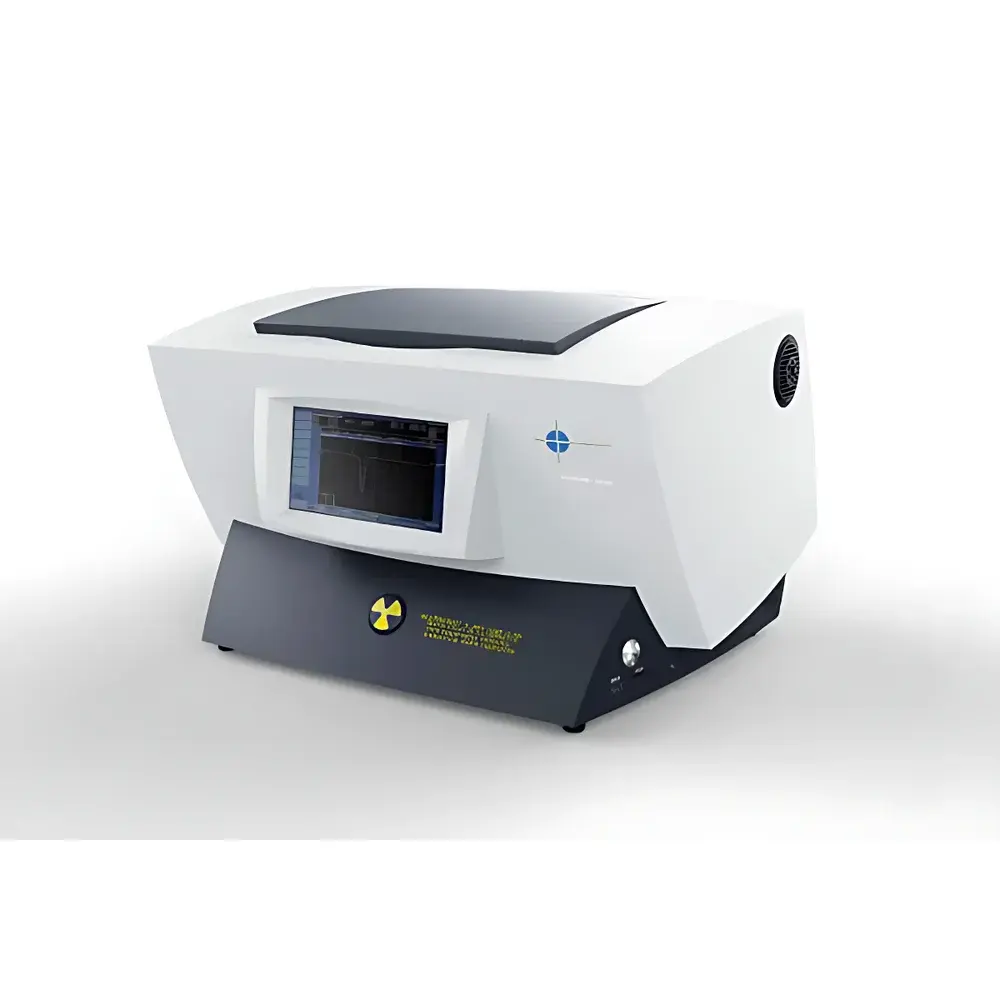
Anchor Wisdom DUBHE-1610 Monochromatic Wavelength Dispersive X-Ray Fluorescence Spectrometer for Ultra-Low Sulfur Analysis
| Brand | Anchor Wisdom |
|---|---|
| Origin | Beijing, China |
| Model | DUBHE-1610 |
| Detection Limit (LLD) | 0.4 ppm (S) |
| Measurement Range | 0.4 ppm – 5 wt% |
| Analysis Time | 60–300 s |
| Repeatability | ≤0.2 ppm (at 2 ppm S), ≤0.5 ppm (at 10 ppm S), ≤2.5 ppm (at 50 ppm S) |
| Excitation Line | Cr Kα (5.41 keV) |
| Optical Configuration | Dual Polycapillary Focusing Monochromator + Full-Focus Bent Crystal Analyzer |
| Sample Preparation | ESP (Easy Sample Prepare) System |
| Operating Mode | Benchtop, Air-path, No Gas or Solvent Consumption |
Overview
The Anchor Wisdom DUBHE-1610 is a monochromatic wavelength dispersive X-ray fluorescence (MWD-XRF) spectrometer engineered specifically for ultra-trace sulfur quantification in liquid and solid matrices. Unlike conventional energy-dispersive (ED-XRF) or polychromatic wavelength-dispersive (WD-XRF) systems, the DUBHE-1610 employs a dual-stage monochromatic excitation and detection architecture grounded in fundamental X-ray optics principles. Primary X-rays from a Cr-target X-ray tube are first filtered through a high-efficiency polycapillary optic to isolate the intense Cr Kα line (5.41 keV). This highly monochromatic beam selectively excites the sulfur K-shell (Kα at 2.307 keV), minimizing bremsstrahlung background and matrix-induced spectral interferences. Emitted sulfur Kα fluorescence is then collected by a large-area, full-focus bent crystal analyzer—optimized for angular dispersion and flux efficiency—and focused onto a high-resolution silicon drift detector (SDD). This physical separation of excitation and emission pathways eliminates continuous background scatter, delivering an exceptional signal-to-background ratio and enabling a certified limit of detection (LLD) of 0.4 ppm sulfur in hydrocarbon matrices under standardized conditions (ASTM D2622–23, ISO 8754:2022).
Key Features
- Patented X-Ray Fixed System (XFS): Pre-aligned optical path sealed within vacuum-tight housing; zero field recalibration required over instrument lifetime.
- Monochromatic Cr Kα excitation: Eliminates spectral overlap from Cl, Ca, and transition metals—critical for diesel, jet fuel, lubricants, and catalysts.
- ESP (Easy Sample Prepare) module: Integrated sample cup forming and polymer film mounting station; achieves reproducible <10 s sample loading without operator training.
- Benchtop air-path operation: No He purge, no cryogenic cooling, no gas cylinders—reducing total cost of ownership (TCO) to
- Stable long-term performance: Certified repeatability per ASTM D7039: ≤0.2 ppm at 2 ppm S level (n=10, 24 h); no daily standardization needed.
- Zero consumables beyond disposable sample cups and Mylar films; no X-ray tube replacement scheduled within 5 years under normal use.
Sample Compatibility & Compliance
The DUBHE-1610 accepts liquids (petroleum distillates, biodiesel blends, process streams), solids (catalyst powders, polymer pellets, coal ash), and thin-film deposits on quartz substrates. All sample forms are analyzed in ambient air with no digestion, dilution, or derivatization. Method validation aligns with regulatory frameworks including ASTM D2622 (Standard Test Method for Sulfur in Petroleum Products by Wavelength-Dispersive XRF), ASTM D7039 (for low-sulfur diesel), ISO 8754 (Petroleum products — Determination of sulfur content — Wavelength-dispersive X-ray fluorescence spectrometry), and EPA Method 1664B (for wastewater extracts). Instrument firmware supports 21 CFR Part 11-compliant audit trails, electronic signatures, and user-access-controlled method locking—fully traceable for GLP/GMP environments.
Software & Data Management
Control and data acquisition are managed via Anchor Wisdom’s proprietary AWARE™ software (v4.2+), compliant with IEC 62443-3-3 cybersecurity standards. The interface provides real-time spectral visualization, automatic peak deconvolution using fundamental parameter (FP) algorithms, and built-in calibration curve management with uncertainty propagation (k=2). Raw spectra, processed results, and system logs are stored in vendor-neutral .csv and .xml formats. Batch reporting supports customizable templates aligned with LIMS integration (via ASTM E1384-compliant ASCII export). Software includes automated QC checks: drift correction via internal reference channel, blank subtraction routines, and flagging of outlier intensities exceeding ±3σ from historical control charts.
Applications
- Refinery quality control: Monitoring sulfur in gasoline, ULSD, marine fuels, and feedstocks per IMO 2020 and EN 590 compliance.
- Chemical manufacturing: Quantifying residual sulfur in pharmaceutical intermediates, silicone oils, and specialty polymers.
- Environmental testing labs: Screening soil extracts, sediment digests, and industrial effluents for regulatory reporting.
- R&D laboratories: Catalyst sulfur poisoning studies, battery electrolyte impurity profiling, and additive stability assessments.
- Contract testing services: High-throughput screening of >50 samples/day with <2% RSD across multi-day runs.
FAQ
Does the DUBHE-1610 require helium purge or vacuum operation?
No. It operates in ambient air using optimized air-path optics and high-efficiency SDD detection.
Can it measure elements other than sulfur?
The optical configuration is optimized for sulfur Kα detection. While Cl, P, and Si signals may be observed, quantitative accuracy is validated only for sulfur per type-approved methods.
Is factory recalibration required after shipment?
No. The XFS architecture ensures factory-set alignment remains stable; users perform only initial verification using certified reference materials (CRMs).
What CRM standards are recommended for routine verification?
NIST SRM 2724b (diesel), NIST SRM 1634c (lubricating oil), and custom matrix-matched CRMs traceable to NIST or BAM.
How is data integrity ensured during audits?
AWARE™ software enforces role-based access, immutable audit logs, electronic signatures, and full export of raw spectra and processing parameters—meeting FDA and EU Annex 11 requirements.
Related Products




