
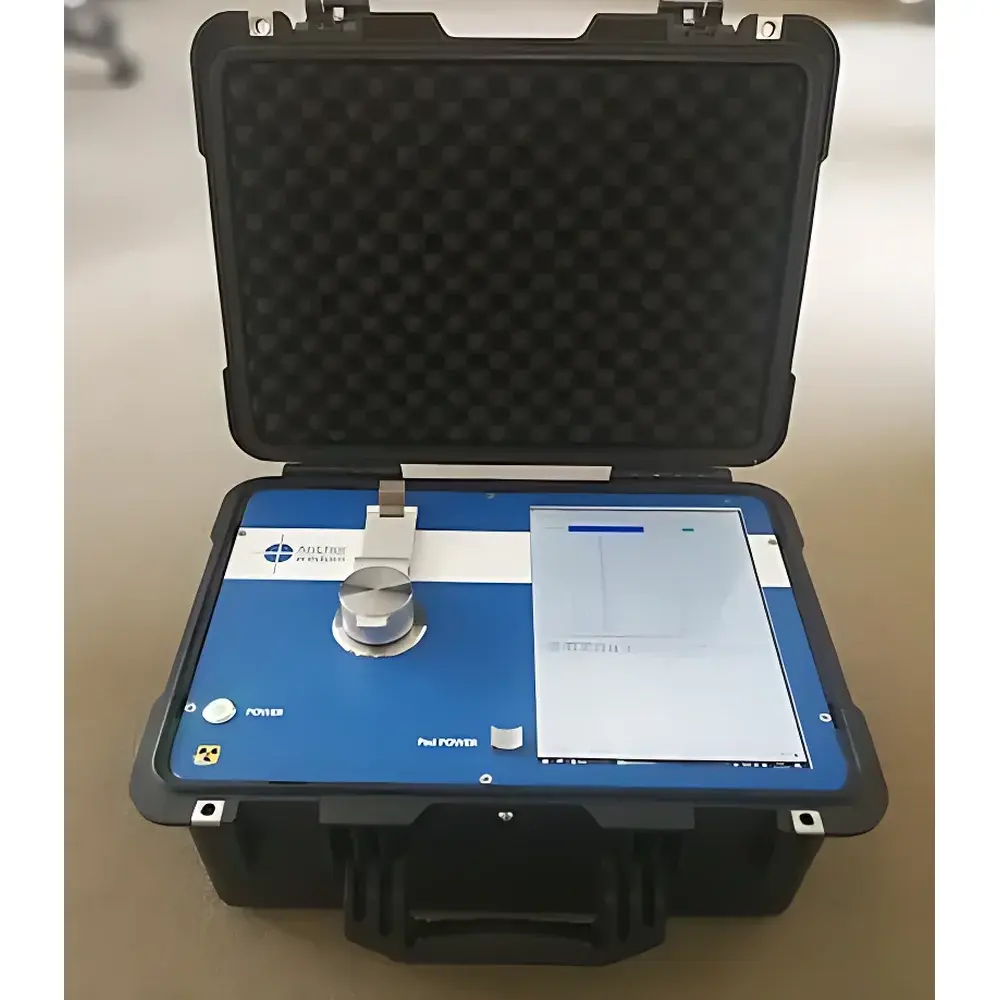
Anchor Wisdom MERAK-MINI Portable Single-Wavelength X-Ray Fluorescence Spectrometer
| Brand | Anchor Wisdom |
|---|---|
| Origin | Beijing, China |
| Model | MERAK-MINI |
| Detection Limit (S) | 0.5 ppm (300 s) |
| Detection Limit (Cl) | 0.3 ppm (300 s) |
| Quantification Range | 0.5 ppm – 5% |
| Analysis Time | 60–300 s |
| Repeatability | RSD ≤ 3% @ 10 ppm S, RSD ≤ 1.5% @ 1000 ppm S |
| Dimensions | 350 mm × 230 mm × 370 mm |
| Weight | 12.5 kg |
| Power Consumption | 80 W |
| Operating Temperature | 5–40 °C |
| Battery Life | >4 h |
| Compliance | ASTM D7039, ASTM D7536, ISO 20884, ISO 15597 |
Overview
The Anchor Wisdom MERAK-MINI is a field-deployable, single-wavelength dispersive X-ray fluorescence (WDXRF) spectrometer engineered for quantitative determination of sulfur (S) and chlorine (Cl) in liquid hydrocarbon fuels—specifically designed to meet regulatory enforcement requirements across fuel supply chains. Unlike energy-dispersive XRF (EDXRF) systems, the MERAK-MINI employs a fixed monochromator crystal and high-resolution Bragg diffraction geometry to isolate characteristic Kα radiation from S (2.308 keV) and Cl (2.622 keV), eliminating spectral overlap and matrix-induced interferences common in complex petroleum matrices. This wavelength-selective architecture delivers sub-part-per-trillion effective background suppression, enabling reliable detection at ≤0.5 ppm S with 300-second counting—a performance benchmark aligned with ASTM D7039 and ISO 20884 for on-site verification of ultra-low-sulfur diesel (ULSD), marine gas oil (MGO), and residual fuel oils.
Key Features
- True portable WDXRF platform: No vacuum pump, no purge gas, no sample digestion or dilution—analysis begins immediately after sample loading into disposable polypropylene cups.
- Patented optical locking mechanism: All critical X-ray optics—including monochromator, detector collimator, and primary beam path—are mechanically stabilized without moving parts, ensuring long-term alignment integrity under vibration and thermal cycling typical in mobile lab or roadside deployment.
- Integrated lithium-ion battery system: Supports ≥4 hours of continuous operation at full analytical throughput (120 s/analysis), with hot-swappable capability and USB-C charging interface.
- Optimized excitation geometry: Dual-target X-ray tube (Ag anode + Rh secondary target) paired with matched LiF(200) monochromator delivers peak-to-background ratios >2000:1 for S Kα, directly contributing to the certified 0.5 ppm LOD.
- Embedded real-time spectral diagnostics: On-board pulse processing monitors dead time, detector resolution drift, and tube output stability—automatically flagging conditions that may affect measurement validity per GLP audit trails.
Sample Compatibility & Compliance
The MERAK-MINI accepts neat liquid fuels—gasoline, diesel, marine distillates, and residual bunker fuels—without pre-treatment. Its sealed sample chamber accommodates standard 10 mL disposable cups (ISO 8217-compliant cup geometry), minimizing cross-contamination risk during high-frequency field screening. Method validation data confirm linearity (R² > 0.9998) across 0.5–5000 ppm S in ASTM D7039-matrix-matched reference oils. Instrument compliance extends to regulatory frameworks governing fuel quality enforcement: ASTM D7039 (sulfur in gasoline/diesel), ASTM D7536 (chlorine in middle distillates), ISO 20884 (marine fuel sulfur), and ISO 15597 (chlorine in petroleum products). Data acquisition firmware supports 21 CFR Part 11–compliant electronic signatures and audit-log generation for GMP-aligned inspection workflows.
Software & Data Management
The instrument runs Anchor Wisdom’s proprietary SpectraLink v3.2 firmware, featuring embedded calibration management, multi-point QC check routines, and automated drift correction using internal reference standards. All raw spectra, processed results, operator metadata, and environmental logs (temperature, humidity, battery voltage) are timestamped and stored in encrypted SQLite databases. Export options include CSV, PDF analytical reports (with embedded calibration certificates), and direct USB transfer to LIMS-compatible formats. Remote firmware updates and method library synchronization are supported via secure HTTPS channel—enabling centralized method version control across distributed enforcement teams.
Applications
- Roadside fuel quality surveillance: Real-time screening of tanker trucks and retail dispensers for non-compliant sulfur/chlorine levels per national fuel specifications (e.g., GB 252–2015, GB 17411–2015).
- Port-state control inspections: In-situ verification of marine fuel sulfur content prior to bunkering, supporting IMO MARPOL Annex VI enforcement and EU Sulphur Emission Control Area (SECA) compliance.
- Refinery gate monitoring: Rapid acceptance testing of finished batches against internal specs before pipeline or vessel loading.
- Research & development: Catalyst deactivation studies, hydrotreating efficiency assessment, and feedstock screening in petroleum refining laboratories.
- Environmental forensics: Correlation of fuel sulfur profiles with ambient SO₂ source apportionment models in port-city air quality monitoring networks.
FAQ
Does the MERAK-MINI require helium or vacuum for analysis?
No. It operates under ambient air conditions with no gas consumption or evacuation steps.
Can it analyze viscous residual fuels such as IFO 380?
Yes—provided samples are homogenized and loaded as stable liquids; optional heated sample holder accessory maintains viscosity below 300 cSt at 40 °C.
Is method validation documentation provided for regulatory submissions?
Yes. Factory-validated ASTM D7039 and ISO 20884 test reports, including precision, accuracy, LOD/LOQ, and ruggedness data, are supplied with each unit.
How is instrument calibration maintained during extended field use?
Built-in daily self-check protocol verifies monochromator alignment and detector gain stability; traceable calibration standards (NIST SRM 2723a, 2724a) are available for user-performed recalibration.
What cybersecurity protocols apply to data export and remote updates?
All firmware updates undergo SHA-256 signature verification; data exports are AES-256 encrypted; network communication uses TLS 1.2+ with certificate pinning.






