
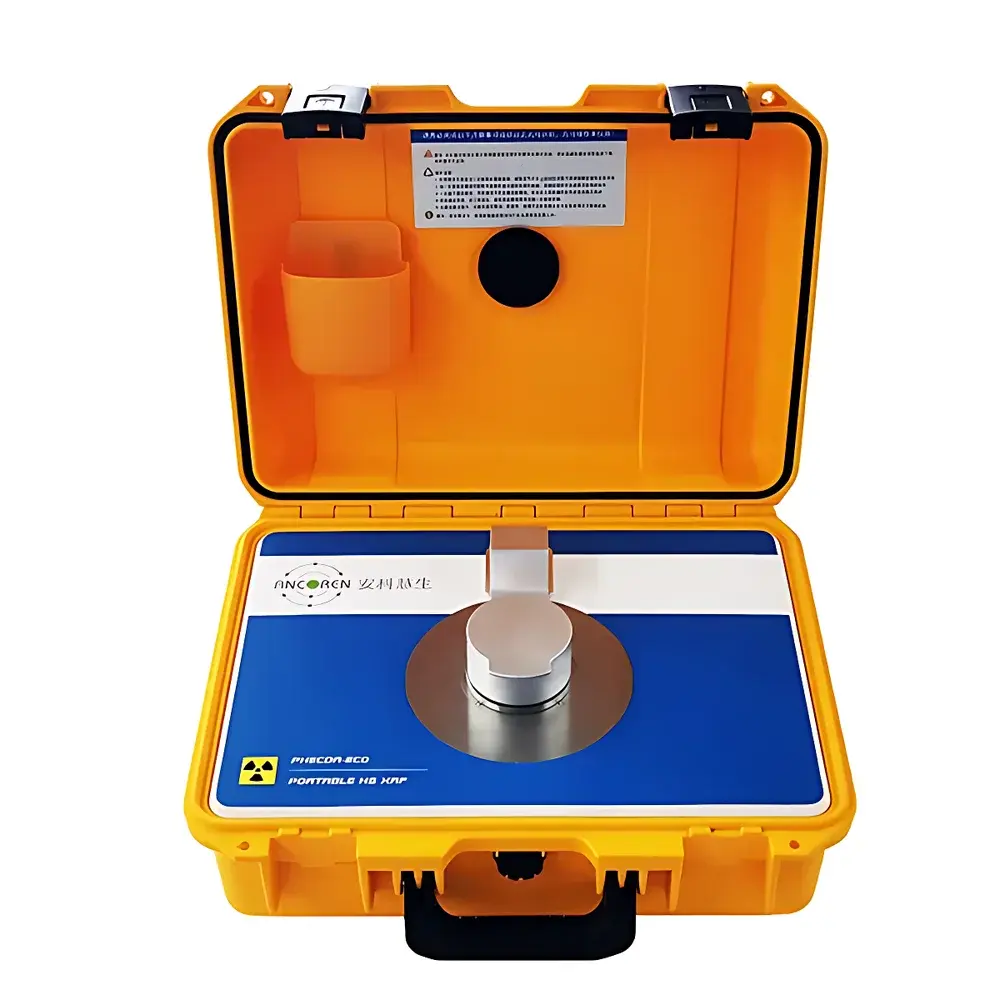
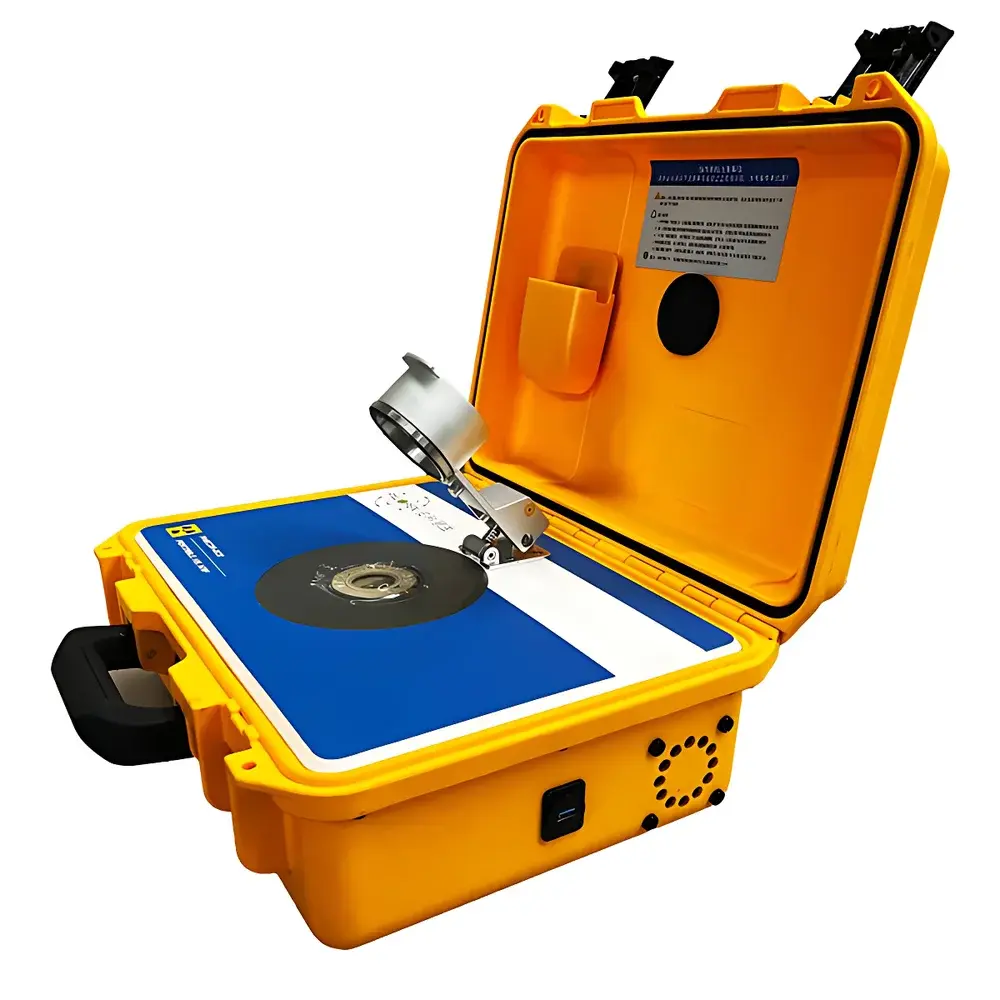
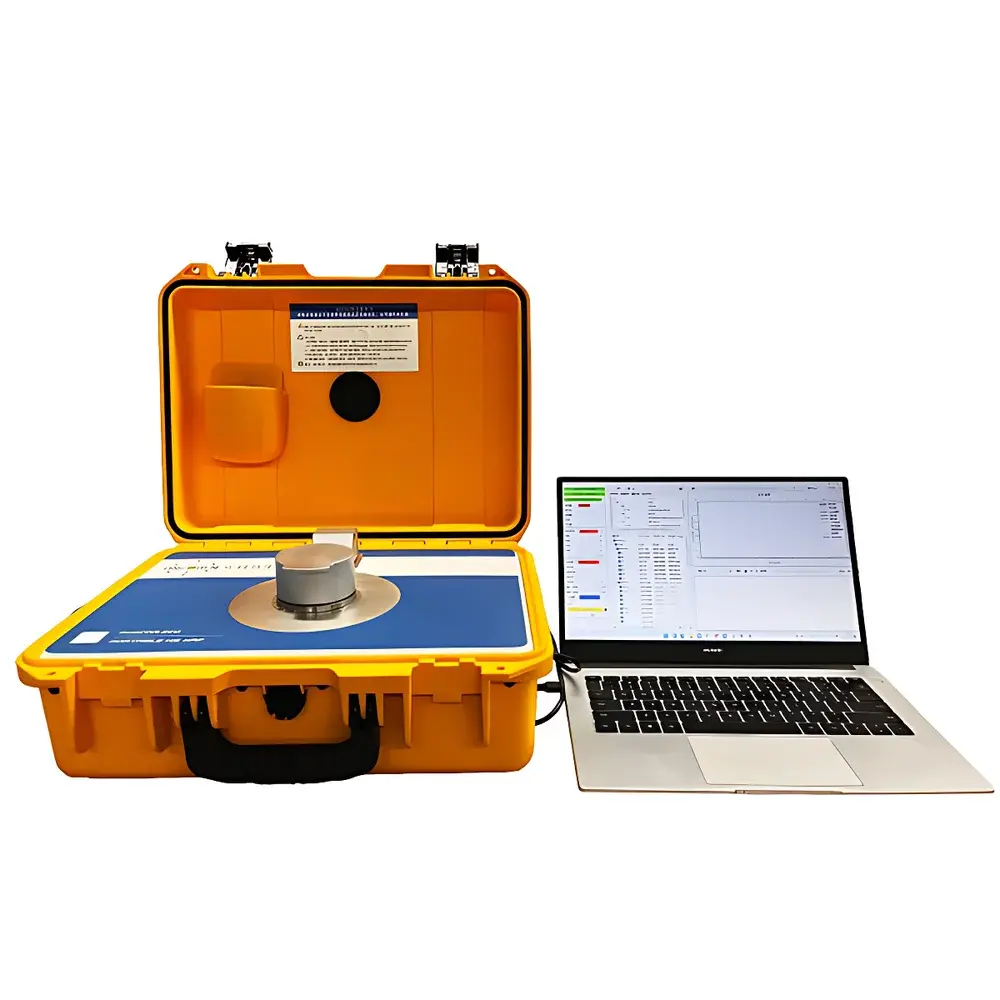
Anchor Wisdom PHECDA-ECO Portable High-Sensitivity Single-Wavelength XRF Spectrometer
| Brand | Anchor Wisdom |
|---|---|
| Origin | Beijing, China |
| Model | PHECDA-ECO |
| Element Range | Mg–U |
| LOD (soil matrix, 600 s) | Cd: 0.06 mg/kg, Pb: 0.4 mg/kg, Cr: 1.0 mg/kg |
| Repeatability (Cd, soil) | ≤0.3 mg/kg, RSD <15% |
| Sample Types | Solid, liquid, powder, viscous |
| Detector | High-performance Silicon Drift Detector (SDD) |
| Excitation | Monochromatic focused excitation via doubly curved crystal (DCC) |
| Method | Single-wavelength excitation + energy-dispersive detection |
| Software | Fast FP® quantitative engine with matrix-adaptive modeling |
| Optional Preconcentration | Heavy Metal Enrichment Tape (HMET®) for aqueous samples (LOD: 1–3 µg/L) |
| Weight | 7.5 kg |
| Dimensions | 370 × 290 × 190 mm |
| Operation | Ambient air, no vacuum/gas required |
| Sample Interface | Motorized sample rotation stage |
Overview
The Anchor Wisdom PHECDA-ECO is a field-deployable, high-sensitivity single-wavelength X-ray fluorescence (SW-XRF) spectrometer engineered for trace-level elemental quantification in complex, heterogeneous matrices. Unlike conventional energy-dispersive XRF (ED-XRF) systems that rely on polychromatic tube emission—introducing high Bremsstrahlung background and spectral interferences—the PHECDA-ECO employs a patented monochromatic focusing excitation architecture. A doubly curved crystal (DCC) optic selectively diffracts and focuses only the high-intensity Kα line from the X-ray tube onto a sub-millimeter spot on the sample surface. This eliminates continuum scatter at the source, yielding an exceptionally low-background spectrum dominated by characteristic fluorescent X-rays and elastically scattered primary radiation. Coupled with a high-resolution, large-area silicon drift detector (SDD), the system achieves signal-to-noise ratios suitable for regulatory-grade analysis of toxic elements—including Cd, Pb, As, Cr, and Hg—at concentrations approaching regulatory action levels in environmental, food, and industrial materials.
Key Features
- Monochromatic Focused Excitation: DCC-based optical filtering delivers intense, narrow-band excitation precisely tuned to maximize fluorescence yield while suppressing Compton and Rayleigh scatter—critical for low-Z element sensitivity and high spectral fidelity.
- High-Performance SDD Detection: Integrated large-active-area SDD with <125 eV Mn Kα resolution and >100 kcps throughput ensures efficient collection of low-energy X-rays (Mg–U) without spectral pile-up or resolution degradation under high count rates.
- Fast FP® Quantitative Engine: A physics-based fundamental parameters algorithm that models X-ray generation, absorption, enhancement, and detection across the full spectral domain. It requires minimal calibration—typically 3–5 certified reference materials—and automatically corrects for matrix effects, density variations, and inter-element absorption-enhancement without empirical fitting.
- Trace Cadmium Detection: Optimized excitation geometry and spectral deconvolution enable a validated limit of detection of 0.06 mg/kg Cd in soil (600 s acquisition), meeting stringent requirements of GB 15618–2018 and US EPA Method 6200.
- True Field Portability: Weighing 7.5 kg with integrated battery operation, ambient-air measurement capability, and no requirement for vacuum pumps, helium purging, or external gas supplies—enabling rapid deployment in remote sites, mobile labs, or incident response scenarios.
- Motorized Sample Rotation Stage: Reduces heterogeneity-induced uncertainty in particulate, powdered, or irregular solid samples by averaging signal across multiple orientations during acquisition.
Sample Compatibility & Compliance
The PHECDA-ECO supports direct analysis of solids (soils, sediments, ores, filters, tablets), liquids (water, oils, digests), powders, and semi-solids (sludges, pastes, biological tissues) with application-specific preparation protocols. For aqueous samples, the optional Heavy Metal Enrichment Tape (HMET®) enables preconcentration of analytes onto polymer membranes, achieving detection limits of 1–3 µg/L for Cd, Pb, and As—fully compliant with ISO 15587-2 and ASTM D5673 for field-deployable water screening. All analytical workflows align with GLP principles and support audit-ready data capture per FDA 21 CFR Part 11 when operated with networked data management. Method validation documentation supports compliance with Chinese national standards (e.g., GB 36600–2018, HJ 829–2017, GB 2762–2017), as well as international frameworks including ISO 18507 and IUPAC guidelines for XRF quantification.
Software & Data Management
The embedded Fast FP® software suite provides full spectral acquisition, real-time peak identification, qualitative screening, and quantitative analysis—all accessible via intuitive touchscreen interface. Key capabilities include: multi-sample batch processing; spectral overlay and difference analysis; customizable reporting templates (PDF/CSV); encrypted local storage with timestamped audit trails; and secure Wi-Fi or Ethernet upload to LIMS or cloud-based platforms. The software implements full traceability for all quantitative results—including raw counts, matrix correction factors, uncertainty propagation estimates, and calibration history—meeting requirements for ISO/IEC 17025 accreditation. Optional remote diagnostics and firmware updates ensure long-term method consistency and regulatory readiness.
Applications
The PHECDA-ECO delivers validated performance across regulated and research-driven domains: environmental monitoring (soil, sediment, PM2.5, wastewater); geochemical exploration (ore grade control, REE profiling); food safety (heavy metals in grains, seafood, herbs); pharmaceutical QC (USP <232>/<233> compliance for elemental impurities); cement and construction materials (clinker, fly ash, leachates); petrochemical QA (metal wear debris in lubricants, additive metals in fuels); and forensic environmental analysis (waste classification per GB 5085.3, toxicity characteristic leaching procedure support). Its ability to quantify >60 elements—from Mg to U—with minimal sample prep reduces turnaround time from days to minutes without compromising metrological rigor.
FAQ
Does the PHECDA-ECO require vacuum or helium purge for light-element analysis?
No. The monochromatic excitation design and high-efficiency SDD enable robust Mg–Al–Si quantification in ambient air, eliminating gas consumption and associated operational complexity.
Can Fast FP® perform truly standardless quantification?
It operates in “few-standard” mode: absolute quantification is achievable with 2–5 CRMs spanning major matrix types; full standardless mode is supported for screening with ±30% uncertainty, depending on sample homogeneity and spectral quality.
Is the system compliant with ISO/IEC 17025 for accredited testing laboratories?
Yes—when deployed with documented SOPs, traceable CRM usage, uncertainty budgeting tools, and audit-log-enabled software, it meets technical requirements for XRF-based elemental testing under ISO/IEC 17025:2017 Clause 7.2 and 7.8.
What sample preparation is needed for soil analysis?
Air-dried, homogenized soil is pressed into a 32-mm pellet or analyzed loose in a disposable cup; no acid digestion or fusion is required for routine screening or compliance verification per GB 15618–2018.
How is instrument performance verified in the field?
Built-in daily verification uses a proprietary check standard with certified Cd/Pb/Cr values; automated drift correction and energy calibration ensure spectral stability across temperature gradients and extended battery operation.






