
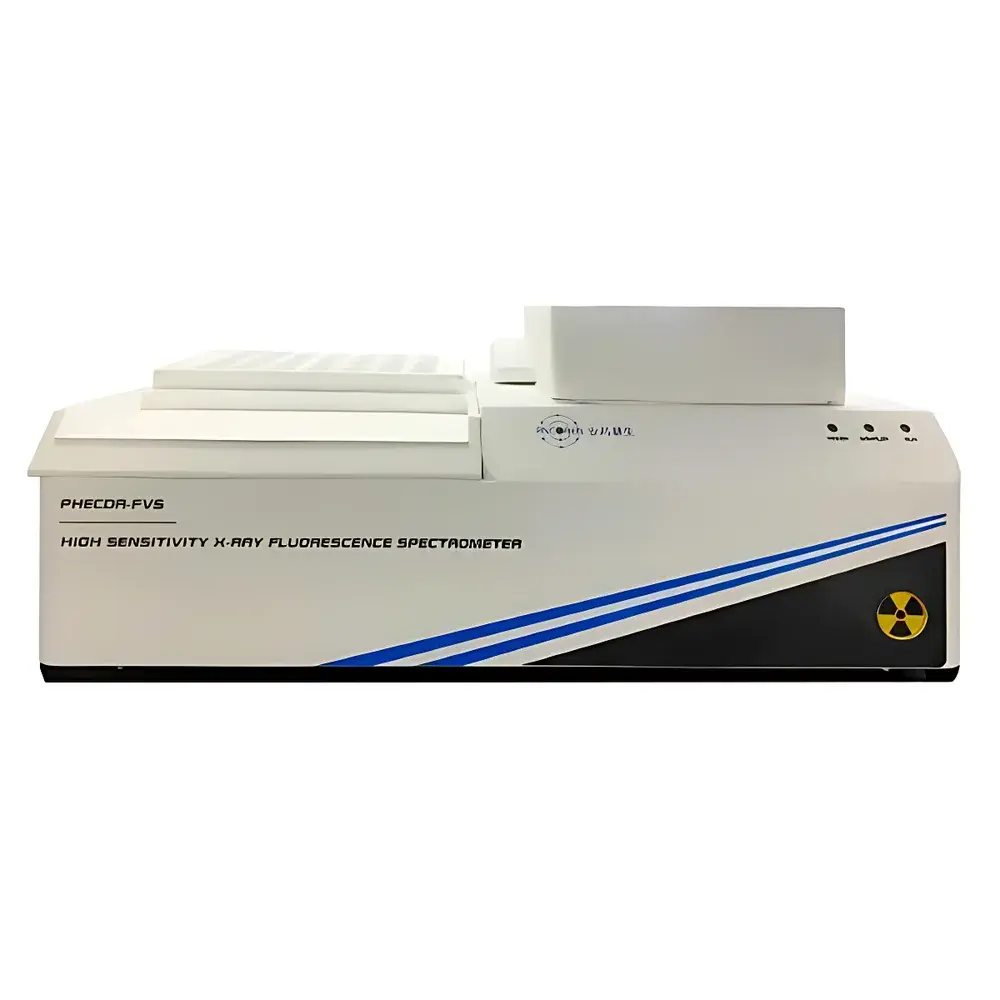
Anchor Wisdom PHECDA-FVS Micro-Zone High-Sensitivity Energy Dispersive X-Ray Fluorescence Spectrometer
| Brand | Anchor Wisdom |
|---|---|
| Origin | Beijing, China |
| Model | PHECDA-FVS |
| Instrument Type | Micro-Zone ED-XRF |
| Elemental Range | Mg to U |
| Detection Limits (Large Spot Mode, Light Matrix) | S: 10 mg/kg, Fe: 2 mg/kg, Pb: 1.0 mg/kg, Cd: 0.3 mg/kg |
| Minimum Focal Spot | φ200 µm |
| Spot Size Options | Software-Selectable Apertures (φ200–φ5000 µm, Rectangular Beam Optional) |
| X-Y Stage Range | ±10 mm |
| Step Resolution | 10 µm |
| Camera Magnification | 10×–100× |
| Sample Chamber Dimensions | 280 × 230 × 70 mm (L×W×H) |
Overview
The Anchor Wisdom PHECDA-FVS is a benchtop micro-zone energy dispersive X-ray fluorescence (ED-XRF) spectrometer engineered for high-sensitivity elemental mapping and quantitative analysis at spatial resolutions down to 200 µm. It operates on the principle of monochromatic focused excitation: a doubly curved crystal (DCC) monochromator selectively diffracts the characteristic Kα line from the X-ray tube anode—typically Rh or Mo—while suppressing bremsstrahlung continuum. This monochromatic, focused beam impinges on the sample surface with minimal background generation, resulting in dramatically improved peak-to-background ratios for trace element detection. Unlike conventional polychromatic ED-XRF systems, the PHECDA-FVS eliminates spectral interference from Compton and Rayleigh scattering of broadband radiation, enabling reliable quantification of low-Z elements (Mg–Al–Si) and heavy metals (Pb, Cd, As, Hg) in heterogeneous, light-matrix samples such as polymers, thin films, geological sections, and electronic components.
Key Features
- Monochromatic Focused Excitation: Dual-curved crystal optics deliver a collimated, energy-selected X-ray beam (<±5 eV bandwidth) focused to φ200 µm, minimizing matrix-induced background and enhancing signal-to-noise for trace-level detection.
- Software-Selectable Micro-Zone Probing: Four fixed-aperture collimators (φ200, φ500, φ1000, φ3000 µm) are motorized and switchable under software control; optional custom apertures up to φ5000 µm or rectangular beams support both high-resolution imaging and bulk composition screening.
- Precision Motorized X-Y Stage: Integrated high-resolution translation stage with ±10 mm travel range and 10 µm step resolution enables automated raster scanning for 2D elemental distribution mapping with sub-millimeter positional repeatability.
- Co-registered Optical Imaging: A coaxial, telecentric HD microscope (10×–100× magnification) provides real-time visual alignment; software synchronizes optical focus and X-ray beam centroid to ensure spatial fidelity between image and spectral acquisition points.
- Large-Volume Sample Chamber: Accommodates irregular or oversized specimens up to 280 × 230 × 70 mm without disassembly; integrated camera-based positioning supports rapid region-of-interest selection for non-planar or multi-layered samples.
Sample Compatibility & Compliance
The PHECDA-FVS is designed for direct solid analysis without digestion or pressing—ideal for quality control in electronics manufacturing (PCB solder paste, plating thickness), RoHS/WEEE compliance screening, geological thin-section characterization, forensic paint layer analysis, and catalyst heterogeneity assessment. Its monochromatic excitation architecture inherently reduces absorption-enhancement effects across diverse matrices (polymers, ceramics, alloys, soils), supporting robust inter-laboratory reproducibility. The system complies with ISO 17025 requirements for analytical instrument validation and supports GLP/GMP documentation workflows. All spectral acquisition and processing routines—including Holospec FP®—are traceable and auditable per FDA 21 CFR Part 11 when deployed with validated electronic signature modules.
Software & Data Management
Holospec FP® (Full Physics Fundamental Parameters) is the core quantification engine embedded in the PHECDA-FVS platform. Unlike empirical calibration methods, Holospec FP models the complete XRF process—from primary beam generation and photoelectric absorption cross-sections to fluorescence yield, secondary fluorescence, and detector efficiency—using fundamental physical constants and user-defined sample geometry. This physics-based approach minimizes reliance on matrix-matched standards: quantitative results for unknowns (including coating thickness, multi-layer composition, and bulk concentration) are derived from first principles, with only minor correction via 2–3 reference materials. Data files (.hfp, .xrf) retain full metadata (beam energy, spot size, live time, chamber pressure, stage coordinates), ensuring FAIR (Findable, Accessible, Interoperable, Reusable) data handling. Export formats include CSV, ASTM E1301-compliant XML, and image stacks compatible with ImageJ/Fiji for post-acquisition spectral clustering.
Applications
- Routine screening of restricted substances (Cd, Pb, Cr⁶⁺, Br, Hg) in consumer electronics per IEC 62321-5 and EN 62321-5.
- Quantitative depth profiling of electroplated layers (Ni/Cu/Sn, Au/Pd/Ni) and thermal barrier coatings (Y₂O₃-stabilized ZrO₂).
- Elemental mapping of inclusion phases in steel, slag particles in metallurgical residues, and mineral zoning in polished thin sections.
- Non-destructive analysis of historical pigments, ink stratigraphy in documents, and corrosion products on archaeological artifacts.
- Validation of additive manufacturing powder feedstock homogeneity (Ti-6Al-4V, Inconel 718) prior to sintering.
FAQ
What is the smallest detectable feature size for elemental mapping?
The PHECDA-FVS achieves a nominal spatial resolution of 200 µm using its smallest aperture; effective resolution may vary slightly depending on sample topography and detector geometry.
Can Holospec FP perform quantitative analysis without certified reference materials?
Yes—Holospec FP enables true “standardless” quantification for major and minor elements in known matrix types; however, optimal accuracy for trace elements (<100 mg/kg) benefits from 1–2 matrix-matched calibrants.
Is vacuum or helium purge required for light-element analysis?
For Mg, Al, and Si quantification, a He-purged chamber or vacuum mode is recommended to minimize air absorption; ambient-air operation remains viable for Na and heavier elements.
How is instrument performance verified over time?
Built-in drift correction uses internal reference peaks (e.g., Rh tube lines); daily QC checks can be automated via NIST-traceable check standards (e.g., NIST SRM 2711a, 610).
Does the system support regulatory reporting for ISO/IEC 17025 accredited labs?
Yes—the software logs all acquisition parameters, user actions, and calibration history with timestamped audit trails, fulfilling ISO/IEC 17025 clause 7.7 and ILAC-G8 requirements for measurement traceability.





