
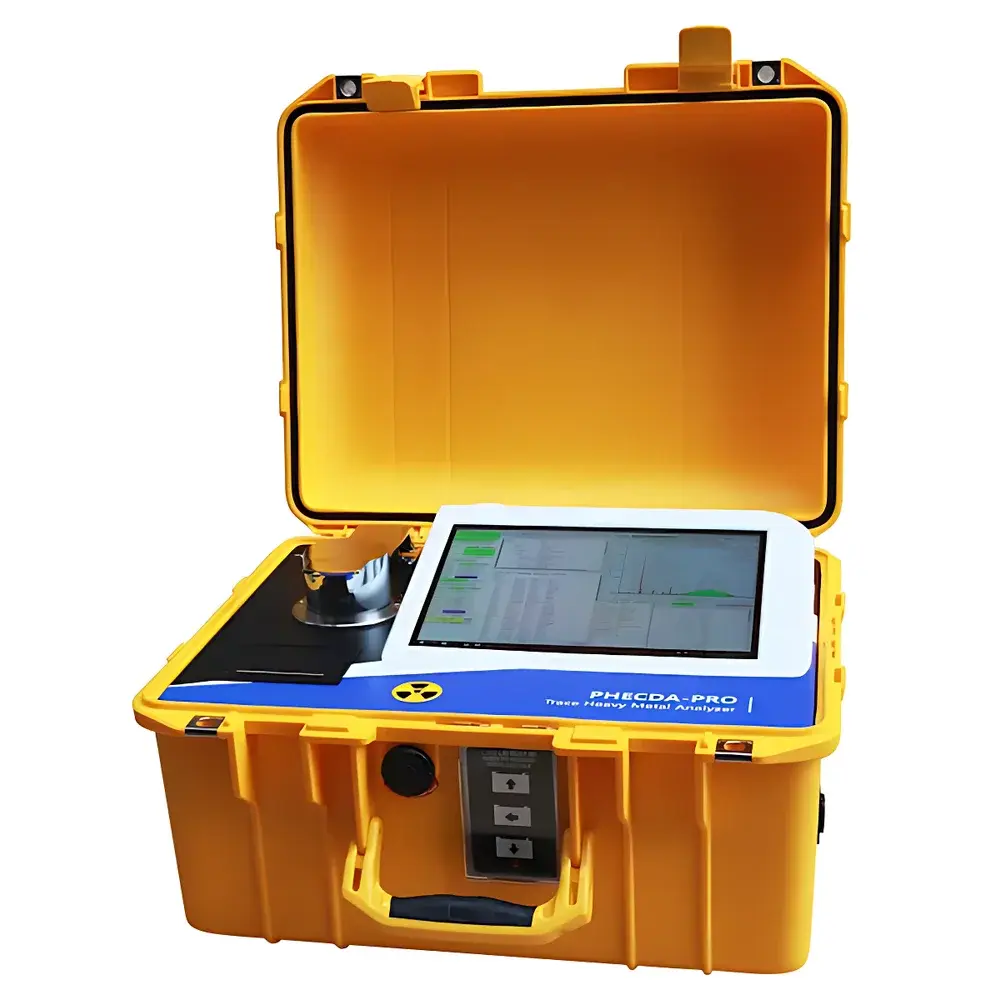
Anchor Wisdom PHECDA-PRO High-Sensitivity Single-Wavelength XRF Spectrometer
| Brand | Anchor Wisdom |
|---|---|
| Origin | Beijing, China |
| Model | PHECDA-PRO |
| Excitation Principle | Monochromatic Focused Excitation (using doubly curved crystal monochromator) |
| Detection Principle | Energy-Dispersive XRF (ED-XRF) |
| Elemental Range | Mg–U |
| LOD (soil matrix, 600 s) | Cd: 0.06 mg/kg, Pb: 0.4 mg/kg, Cr: 1.0 mg/kg |
| Precision (RSD) | Cd <15% at 0.3 mg/kg (soil, 600 s) |
| Sample Types | Solids, powders, slurries, liquids (with HMET® membrane enrichment), filters (e.g., PM₂.₅), and viscous matrices |
| Detector | High-performance silicon drift detector (SDD) with optimized active area and energy resolution |
| Software | Fast FP® quantitative engine (fundamental parameters-based, matrix-adaptive, standard-free or minimal-standard calibration) |
| Optional Enhancement | Heavy Metal Enrichment Technology (HMET®) for aqueous samples (LOD: 1–3 µg/L) |
| Portability | 8.7 kg |
Overview
The Anchor Wisdom PHECDA-PRO is a high-sensitivity, field-deployable single-wavelength X-ray fluorescence (SW-XRF) spectrometer engineered for trace-level elemental quantification in complex, heterogeneous matrices. Unlike conventional energy-dispersive XRF (ED-XRF) systems that rely on polychromatic tube emission — generating high background from Bremsstrahlung radiation — the PHECDA-PRO employs a patented monochromatic focused excitation architecture. A doubly curved crystal (DCC) monochromator selectively diffracts and focuses a single high-intensity characteristic line (e.g., Mo Kα at 17.4 keV or Ag Kα at 22.1 keV) onto a sub-millimeter spot on the sample surface. This eliminates continuum background at the detector, dramatically improving signal-to-background ratio (S/B) and enabling detection limits two to three orders of magnitude lower than standard ED-XRF for key toxic elements such as Cd, Pb, and As. The instrument operates on the physical principle of wavelength-selective excitation followed by energy-resolved fluorescence detection — a hybrid approach bridging the analytical rigor of WDXRF with the operational simplicity and speed of ED-XRF. It is designed for compliance-driven environmental, regulatory, and industrial laboratories requiring rapid, on-site or lab-based screening and quantification without sample digestion.
Key Features
- Monochromatic Focused Excitation: DCC monochromator delivers intense, narrow-band X-ray irradiation, minimizing Compton and Rayleigh scatter while maximizing element-specific fluorescence yield.
- High-Performance Silicon Drift Detector (SDD): Optimized for count rate, energy resolution (<125 eV at Mn Kα), and low-noise operation under ambient conditions — critical for resolving overlapping peaks in complex spectra (e.g., Cd Kα at 23.1 keV adjacent to Sn Kβ).
- Fast FP® Quantitative Engine: A physics-based fundamental parameters algorithm that models X-ray generation, absorption, enhancement, secondary fluorescence, and detector response. Eliminates reliance on extensive matrix-matched calibration standards; enables accurate quantification across diverse sample types using ≤5 reference materials.
- Trace Cadmium Detection: Optimized excitation/detection pathway achieves 0.06 mg/kg LOD for Cd in soil (600 s acquisition), meeting stringent regulatory thresholds defined in GB 15618–2018 and US EPA Method 6200.
- True Field Portability: Weighing only 8.7 kg, fully self-contained — no vacuum pump, helium purge, liquid nitrogen, or external power conditioning required. Operates on internal battery or universal AC input (100–240 V).
- HMET® Integration Ready: Compatible with Heavy Metal Enrichment Technology membrane kits for pre-concentration of aqueous samples, extending detection capability to 1–3 µg/L for Pb, Cd, Cu, and Ni in water matrices — aligned with ISO 8288 and ASTM D3559.
Sample Compatibility & Compliance
The PHECDA-PRO accommodates solids (soils, sediments, ores, cement, pharmaceuticals), pressed powders, filter media (PM₂.₅, air sampling filters), liquids (via HMET® membranes), and semi-solids (sludges, food homogenates). No acid digestion or fusion is required for routine screening; minimal preparation (drying, grinding, pelletizing) suffices for most solid applications. Its performance supports compliance with multiple international and national regulatory frameworks: GB 15618–2018 and GB 36600–2018 (China soil risk screening); HJ 829–2017 (PM₂.₅ elemental analysis); GB 2762–2017 (food contaminants); Chinese Pharmacopoeia (herbal medicine heavy metals); and ASTM D5630 (plastics ash content), D6443 (petroleum products). Data integrity meets GLP/GMP expectations through audit-trail-enabled Fast FP software, with optional 21 CFR Part 11 compliance modules available for regulated environments.
Software & Data Management
Fast FP® software provides full spectral acquisition, visualization, peak deconvolution, and quantitative reporting in a single integrated interface. It supports method development via empirical or physics-based calibration, batch processing of multi-sample sequences, spectral library matching, and customizable report generation (PDF/CSV/XLSX). All quantitative results include uncertainty estimation based on counting statistics and matrix correction residuals. Data are stored locally with timestamped metadata (operator ID, GPS coordinates, environmental conditions) and can be exported via Ethernet, Wi-Fi, or USB. Remote diagnostics and firmware updates are supported. The software architecture allows creation of application-specific modules — e.g., “Soil Screening Mode”, “Water HMET Workflow”, or “Pharma Heavy Metals Template” — ensuring consistent, SOP-driven operation across user groups.
Applications
- Environmental Monitoring: Rapid field screening of soils, sediments, and landfill leachates for As, Cd, Cr, Cu, Ni, Pb, and Zn; quantification compliant with EU Soil Framework Directive and China’s Soil Pollution Prevention Action Plan.
- Air Quality Analysis: Direct analysis of PM₂.₅ and TSP filters for 30+ elements; source apportionment via elemental ratios (e.g., V/Ni for oil combustion, Fe/Mn for crustal dust).
- Water & Wastewater: With HMET®, quantifies regulated metals in drinking water, effluents, and groundwater at µg/L levels — supporting ISO 11885 and EPA 200.8 workflows.
- Industrial QA/QC: Cement raw meal and clinker analysis (Na, Mg, Al, Si, S, Cl, K, Ca, Ti, Mn, Fe); catalyst monitoring in petrochemical streams; wear metal analysis in lubricants (Fe, Cr, Al, Cu, Pb).
- Food Safety & Forensics: Screening of rice, seafood, spices, and herbal products for Cd, Pb, As, and Hg; admissible in customs border control and judicial evidence collection per GB/T 5009.12–2017.
- Geoscience & Mining: In-field grade control of ores (Fe, Cu, Zn, Pb, REEs); identification of pathfinder elements in exploration geochemistry.
FAQ
Does the PHECDA-PRO require vacuum or helium purging during operation?
No. It operates under ambient atmospheric conditions using an ultra-thin polymer X-ray window and optimized SDD thermal management.
Can it quantify light elements such as Na, Mg, or Al?
Yes — down to magnesium (Mg, Z=12) in favorable matrices; sensitivity for Na (Z=11) is limited but achievable in low-absorbing substrates with extended counting time.
Is Fast FP® validated against certified reference materials (CRMs)?
Yes — extensively validated using NIST SRM 2710a (Montana Soil), GBW07405 (Chinese Soil CRM), and ERM-CC141 (Sewage Sludge), demonstrating mean recovery of 92–105% across 25 elements.
How does it handle overlapping peaks, such as Pb L-lines interfering with As K-lines?
Fast FP® incorporates iterative peak fitting with physically constrained line shapes and inter-element absorption corrections, enabling robust deconvolution even in high-background or multi-element overlap scenarios.
What maintenance is required for long-term field deployment?
Annual SDD energy calibration and DCC monochromator alignment verification are recommended; no consumables or scheduled replacement parts are required within the first 5 years of typical use.




