
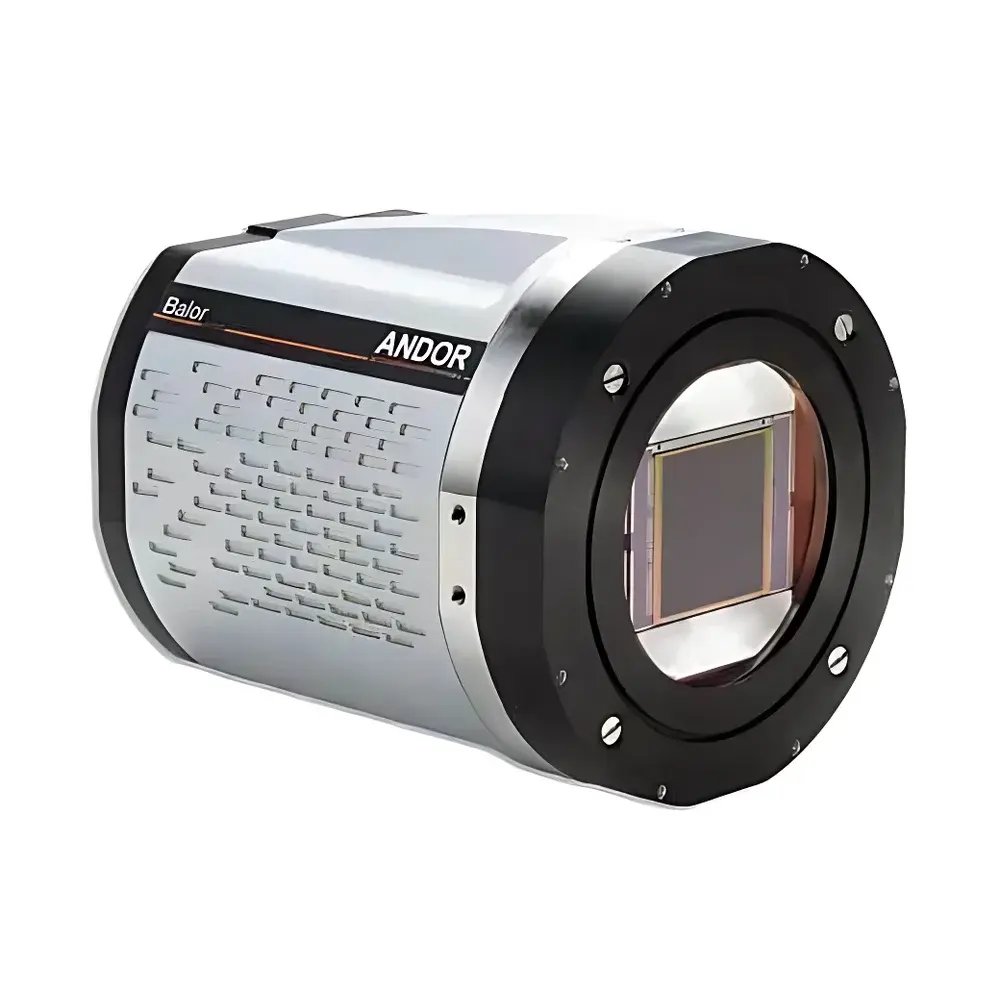
Andor Balor 17F-12 Ultra-Large-Field sCMOS Camera
| Brand | Andor |
|---|---|
| Origin | USA |
| Model | Balor 17F-12 |
| Effective Pixels | 16.9 MP |
| Pixel Size | 12 µm |
| Diagonal Sensor Size | 70 mm |
| Max Frame Rate | 54 fps |
| Readout Time | 18.5 ms |
| Read Noise | < 3 e⁻ |
| Full Well Capacity | High (12 µm pixel) |
| Cooling | Vacuum-Sealed Thermoelectric |
Overview
The Andor Balor 17F-12 is a scientific-grade ultra-large-field sCMOS camera engineered for high-fidelity, quantitative imaging across demanding time-resolved and wide-field applications. Built around a proprietary 70 mm diagonal monolithic sCMOS sensor—the largest commercially available sCMOS detector—it delivers unprecedented field coverage without tiling or stitching artifacts. Unlike legacy CCD architectures constrained by serial readout bottlenecks, the Balor leverages parallel pixel readout architecture to achieve full-frame acquisition at 54 frames per second while maintaining sub-3-electron read noise and >99.7% photometric linearity. Its operation is grounded in solid-state photon detection physics, where incident photons generate electron-hole pairs within a silicon photodiode array; signal integrity is preserved through vacuum-sealed thermal management and on-chip correlated double sampling (CDS). This enables reliable measurement of both transient phenomena (e.g., plasma dynamics, solar flares) and low-signal astrometric targets (e.g., near-Earth objects, exoplanet transits) across exposure durations spanning milliseconds to minutes.
Key Features
- 70 mm diagonal monolithic sCMOS sensor: Eliminates field distortion, vignetting, and registration errors inherent in mosaic-based systems—critical for precision photometry and centroid tracking.
- 16.9 megapixel resolution with 12 µm pixels: Balances spatial sampling and full-well capacity (≥ 80,000 e⁻ typical), supporting high-dynamic-range quantification from faint background-limited signals to bright saturated features.
- 18.5 ms full-frame readout at 54 fps: Enables Nyquist-sampled temporal resolution for solar limb dynamics, laser-driven plasma expansion, and atmospheric scintillation studies.
- Vacuum-sealed sensor enclosure: Provides long-term hermeticity and stable deep-cooling performance (down to –45 °C) without desiccant replacement or periodic re-evacuation—distinct from O-ring–sealed or back-filled alternatives.
- Free-shutter architecture: Removes mechanical shutter-induced vibration and timing jitter, essential for synchronized pump-probe experiments and lucky imaging pipelines.
- On-chip multi-gain amplification: Dynamically optimizes signal-to-noise ratio across intensity ranges, preserving linearity and enabling single-exposure HDR capture compliant with ISO 15739 and ASTM E1548 standards.
Sample Compatibility & Compliance
The Balor 17F-12 is compatible with standard C-mount, F-mount, and custom optical interfaces via optional adapters, supporting integration into vacuum chambers, telescope focal planes (including Nasmyth and Cassegrain configurations), and laser plasma diagnostics setups. Its vacuum housing meets MIL-STD-810G environmental robustness criteria for thermal shock and altitude simulation. Data integrity complies with GLP/GMP-aligned workflows: metadata embedding (EXIF/FITS), hardware-timestamped frame headers, and optional FDA 21 CFR Part 11–compliant audit trail modules via Andor’s Solis software suite. Calibration certificates traceable to NIST standards are provided for quantum efficiency, linearity, and dark current characterization.
Software & Data Management
Controlled via Andor’s Solis v5.x platform (Windows/Linux), the Balor supports real-time streaming to RAM or SSD at sustained 2.1 GB/s throughput using PCIe 3.0 x8 interface. Solis provides programmable ROI binning, hardware-triggered burst acquisition, and synchronized multi-camera coordination. Raw data export adheres to FITS 4.0 and HDF5 1.12 specifications, ensuring interoperability with Python (Astropy, NumPy), MATLAB, and IRAF-based reduction pipelines. Optional SDKs (C/C++, .NET, Python) enable integration into custom LabVIEW, EPICS, or TANGO control systems—commonly deployed in synchrotron beamlines and adaptive optics testbeds.
Applications
- Orbital debris tracking and cataloging using ground-based optical telescopes (e.g., ESA’s SST network)
- Solar physics: High-cadence magnetogram and chromospheric imaging (Hα, Ca II K) at arcsecond resolution
- Laser-plasma interaction diagnostics: Capturing relativistic electron beam emission and ion acceleration fronts
- Atmospheric lidar and airglow tomography requiring wide-field photon budget optimization
- Speckle/lucky imaging with adaptive optics systems (e.g., Gemini MCAO, Keck NIRC2) for diffraction-limited planetary science
- Exoplanet transit photometry with simultaneous reference star monitoring across large FOV
- Asteroid rotation period analysis and shape modeling via lightcurve inversion
FAQ
What cooling method does the Balor 17F-12 use, and what is its operating temperature range?
It employs a two-stage thermoelectric cooler integrated into a permanently vacuum-sealed housing, achieving stable sensor temperatures down to –45 °C with ±0.1 °C regulation.
Is the Balor compatible with third-party adaptive optics systems?
Yes—its trigger-in/trigger-out I/O, low-latency frame sync, and free-shutter design support deterministic synchronization with deformable mirrors and wavefront sensors from ALPAO, Boston Micromachines, and Xinetics.
Does the camera support hardware binning or region-of-interest readout?
No hardware binning is implemented; however, flexible software-defined ROI readout is supported—including non-contiguous regions—for optimized bandwidth usage in high-speed tracking applications.
How is radiometric calibration maintained over time?
Each unit ships with factory-acquired flat-field, dark-frame, and gain maps. Users may perform routine recalibration using Andor’s certified LED illumination sources traceable to NIST SRM 2032.
Can the Balor be operated in vacuum environments external to the camera body?
The sensor chamber is internally vacuum-sealed and not designed for external vacuum exposure; however, the front flange conforms to CF-63 or DN100 ISO-K standards for integration into evacuated optical benches.



