
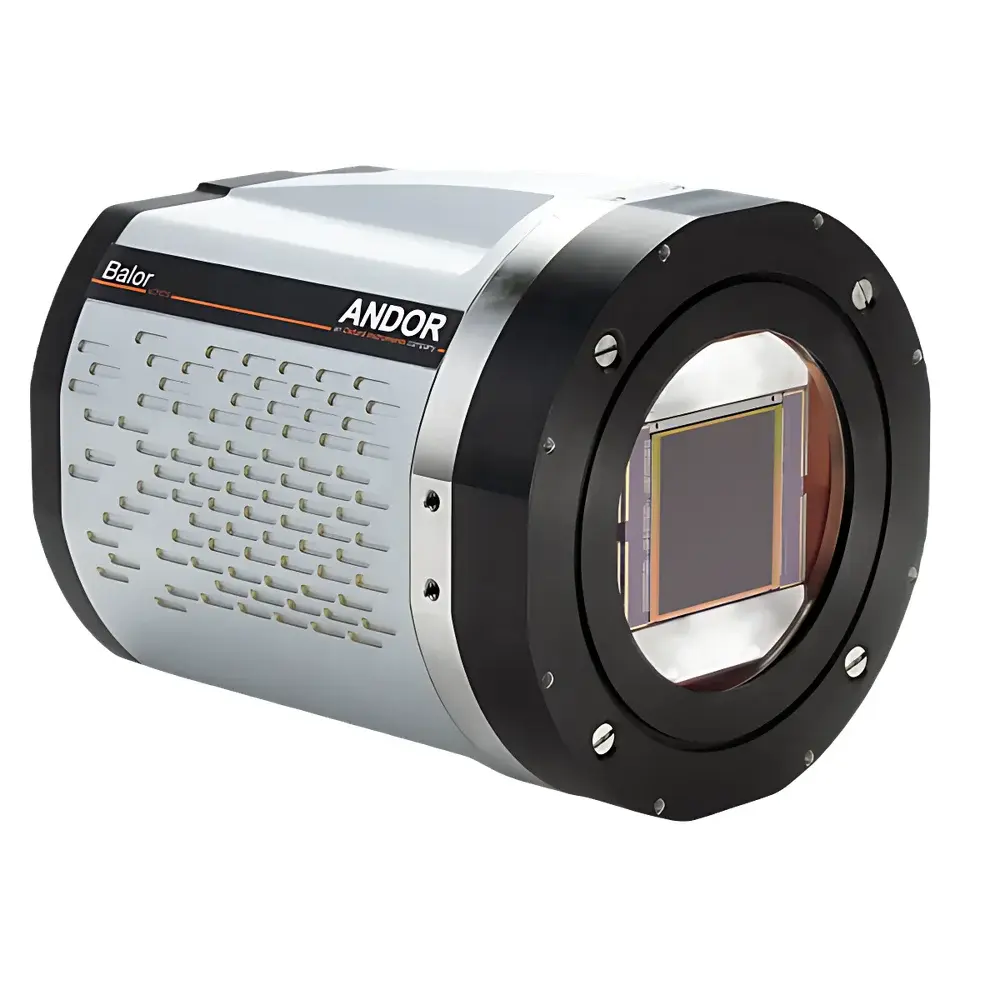
Andor Balor sCMOS Scientific Camera
| Brand | Andor |
|---|---|
| Origin | United Kingdom |
| Model | Balor sCMOS |
| Pixel Size | 12 µm × 12 µm |
| Sensor Format | Large-Area Monolithic sCMOS |
| Readout Speed | Up to 30 fps at full 16.8 MP resolution |
| Read Noise | <1.5 e⁻ RMS (typ.) |
| Dynamic Range | >91 dB (typ.) |
| Cooling | Thermoelectric to –45 °C (stabilized) |
| Interface | 10 GbE |
| Compliance | CE, RoHS, FDA 21 CFR Part 11 ready (via Solis software audit trail) |
Overview
The Andor Balor sCMOS Scientific Camera is a high-performance, large-format monolithic sCMOS imaging platform engineered for demanding quantitative low-light applications in astronomy, physical sciences, and life science microscopy. Unlike legacy CCD architectures—whose readout limitations constrain temporal resolution—Balor leverages a true 16.8 megapixel (4128 × 4128) monolithic sCMOS sensor with parallel column-level analog-to-digital conversion. This architecture enables sub-second full-frame readout while maintaining single-electron read noise performance and deep-cooled thermal stability. Its core measurement principle relies on photon-limited detection under controlled quantum efficiency (peak QE > 95% at 600 nm), making it ideal for photometric time-series analysis, transient event capture, and wide-field adaptive optics wavefront sensing where both spatial fidelity and temporal fidelity are simultaneously critical.
Key Features
- Monolithic 16.8 MP sCMOS sensor with zero stitching artifacts and uniform pixel response across the entire field
- Thermoelectric cooling to –45 °C with ±0.05 °C stability, enabling dark current suppression to <0.001 e⁻/pix/sec
- Ultra-low read noise (<1.5 e⁻ RMS typical) achieved via correlated double sampling and optimized on-chip circuitry
- High dynamic range (>91 dB) supported by 16-bit digitization and dual-gain architecture
- 10 Gigabit Ethernet interface ensuring deterministic, jitter-free data streaming at sustained 30 fps (full frame)
- Hardware-based region-of-interest (ROI) readout, binning, and frame buffering for application-specific optimization
- Integrated mechanical shutter and TTL-compatible trigger I/O for precise synchronization with lasers, shutters, or external timing systems
Sample Compatibility & Compliance
The Balor sCMOS supports standard C-mount and F-mount optical interfaces, enabling seamless integration with telescopes, microscopes, and custom optical benches. Its vacuum-tight, hermetically sealed sensor chamber prevents condensation during extended cryogenic operation. From a regulatory standpoint, the system complies with CE marking requirements for electromagnetic compatibility (EMC Directive 2014/30/EU) and low-voltage safety (LVD Directive 2014/35/EU). When operated with Andor’s Solis software suite configured for audit trail logging, electronic signatures, and user access control, the platform meets foundational criteria for GLP and GMP environments per FDA 21 CFR Part 11 Annex 11 expectations. It is routinely deployed in ISO/IEC 17025-accredited laboratories performing photometric calibration and astronomical instrumentation validation.
Software & Data Management
Andor Solis v5.x provides native support for Balor, offering real-time image acquisition, non-uniformity correction (flat-field, dark-frame, gain-map), and pixel defect mapping. The software includes built-in photometry tools (aperture photometry, centroid tracking, differential imaging) and exports fully calibrated FITS, TIFF, and HDF5 files with embedded metadata (exposure time, temperature, gain, timestamp, GPS-synced UTC). For high-throughput workflows, the Andor SDK (C/C++, Python, MATLAB) enables direct memory-mapped frame access and integration into custom acquisition pipelines. All raw and processed datasets retain traceable provenance—including hardware configuration state and environmental logs—supporting reproducibility requirements in peer-reviewed publications and regulatory submissions.
Applications
- Astronomical time-domain surveys: monitoring variable stars, exoplanet transits, and fast radio burst afterglows over millisecond-to-hour baselines
- Adaptive optics wavefront sensing: real-time Shack-Hartmann spot detection across wide fields with high SNR
- Quantitative fluorescence lifetime imaging (FLIM) when synchronized with pulsed laser sources
- Plasma diagnostics and laser-induced breakdown spectroscopy (LIBS) requiring high dynamic range and shot-to-shot intensity stability
- High-resolution digital holography and quantitative phase imaging requiring pixel-level linearity and low fixed-pattern noise
- Particle image velocimetry (PIV) in large-scale fluid dynamics rigs where field-of-view and frame rate must scale concurrently
FAQ
What is the maximum sustained frame rate at full resolution?
30 frames per second at 4128 × 4128 pixels with 16-bit output and full cooling enabled.
Does Balor support hardware triggering and external synchronization?
Yes—it features two opto-isolated TTL inputs (exposure start, frame trigger) and one TTL output (exposure active), compatible with standard timing controllers and lock-in amplifiers.
Can Balor be used in vacuum or pressure-controlled environments?
No—the camera is rated for ambient atmospheric operation only; its thermoelectric cooler requires convective heat dissipation via integrated heatsink and fan.
Is the sensor sensitive to near-infrared wavelengths?
The back-illuminated device delivers >70% QE at 900 nm and remains usable up to ~1100 nm, though optimal performance is achieved between 400–850 nm.
How is calibration data managed and validated?
Factory-measured flat-field, dark-current, and gain maps are stored in non-volatile memory and applied automatically; users may acquire and store custom calibration sets with versioned metadata.




