
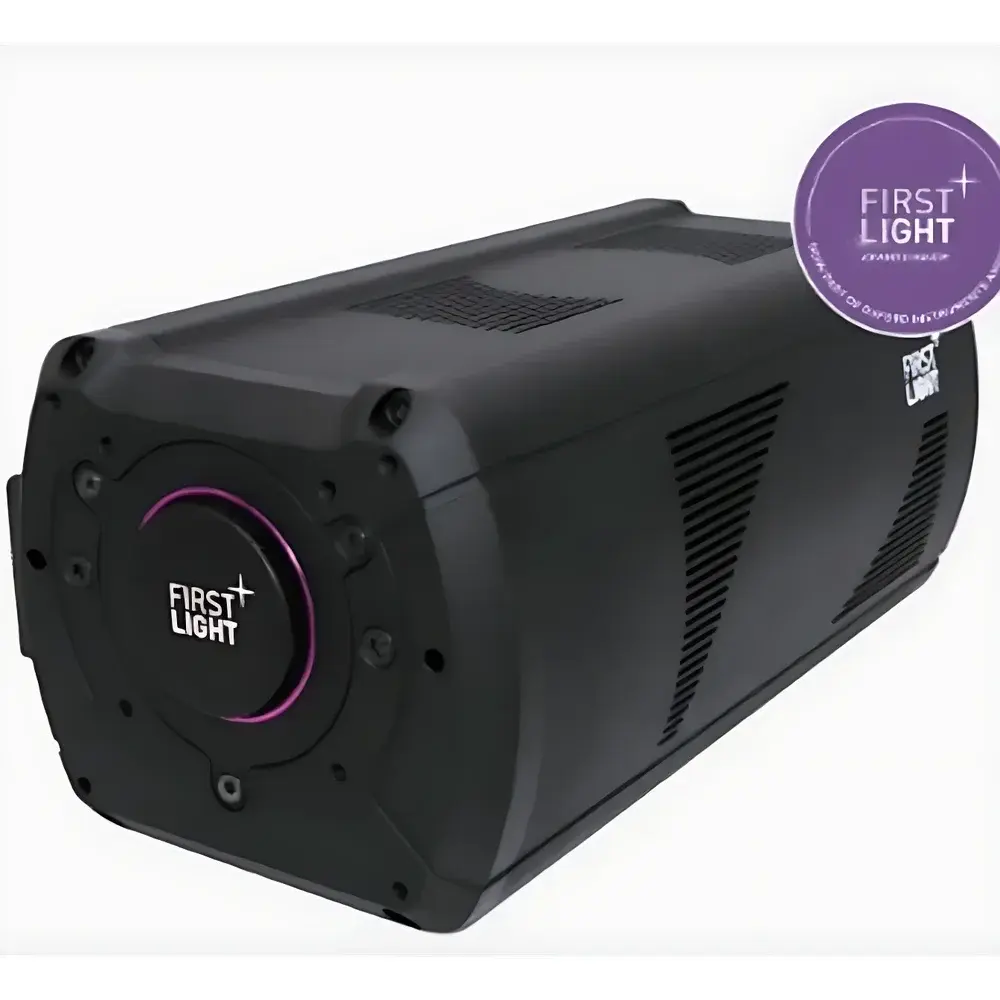
Andor CB2 24B Scientific-grade Back-Illuminated sCMOS Camera with Global Shutter
| Brand | Andor Technology (Oxford Instruments) |
|---|---|
| Origin | United Kingdom |
| Model | CB2 24B |
| Sensor Resolution | 5328 × 4608 pixels |
| Effective Pixels | 24.5 MP |
| Pixel Size | 2.74 µm (native), 5.48 µm (on-chip 2×2 binning) |
| Read Noise | 1.3 e⁻ RMS |
| Dark Current | 0.0015 e⁻/pixel/sec at −20°C |
| Frame Rates | 106 fps (8-bit), 74 fps (12-bit), 37 fps (16-bit HDR) |
| Shutter Type | Global Shutter |
| Cooling | Thermoelectric (TE) to −20°C |
| Interface | CoaXPress 2.0 or 10 GigE |
| Compliance | GigE Vision v2.0, GenICam v3.x |
| Lens Mount | C-mount (standard), TFL-mount (optional) |
| Operating Ambient Temperature Range | Certified down to −40°C |
Overview
The Andor CB2 24B is a high-performance scientific imaging platform engineered for demanding low-light, high-speed, and long-exposure applications across life sciences, astronomy, quantum optics, and industrial metrology. Built around a back-illuminated sCMOS sensor with true global shutter architecture, the CB2 24B eliminates motion-induced temporal distortion inherent in rolling-shutter designs—enabling precise snapshot capture of fast dynamic events such as ion dynamics, adaptive optics wavefront correction, or cellular motility. Its 24.5 megapixel sensor delivers exceptional spatial resolution (5328 × 4608 pixels) with native 2.74 µm pixels, supporting wide-field imaging at low magnifications while maintaining Nyquist sampling under high-NA objectives. Critically, the CB2 24B bridges a longstanding performance gap between traditional deep-cooled CCDs and modern sCMOS cameras by achieving ultra-low dark current (0.0015 e⁻/pixel/sec at −20°C)—approximately two to three orders of magnitude lower than conventional sCMOS sensors. This enables exposure durations from seconds to minutes without significant thermal noise accumulation, making it suitable for bioluminescence imaging, narrowband astrophotography, and single-molecule detection where signal integration time is paramount.
Key Features
- Back-illuminated sCMOS sensor with >95% peak quantum efficiency across visible spectrum (400–700 nm)
- True hardware global shutter—no image skew, no time-dependent pixel readout delay
- On-chip 2×2 pixel binning (2.74 µm → 5.48 µm) without doubling read noise—preserves SNR scalability
- Thermoelectric cooling to −20°C (liquid-cooling option available); certified operation at ambient temperatures down to −40°C
- Multiple bit-depth modes: 8-bit (106 fps), 12-bit (74 fps), 16-bit HDR (37 fps), and flexible ROI-based frame rate scaling
- Configurable analog gain (up to 24 dB) and digital gain (up to 48 dB) for dynamic range optimization
- CoaXPress 2.0 or 10 GigE interface with deterministic latency, full GenICam v3.x and GigE Vision v2.0 compliance
- Compact form factor (177.5 × 93 × 77.5 mm; 1.1 kg) with C-mount standard and optional TFL-mount for large-aperture optics
Sample Compatibility & Compliance
The CB2 24B is designed for integration into regulated and research-grade optical systems requiring traceable performance and interoperability. It complies fully with GigE Vision 2.0 and GenICam 3.x standards, ensuring seamless compatibility with third-party acquisition software (e.g., Micro-Manager, NIS-Elements, MATLAB Image Acquisition Toolbox) and OEM machine vision platforms. For laboratories operating under GLP or GMP frameworks, the camera supports audit-trail-capable metadata embedding—including timestamping, sensor temperature logging, exposure parameters, and firmware version—aligned with FDA 21 CFR Part 11 data integrity expectations. Its robust thermal management system and extended cold-temperature certification (−40°C ambient) meet IEC 60068-2 environmental stress testing requirements, validating suitability for field-deployable astronomical observatories, high-altitude balloon payloads, and cryogenic microscopy setups. The sensor’s linear response and calibrated gain structure support quantitative intensity measurements compliant with ISO 15739:2013 (noise and dynamic range characterization) and ASTM E1548 (digital imaging performance evaluation).
Software & Data Management
Andor provides the Solis® Software Suite—a modular, cross-platform application enabling full hardware control, real-time visualization, and advanced post-processing. Solis supports multi-camera synchronization, hardware-triggered acquisition sequences, and programmable ROI definitions via intuitive GUI or Python API (via Andor SDK). All acquired images embed EXIF-compatible metadata, including sensor temperature, exposure time, gain settings, and binning mode—facilitating reproducible experiment documentation. Raw data export is supported in TIFF, HDF5, and FITS formats, with optional lossless compression. For enterprise environments, Solis integrates with Andor’s Enterprise Data Manager (EDM), offering centralized configuration management, user-access controls, and automated backup to network-attached storage (NAS) or cloud repositories. Audit logs record all acquisition parameter changes, aligning with ALCOA+ principles for data integrity in regulated research.
Applications
- Astronomy & Space Science: Wide-field survey imaging, lucky imaging, speckle interferometry, and photometric monitoring—leveraging low dark current and high QE for faint-object detection.
- Live-Cell & Super-Resolution Microscopy: High-fidelity tracking of subcellular structures, calcium flux imaging, and structured illumination microscopy (SIM) where global shutter eliminates motion artifacts.
- Quantum Optics & Cold Atom Physics: Single-shot imaging of Bose-Einstein condensates, ion trap dynamics, and quantum gas thermometry requiring both speed and photon-starved sensitivity.
- Industrial Inspection & Metrology: Real-time defect detection on moving substrates, laser-induced breakdown spectroscopy (LIBS), and high-magnification PCB inspection with minimal geometric distortion.
- Bioluminescence & Chemiluminescence Imaging: Long-exposure quantification of luciferase activity in vivo or in vitro—enabled by sub-0.002 e⁻/pixel/sec dark current at stabilized −20°C.
FAQ
What distinguishes the CB2 24B from conventional sCMOS cameras in long-exposure applications?
Its ultra-low dark current (0.0015 e⁻/pixel/sec at −20°C) and deep thermoelectric cooling enable exposures up to several minutes without thermal noise dominance—making it functionally comparable to slow-scan CCDs while retaining sCMOS speed and resolution.
Does the on-chip 2×2 binning increase read noise?
No. Unlike off-chip software binning or conventional sCMOS architectures, CB2’s hardware-level 2×2 pixel merging preserves the original 1.3 e⁻ RMS read noise, effectively doubling full-well capacity without SNR penalty.
Can the CB2 24B be synchronized with external hardware triggers?
Yes. It supports TTL-compatible hardware triggering (start/stop, exposure gate, frame trigger) with jitter <100 ns and configurable delay compensation for precise temporal alignment with lasers, shutters, or electrophysiology stimulators.
Is the camera compatible with vacuum or low-pressure environments?
While not rated for direct vacuum exposure, the CB2 24B has been successfully deployed in sealed, nitrogen-purged enclosures for space simulation and electron microscopy applications. Optional conformal coating is available upon request.
What cooling options are available beyond standard TE cooling?
Liquid cooling kits are offered for applications requiring sustained −25°C sensor stabilization or vibration-sensitive setups (e.g., patch-clamp electrophysiology), with integrated flow sensors and temperature feedback loops.




