
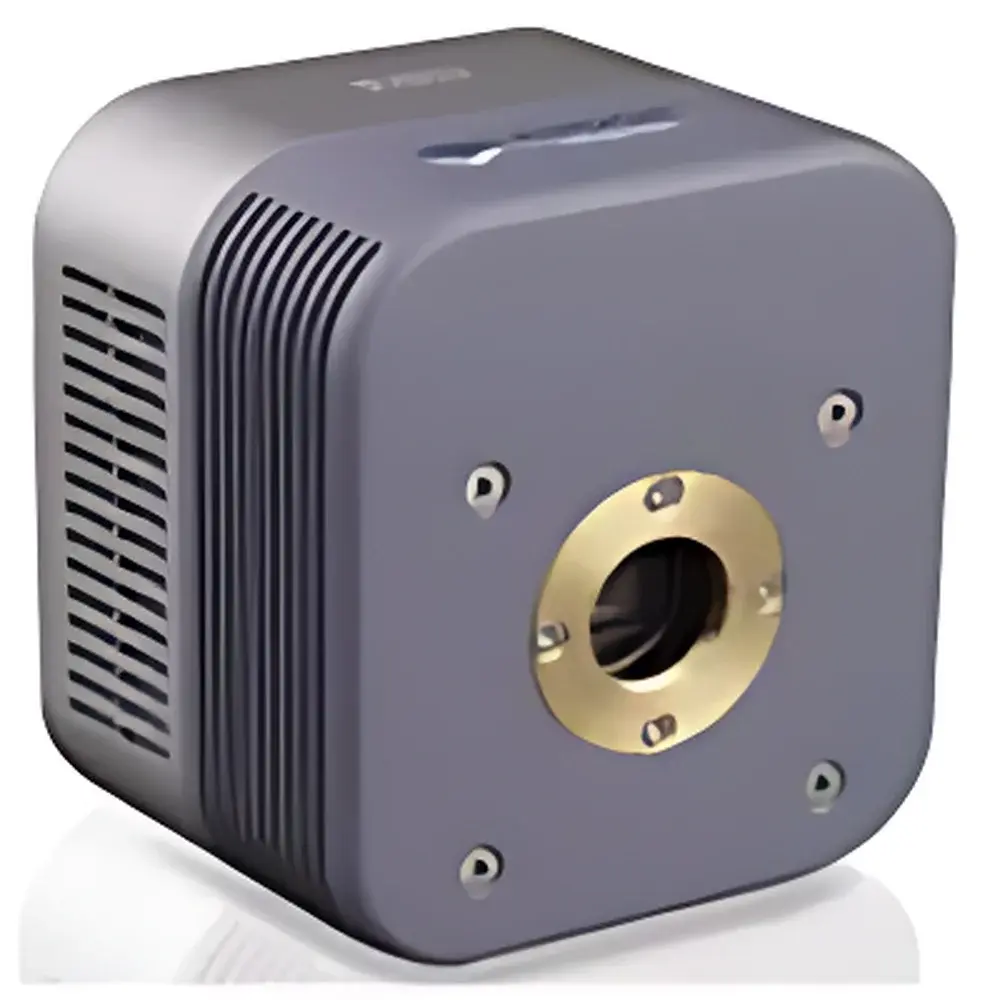
Andor Clara Cold CCD Camera
| Brand | Andor |
|---|---|
| Origin | United Kingdom |
| Model | Clara / Clara E |
| Resolution | 1392 × 1040 pixels |
| Pixel Size | 6.45 × 6.45 µm |
| Sensor Format | 8.98 × 6.71 mm |
| Full Well Capacity | 18,000 e⁻ |
| Max Frame Rate | 11.6 fps |
| Dark Current | 0.0003 e⁻/pix/s (Clara), 0.0015 e⁻/pix/s (Clara E) |
| Cooling Temperature | −45 °C (Clara), −20 °C (Clara E) |
| A/D Conversion | 14-bit & 16-bit |
| Interface | USB 2.0 |
| Vacuum Sealing | UltraVac™ metal-sealed vacuum enclosure |
| Read Noise | <3 e⁻ |
Overview
The Andor Clara Cold CCD Camera is a high-performance, thermoelectrically cooled scientific imaging device engineered for low-light quantitative applications in life sciences microscopy, industrial inspection, and photon-limited spectroscopy. Based on front-illuminated CCD sensor architecture, the Clara leverages deep-cooling capability—down to −45 °C for the standard model and −20 °C for the Clara E variant—to suppress thermal dark current to sub-millielectron levels, enabling extended exposure times without significant background accumulation. Its 1392 × 1040 pixel array features uniform 6.45 µm square pixels and a total active area of 8.98 × 6.71 mm, delivering optimal balance between spatial resolution, field-of-view, and signal-to-noise ratio (SNR) in widefield fluorescence, time-lapse cytology, and low-flux luminescence assays. Unlike consumer-grade sensors, the Clara’s monolithic silicon die is housed within an UltraVac™ metal-sealed vacuum chamber—a proprietary Andor technology that ensures long-term hermetic integrity and eliminates condensation or outgassing-related degradation over years of operation.
Key Features
- UltraVac™ vacuum encapsulation with metal-to-metal sealing for stable, maintenance-free cooling performance across decades of use
- Thermoelectric cooling to −45 °C (Clara) or −20 °C (Clara E), reducing dark current to ≤0.0003 e⁻/pix/s at full cooling
- Read noise <3 e⁻ (rms), optimized via correlated double sampling (CDS) and precision clocking design
- Flexible digitization: simultaneous 14-bit and 16-bit A/D conversion paths selectable in software for dynamic range adaptation
- USB 2.0 interface providing plug-and-play compatibility with Windows and Linux platforms; no frame grabber required
- High quantum efficiency (>60% peak @ 550 nm) and linear response across 10⁴ intensity range
- On-chip binning (1×1 to 4×4) and region-of-interest (ROI) readout for accelerated acquisition and reduced data volume
Sample Compatibility & Compliance
The Clara integrates seamlessly into inverted and upright microscope configurations via C-mount or F-mount adapters, supporting both transmitted-light and epi-fluorescence modalities. It complies with CE marking requirements under the EU Electromagnetic Compatibility (EMC) Directive 2014/30/EU and Low Voltage Directive 2014/35/EU. For regulated environments—including GLP-compliant laboratories and GMP-aligned QC workflows—the camera supports metadata embedding (timestamp, exposure, gain, temperature) and optional audit-trail logging when used with Andor’s Solis™ or SDK-controlled acquisition software. While not FDA 21 CFR Part 11–certified out-of-the-box, its deterministic behavior, repeatable calibration routines, and traceable firmware versioning enable validation per ISO/IEC 17025 and ASTM E2753-10 (Standard Guide for Digital Imaging System Validation).
Software & Data Management
Controlled via Andor Solis™ software (Windows/Linux), the Clara supports real-time image preview, hardware-triggered acquisition, and multi-channel time-series capture with synchronized external event logging. The Andor SDK (C/C++, Python, MATLAB) enables integration into custom automation frameworks, including LabVIEW and Python-based microscopes (e.g., Micro-Manager). All acquired images are saved in standardized TIFF or Andor’s native SIF format, preserving raw pixel values, metadata headers, and non-destructive gain/offset corrections. Batch processing tools support flat-field correction, dark-frame subtraction, and intensity normalization—critical for longitudinal studies requiring inter-session comparability.
Applications
- Widefield fluorescence imaging of fixed and live-cell specimens (e.g., GFP, mCherry, DAPI)
- Low-light industrial inspection: semiconductor wafer defect mapping, phosphor decay analysis, and LED uniformity testing
- Spectroscopic detection in Raman, UV-Vis absorption, and chemiluminescence systems
- Time-lapse developmental biology, where phototoxicity constraints demand maximal photon collection efficiency
- Quantitative colocalization and FRET analysis requiring high SNR and pixel-level linearity
- Automated quality control in pharmaceutical manufacturing environments with validated imaging protocols
FAQ
What is the difference between the Clara and Clara E models?
The Clara achieves deeper cooling (−45 °C) and lower dark current (0.0003 e⁻/pix/s), while the Clara E operates at −20 °C with slightly higher dark current (0.0015 e⁻/pix/s) but offers enhanced stability for long-duration acquisitions in ambient lab conditions.
Does the Clara support hardware triggering?
Yes—it accepts TTL-compatible external trigger signals for precise synchronization with light sources, shutters, or stage motion controllers.
Can I perform on-camera binning?
Yes—hardware binning from 1×1 up to 4×4 is supported, improving SNR and frame rate at the cost of spatial resolution.
Is the sensor back-illuminated?
No—the Clara uses a front-illuminated CCD architecture; for higher QE in UV/blue wavelengths, consider Andor’s iXon series with back-illuminated EMCCDs.
How is calibration handled?
Factory-calibrated gain, offset, and linearity tables are embedded in firmware; users may perform optional dark/flat-field calibration using Solis or SDK tools.



