
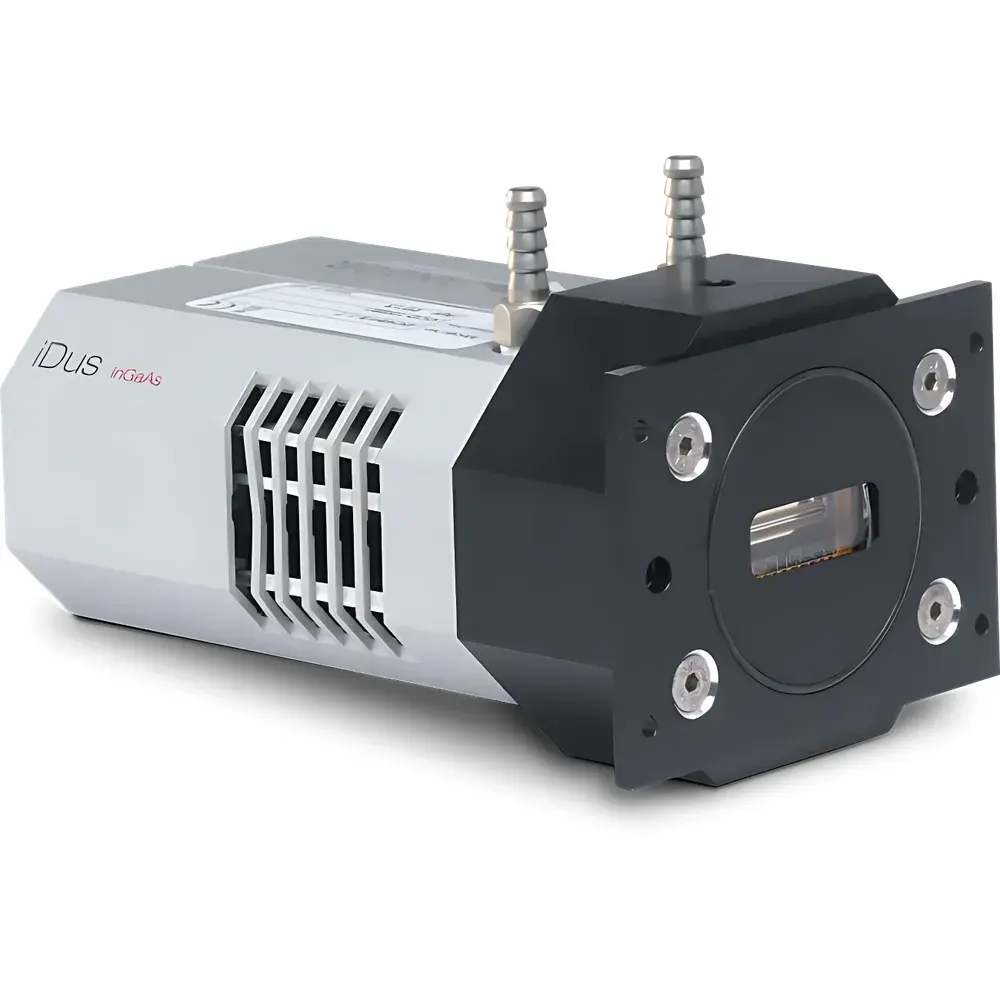
Andor iDus Series Scientific CCD and InGaAs Spectroscopy Cameras
| Brand | Oxford Instruments |
|---|---|
| Origin | United Kingdom |
| Model | iDus |
| Effective Pixels | 1024 |
| Pixel Size | 25 µm |
| Cooling | TE-cooled to –100 °C (iDus 401/420), –95 °C (iDus 416), –90 °C (iDus 491/492) |
| Sensor Types | Back-illuminated deep-depletion CCD, front-illuminated CCD, InGaAs (1.7 µm & 2.2 µm cutoff) |
| Peak Quantum Efficiency | up to 95% (CCD), >85% (1.7 µm InGaAs), >70% (2.2 µm InGaAs) |
| Key Technology | UltraVac™ vacuum architecture, single fused-silica window, fringe suppression, open-electrode design (optional) |
Overview
The Andor iDus series represents a family of scientific-grade, thermoelectrically cooled CCD and InGaAs array detectors engineered exclusively for high-fidelity spectroscopic measurement. Designed and manufactured by Oxford Instruments Andor in Belfast, UK, the iDus platform leverages deep-depletion silicon CCD technology and optimized InGaAs architectures to deliver ultra-low read noise, high quantum efficiency (QE), and exceptional dynamic range across ultraviolet (UV), visible (VIS), near-infrared (NIR), and short-wave infrared (SWIR) spectral regions. Each model—iDus 401, 416, 420, 491, and 492—is purpose-built around a specific sensor format and spectral response profile, enabling precise matching to optical bench configurations, grating dispersion characteristics, and application-specific signal-to-noise requirements. The core measurement principle relies on photon-to-electron conversion within a vacuum-sealed, thermally stabilized detector, followed by low-noise correlated double sampling (CDS) readout. This architecture ensures stability over extended integrations, minimal dark current accumulation, and reproducible calibration traceable to NIST-traceable standards—critical for quantitative spectroscopy under GLP or ISO/IEC 17025-compliant laboratory environments.
Key Features
- UltraVac™ vacuum architecture with single fused-silica entrance window, eliminating internal reflections and ensuring optimal transmission from 200 nm to 2.2 µm
- Thermoelectric (TE) cooling down to –100 °C (CCD variants) or –90 °C (InGaAs), achieving dark current levels <0.001 e⁻/pix/sec at full operating temperature
- Deep-depletion back-illuminated CCD sensors with peak QE ≥95% at 600–700 nm and enhanced red/NIR response (>80% at 900 nm)
- InGaAs variants (iDus 491 and 492) featuring extended cutoffs at 1.7 µm and 2.2 µm respectively, with >85% and >70% peak QE in their respective bands
- Fringe suppression technology integrated into sensor packaging to minimize etalon effects in high-resolution Raman and laser-induced fluorescence measurements
- Open-electrode front-illuminated option (iDus 420) for rapid frame rates up to 1 kHz in multi-channel spectroscopy applications
- Rugged, compact OEM-ready housing with industry-standard electrical and mechanical interfaces (e.g., USB 3.0, Cameralink, 26-pin D-sub)
Sample Compatibility & Compliance
The iDus series is compatible with all standard Czerny–Turner, Echelle, and transmission grating spectrometers, including those from Horiba, Princeton Instruments, Ocean Insight, and custom-built systems. Its modular sensor selection supports direct coupling via fiber optic input (SMA 905), free-space imaging (F-mount or custom flange), or vacuum-compatible mounting for UHV Raman or synchrotron beamlines. All models comply with CE, RoHS, and UKCA directives. Firmware and driver stacks support audit trails and electronic signatures per FDA 21 CFR Part 11 when used with Andor’s Solis™ or SDK-controlled acquisition environments. Calibration certificates—including spectral responsivity, linearity, and dark current maps—are supplied with each unit and are valid for 12 months under standard lab conditions (20–25 °C ambient, <60% RH).
Software & Data Management
iDus cameras operate natively with Andor’s Solis™ software suite (Windows 10/11, 64-bit), providing real-time spectral visualization, multi-region-of-interest (ROI) extraction, kinetic series acquisition, and automated dark/flat-field correction. For integration into custom workflows, the Andor Software Development Kit (SDK) offers C++, Python (PyAndor), and LabVIEW APIs with full access to hardware registers, timing control, and non-destructive readout modes. Metadata—including exposure time, temperature, gain, sensor ID, and firmware revision—is embedded in FITS and TIFF output formats, ensuring FAIR (Findable, Accessible, Interoperable, Reusable) data principles. Raw image buffers support lossless compression (HDF5 with Blosc) and are compatible with third-party analysis platforms such as MATLAB, Igor Pro, and Python-based SciPy/NumPy pipelines.
Applications
- Low-light fluorescence spectroscopy: Detection of weak emission signals from single-molecule studies, quantum dots, and biological fluorophores using iDus 401 (deep depletion) or iDus 420 (high-speed ROI readout)
- Confocal and micro-Raman: High spatial/spectral resolution mapping with fringe-suppressed iDus 416 for NIR excitation (785 nm, 830 nm) and reduced acquisition times
- Photoluminescence (PL) of semiconductors: Broadband detection from UV to SWIR using iDus 492 (2.2 µm) for GaSb, InAs, and PbS quantum well characterization
- Astronomical spectroscopy: Long-exposure stellar spectra acquisition with iDus 401’s ultra-low dark current and stable thermal drift (<0.02 °C/hour)
- Process analytical technology (PAT): Real-time monitoring of chemical reactions in pharmaceutical manufacturing, compliant with ICH Q2(R2) validation guidelines
- Plasma diagnostics: Time-resolved emission spectroscopy in fusion research and industrial plasma sources
FAQ
What cooling method does the iDus use, and how does it compare to liquid nitrogen?
The iDus employs multi-stage thermoelectric (Peltier) cooling, achieving stable operating temperatures down to –100 °C for CCD models and –90 °C for InGaAs variants. Unlike LN₂ systems, this eliminates cryogen handling, refills, and thermal shock risks while maintaining comparable dark current performance for exposures ≤30 minutes.
Is the iDus compatible with third-party spectrometers?
Yes—the iDus supports standard mechanical flanges (C-mount, F-mount), SMA-905 fiber inputs, and electrical interfaces (USB 3.0, Camera Link). Mechanical drawings and SDK documentation are provided for seamless OEM integration.
Does the iDus support triggering and synchronization?
All models feature TTL-compatible external trigger input/output, programmable exposure delay, and hardware-level sync pulses for lock-in or pump-probe experiments.
How is calibration traceability maintained?
Each unit ships with a NIST-traceable calibration certificate covering absolute QE, linearity (±0.5%), and pixel response uniformity. Recalibration services are available through Andor’s UK and US service centers.
Can the iDus be used in vacuum or UHV environments?
The iDus is not rated for direct UHV exposure; however, its UltraVac™ internal vacuum (10⁻⁶ mbar) and bakeable stainless-steel housing allow operation behind differential pumping stages or in high-vacuum chambers with appropriate feedthroughs.




