
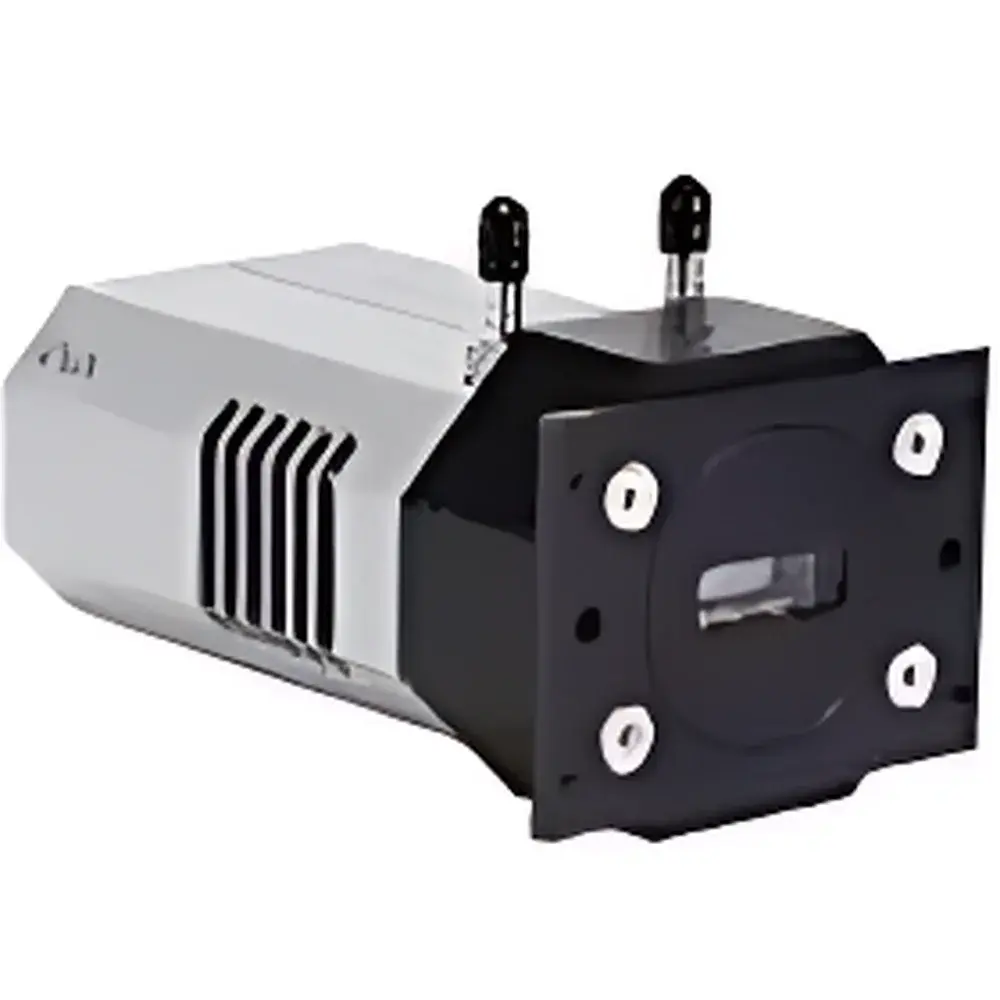
Andor iDus Series Spectroscopy-Optimized CCD Camera
| Brand | Andor |
|---|---|
| Origin | United Kingdom |
| Model | iDus Series |
| Sensor Formats | 1024 × 127 pixels |
| Available Sensor Types | 7 distinct back-illuminated and deep-depletion CCD variants |
| Cooling | Thermoelectric (TE) cooled to –95 °C |
| Read Noise | <3 e⁻ (typ. at 1 MHz readout) |
| Quantum Efficiency | Up to 95% (peak, back-illuminated) |
| Pixel Size | 26 µm × 26 µm (standard) |
| Interface | USB 2.0 or PCIe (model-dependent) |
| Compliance | CE, RoHS, UKCA |
Overview
The Andor iDus Series is a family of scientific-grade, spectroscopy-optimized charge-coupled device (CCD) cameras engineered for high-sensitivity, low-noise spectral detection across ultraviolet (UV), visible (VIS), and near-infrared (NIR) wavelength ranges. Designed explicitly for integration with monochromators, spectrographs, and Raman systems, the iDus platform leverages deep-depletion and back-illuminated CCD architectures to maximize quantum efficiency—particularly in the critical 200–1100 nm region where conventional front-illuminated sensors exhibit significant response roll-off. Its thermoelectric cooling system achieves stable operating temperatures down to –95 °C, enabling extended exposure times while suppressing dark current to sub-0.001 e⁻/pixel/s levels. This thermal stability, combined with ultra-low read noise (<3 e⁻ at standard readout speeds), ensures high signal-to-noise ratio (SNR) performance essential for weak-light applications such as low-concentration fluorescence spectroscopy, time-resolved emission, and plasma diagnostics.
Key Features
- Two standard sensor formats: 1024 × 127 and 1024 × 255 active pixel arrays, optimized for vertical binning in spectroscopic slit imaging.
- Seven selectable CCD sensor variants—including UV-enhanced, deep-depletion, and broadband AR-coated options—each tailored to specific spectral response, etaloning suppression, and etendue matching requirements.
- Integrated thermoelectric (Peltier) cooling with real-time temperature monitoring and closed-loop stabilization; no liquid nitrogen or external chillers required.
- Flexible readout architecture supporting multiple gain modes and clocking configurations to balance speed, noise, and dynamic range.
- USB 2.0 and PCIe interface options ensure compatibility with legacy and high-throughput data acquisition environments, including Windows and Linux-based control platforms.
- Robust mechanical housing with magnetic shielding and EMI-suppressed cabling, validated for operation in electromagnetically noisy laboratory environments (e.g., adjacent to lasers or RF sources).
Sample Compatibility & Compliance
The iDus Series supports direct coupling to all major commercial spectrographs via standard C-mount or F-mount adapters, and integrates seamlessly with Andor’s own Shamrock spectrographs and SOLIS software suite. It is routinely deployed in ISO/IEC 17025-accredited laboratories for spectral calibration traceability and meets essential regulatory prerequisites for analytical instrumentation used in GLP-compliant research. While not inherently FDA 21 CFR Part 11–certified as a standalone device, its firmware and driver architecture support audit-trail-enabling software layers when deployed within validated instrument control frameworks. All units comply with CE marking directives (EMC Directive 2014/30/EU, Low Voltage Directive 2014/35/EU), RoHS 2011/65/EU, and UKCA requirements.
Software & Data Management
Andor SOLIS software provides native, full-featured control of the iDus camera—including real-time preview, multi-region-of-interest (ROI) acquisition, kinetic series capture, and on-the-fly spectral calibration using NIST-traceable emission lines. The SDK (Software Development Kit) offers comprehensive C/C++, MATLAB, Python (via PyAndor), and LabVIEW APIs, enabling custom automation in QC workflows or OEM integration. Raw image data is saved in vendor-neutral FITS or TIFF formats with embedded metadata (exposure time, temperature, gain, timestamp), ensuring long-term archival integrity and interoperability with third-party analysis tools such as Igor Pro, OriginLab, and Python-based SciPy stacks.
Applications
- High-resolution atomic emission spectroscopy (AES) for metallurgical and environmental elemental analysis.
- Raman spectroscopy of pharmaceutical polymorphs, battery materials, and 2D nanomaterials under ambient or cryogenic conditions.
- Time-gated luminescence decay profiling in photophysics and bioimaging studies.
- Plasma diagnostics in fusion research and industrial process monitoring.
- UV-VIS-NIR absorbance and reflectance measurements in thin-film metrology and semiconductor characterization.
- Calibration reference standards verification using primary line sources (e.g., Hg/Ar lamps) per ASTM E275 and ISO 17025 Annex A.3 guidelines.
FAQ
What cooling method does the iDus Series use, and what minimum sensor temperature is achievable?
The iDus employs single-stage thermoelectric (Peltier) cooling and achieves stable sensor temperatures down to –95 °C under ambient conditions.
Are all seven sensor variants available with both 1024 × 127 and 1024 × 255 formats?
No—sensor availability is format-specific; certain deep-depletion or UV-optimized variants are only offered in one of the two pixel geometries due to fabrication constraints.
Can the iDus be synchronized with pulsed laser sources for time-resolved measurements?
Yes—hardware triggering via TTL-compatible input/output ports enables precise gate delays and exposure synchronization with external events, supporting pump-probe and gated-integration protocols.
Is remote operation supported over Ethernet or networked environments?
While the base interface is USB 2.0 or PCIe, Andor provides optional USB-over-Ethernet extenders and middleware solutions for secure remote acquisition in distributed lab networks.
Does the camera support binning, and how does it affect spectral resolution?
Vertical binning is fully supported and commonly applied to increase sensitivity along the dispersion axis; however, it reduces effective spectral resolution proportionally to the number of binned rows—requiring careful trade-off evaluation during experimental design.




