
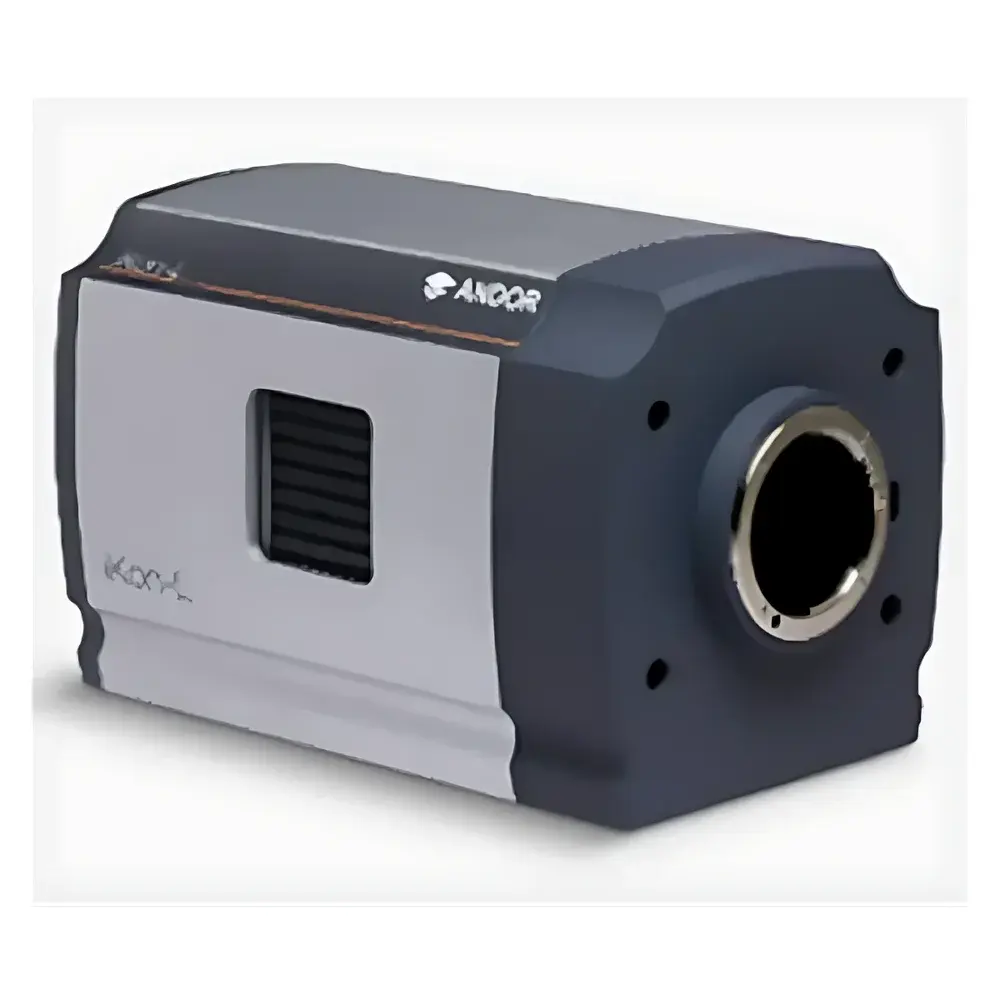
Andor iKon-L 936 Deep-Cooling Back-Illuminated CCD Camera
| Brand | Andor |
|---|---|
| Origin | United Kingdom |
| Model | iKon-L 936 |
| Effective Pixels | 4.2 MP (2048 × 2048) |
| Pixel Size | 13.5 µm |
| Peak Quantum Efficiency | >95% (Back-Illuminated) |
| Cooling Temperature | -100°C (TEC, UltraVac sealed) |
| Dark Current | 5.9 × 10⁻⁵ e⁻/pix/sec |
| Read Noise | 2.9 e⁻ rms |
| Full Well Capacity | 150,000 e⁻ |
| Bit Depth | 16-bit |
| Readout Speeds | 0.05 / 1 / 3 / 5 MHz |
| Interface | USB 2.0 with TTL timestamping |
| Mount | F-mount |
| Diagonal Sensor Size | 39 mm |
Overview
The Andor iKon-L 936 is a deep-cooling, back-illuminated scientific CCD camera engineered for ultra-low-light imaging applications requiring long exposure durations—from tens of seconds to multiple hours. Based on a 2048 × 2048 pixel, 13.5 µm pitch sensor with a 39 mm diagonal format and F-mount interface, the iKon-L 936 leverages Andor’s proprietary UltraVac vacuum-sealed architecture and high-efficiency thermoelectric cooling to achieve stable, continuous operation at -100°C. This thermal management system eliminates reliance on liquid nitrogen or mechanical cryocoolers while suppressing dark current to 95% quantum efficiency across 350–1100 nm—including strong near-infrared response—enabling high-fidelity spectral coverage without external wavelength conversion.
Key Features
- Ultra-stable -100°C thermoelectric cooling via UltraVac vacuum encapsulation—no consumables, no maintenance, no condensation risk
- Back-illuminated deep-depletion CCD with >95% peak QE and optimized fringing suppression for NIR-sensitive applications
- Lowest-in-class dark current (5.9 × 10⁻⁵ e⁻/pix/sec) and read noise (2.9 e⁻ rms), enabling single-photon-level detection fidelity
- 16-bit digitization with 150,000 e⁻ full-well capacity, supporting wide dynamic range (>90 dB) for heterogeneous sample intensity distributions
- Multiple readout speeds (0.05–5 MHz) and selectable gain modes—optimized for both ultra-long exposures and rapid kinetic acquisition (down to microsecond-scale frame intervals in “Fast Kinetics” mode)
- F-mount interface with 39 mm diagonal sensor—maximizing field-of-view compatibility with macro, stereomicroscopy, and custom optical train configurations
Sample Compatibility & Compliance
The iKon-L 936 is routinely deployed in regulated life science and preclinical research environments where data traceability and instrument validation are essential. Its deterministic analog signal chain, hardware-based TTL timestamping, and deterministic USB 2.0 communication protocol support audit-ready workflows compliant with GLP and GMP frameworks. While the camera itself does not execute software-based electronic signatures, its raw image output (FITS or TIFF) and metadata—including precise exposure start/stop timestamps, sensor temperature logs, and gain settings—are fully exportable for integration into validated LIMS or ELN systems. It meets ISO 17025-relevant criteria for measurement uncertainty control in photometric assays, and its spectral response is characterized per ISO 15739:2013 (Imaging sensors — Noise measurement). No internal battery or volatile memory is used; all configuration parameters persist across power cycles without drift.
Software & Data Management
Controlled via Andor’s SDK (Software Development Kit) and bundled Solis® software, the iKon-L 936 supports fully scriptable acquisition, real-time histogram analysis, and multi-dimensional stack capture (time-lapse, Z-series, wavelength series). Solis implements lossless 16-bit TIFF and FITS export with embedded EXIF-style metadata—including exposure time, sensor temperature, readout speed, and calibration flags. For automated compliance workflows, the SDK provides direct API access to hardware registers, enabling integration with Python, MATLAB, LabVIEW, or C#-based custom platforms. All firmware updates are cryptographically signed and installed via authenticated channels. Audit trail functionality (e.g., user action logging, parameter change history) is available when Solis is deployed under Windows Event Log–integrated enterprise IT policies. Raw data files contain no embedded compression or proprietary encoding—ensuring long-term archival integrity and third-party tool interoperability (e.g., ImageJ/Fiji, Python’s astropy.io.fits).
Applications
- Bioluminescent & chemiluminescent imaging: Quantitative monitoring of luciferase reporter gene expression in live animals, plant tissues, or microbial colonies—where signal intensities remain below 1 photon/pixel/sec for minutes to hours
- In vivo fluorescence tomography (FT): Low-background acquisition of NIR-emitting probes (e.g., IRDye 800CW, Cy7) in murine models, leveraging high QE beyond 800 nm
- Plant phenotyping: High-sensitivity chlorophyll fluorescence (Fv/Fm), delayed fluorescence, and stress-induced luminescence mapping under controlled environmental chambers
- Astronomical photometry: Precision stellar magnitude measurement and exoplanet transit photometry using stable, drift-free long-exposure capability
- Single-molecule microscopy (widefield): Detection of sparse fluorophore-labeled targets in fixed or lightly stained specimens with minimal photobleaching
FAQ
What cooling method does the iKon-L 936 use—and why is vacuum sealing critical?
The iKon-L 936 employs solid-state thermoelectric cooling (TEC) coupled with UltraVac permanent vacuum encapsulation. Vacuum eliminates convective heat transfer and moisture ingress, ensuring thermal stability and eliminating condensation risks during multi-hour exposures—unlike air-cooled or Peltier-only designs.
Can this camera be used for kinetic studies despite its “slow-scan” designation?
Yes. In Fast Kinetics mode, the iKon-L 936 achieves sub-millisecond inter-frame timing with hardware-synchronized shutter control and on-chip binning—enabling transient luminescence decay profiling or rapid sequential wavelength acquisition.
Is the sensor sensitive in the near-infrared (NIR) range—and how is fringing mitigated?
The deep-depletion back-illuminated sensor provides enhanced NIR response up to 1100 nm. Fringing—caused by interference in thick silicon—is suppressed via proprietary anti-reflection coating and optical path optimization, reducing amplitude to <0.5% of peak signal.
Does the camera support hardware triggering and synchronization with external equipment?
Yes. It features TTL-compatible trigger input/output lines for precise external synchronization with lasers, shutters, or stage controllers—essential for gated acquisition or pump-probe experiments.
How is calibration handled for quantitative intensity measurements?
Andor provides factory-measured gain, offset, and flat-field correction maps. Users may acquire dark frames and pixel-response uniformity (PRNU) references under identical operating conditions for application-specific calibration—traceable to NIST-traceable light sources upon request.




