
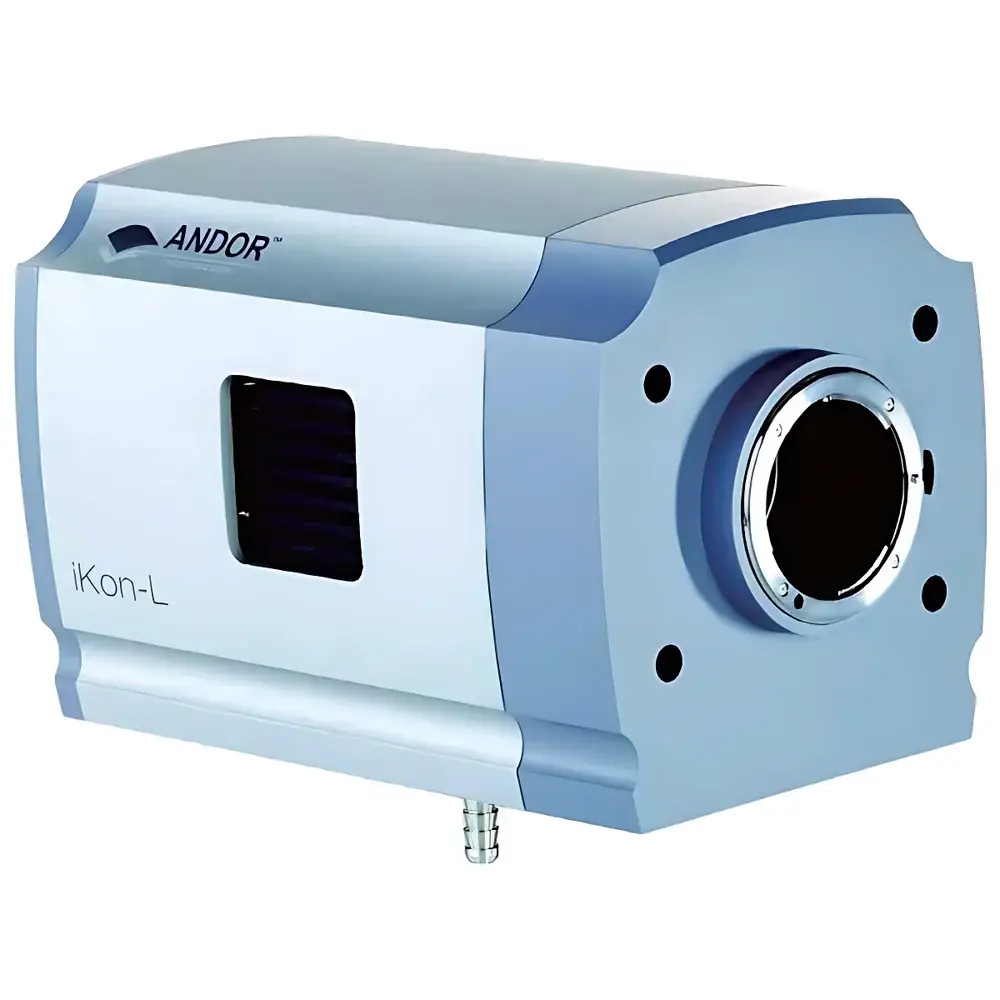
Andor iKon-L 936 Series Large-Format CCD Camera
| Brand | Andor |
|---|---|
| Origin | United Kingdom |
| Model | iKon-L 936 |
| Sensor Format | 2048 × 2048 pixels |
| Pixel Size | 13.5 µm × 13.5 µm |
| Cooling | Thermoelectric (TE), 5-stage, down to −100 °C |
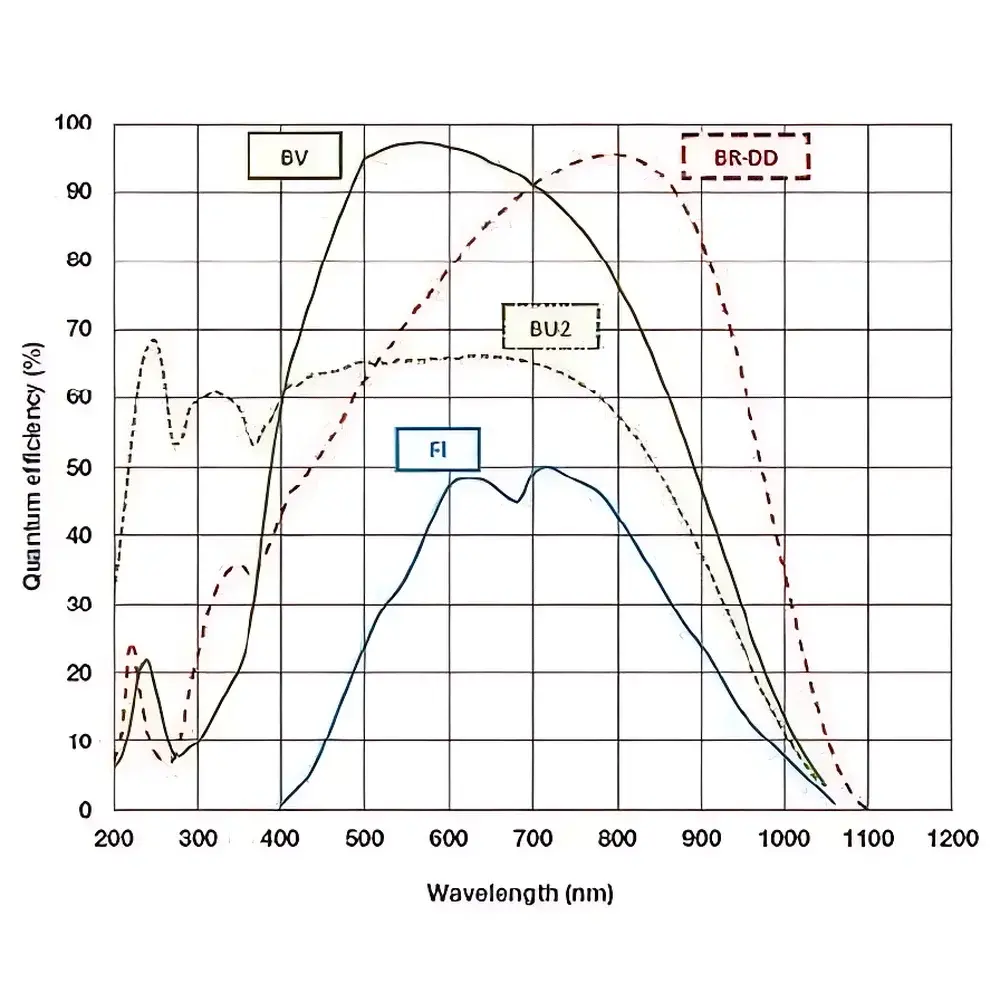
| Quantum Efficiency | up to 95% |
| Readout Modes | High-Sensitivity and High-Dynamic-Range |
| Bit Depth | 16-bit |
| Interface | USB 2.0 |
| Vacuum Technology | UltraVac™ |
| Mount | Integrated F-mount |
| Shutter | Integrated 45 mm mechanical shutter |
| Optional Accessories | C-to-F adapter, water-cooling unit |
Overview
The Andor iKon-L 936 Series is a large-format, scientific-grade CCD camera engineered for demanding low-light imaging applications in astronomy, spectroscopy, fluorescence microscopy, and synchrotron radiation detection. At its core lies a 2048 × 2048 pixel front-illuminated or back-illuminated CCD sensor with 13.5 µm square pixels, delivering an optimal balance between spatial resolution and full-well capacity. The camera employs a proprietary 5-stage thermoelectric (TE) cooling architecture, achieving stable sensor temperatures as low as −100 °C — significantly suppressing dark current and enabling integration times from milliseconds to hours without saturation or thermal noise degradation. Its vacuum-sealed UltraVac™ housing eliminates condensation, ensures long-term sensor stability, and maintains consistent quantum efficiency across repeated thermal cycles. Designed for quantitative imaging, the iKon-L 936 meets the stringent requirements of GLP-compliant laboratories and ISO/IEC 17025-accredited facilities where traceable signal fidelity and reproducible photon counting are essential.
Key Features
- Large-area 2048 × 2048 CCD sensor with 13.5 µm pixel pitch — optimized for wide-field imaging and high-resolution spectral line profiling
- UltraVac™ vacuum packaging — guarantees permanent hermetic seal and eliminates outgassing or dew formation during extended cryogenic operation
- Five-stage TE cooling system — achieves sensor stabilization at −100 °C with <0.01 °C temperature stability over 24 h
- Configurable sensor options: standard front-illuminated, deep-depletion back-illuminated (BR-DD), UV-enhanced, and near-infrared optimized variants
- Peak quantum efficiency up to 95% (at selected wavelengths, depending on sensor type)
- Dual readout modes: High-Sensitivity mode (optimized for sub-electron read noise) and High-Dynamic-Range mode (full-well >100 ke⁻ per pixel)
- Software-selectable readout speeds — from ultra-low-noise 10 kHz to rapid 2 MHz digitization, preserving flexibility across exposure regimes
- Integrated F-mount lens interface and 45 mm mechanical shutter — enables seamless coupling with standard optical train components and precise exposure control
- Fringe Suppression Technology™ — actively mitigates etalon fringing in the 700–1100 nm range for BR-DD sensors, critical for Raman and NIR spectroscopy
Sample Compatibility & Compliance
The iKon-L 936 supports a broad spectrum of sample types — from faint astronomical objects and time-resolved luminescent specimens to diffraction-limited spectroscopic sources and synchrotron beamline diagnostics. Its vacuum integrity and thermal stability comply with ASTM E1548 (Standard Guide for Determining the Suitability of Imaging Detectors) and align with ISO 15739:2013 (Imaging sensors — Noise measurement methodology). When operated with optional water-cooling accessories, the system satisfies continuous-duty thermal management requirements under IEC 61000-6-3 (EMC emission standards) and maintains conformity with FDA 21 CFR Part 11 when integrated into validated acquisition workflows using Andor’s Solis® software with audit-trail-enabled configuration logging.
Software & Data Management
The camera is fully supported by Andor’s Solis® software suite — a platform certified for use in regulated environments requiring electronic records and signature compliance. Solis provides real-time histogram analysis, non-uniformity correction (NUC), pixel defect mapping, and synchronized multi-camera acquisition. Raw image data is saved in FITS or TIFF formats with embedded metadata (exposure time, temperature, gain, binning, sensor ID), ensuring FAIR (Findable, Accessible, Interoperable, Reusable) data principles. Integration with third-party platforms — including LabVIEW, MATLAB, Python (via Andor SDK), and EPICS — enables automated acquisition in synchrotron beamlines or industrial QA/QC systems. All firmware and driver updates undergo rigorous regression testing against USP Analytical Instrument Qualification protocols.
Applications
- Astronomical photometry and narrowband imaging requiring high dynamic range and minimal dark signal
- Raman and photoluminescence spectroscopy — especially with BR-DD sensors and Fringe Suppression Technology™ enabled
- Time-resolved fluorescence lifetime imaging (FLIM) and single-molecule detection
- X-ray and EUV imaging at synchrotron and free-electron laser facilities
- High-resolution transmission electron microscopy (HRTEM) camera replacement systems
- Quantitative thin-film interference metrology and ellipsometry
- Low-flux particle tracking in microfluidic and soft-matter physics experiments
FAQ
What cooling performance can be expected without external water cooling?
The iKon-L 936 achieves −100 °C sensor temperature using only air convection and internal heat sinking; water cooling is optional and recommended only for continuous operation above 1 Hz frame rates.
Is the camera compatible with Windows 11 and 64-bit Linux distributions?
Yes — Andor provides signed drivers and SDKs for Windows 10/11 (x64) and Ubuntu LTS 20.04+ and Red Hat Enterprise Linux 8+, with full support for kernel versions up to 6.5.
Can the mechanical shutter be triggered externally via TTL input?
Yes — the integrated 45 mm shutter supports hardware-triggered opening/closing with programmable delay (0–10 s, 1 ms resolution) and TTL-compatible opto-isolated inputs.
How is calibration data managed and preserved across firmware updates?
All sensor-specific calibration files (bias, dark, flat-field) are stored in non-volatile memory on the camera PCB and remain intact during firmware upgrades; Solis software auto-detects and applies appropriate corrections based on sensor serial number.
Does the iKon-L 936 support hardware binning?
No — binning is performed digitally in the FPGA during readout; however, on-chip charge summation is not implemented, preserving full spatial sampling fidelity for post-processing alignment and deconvolution workflows.





