
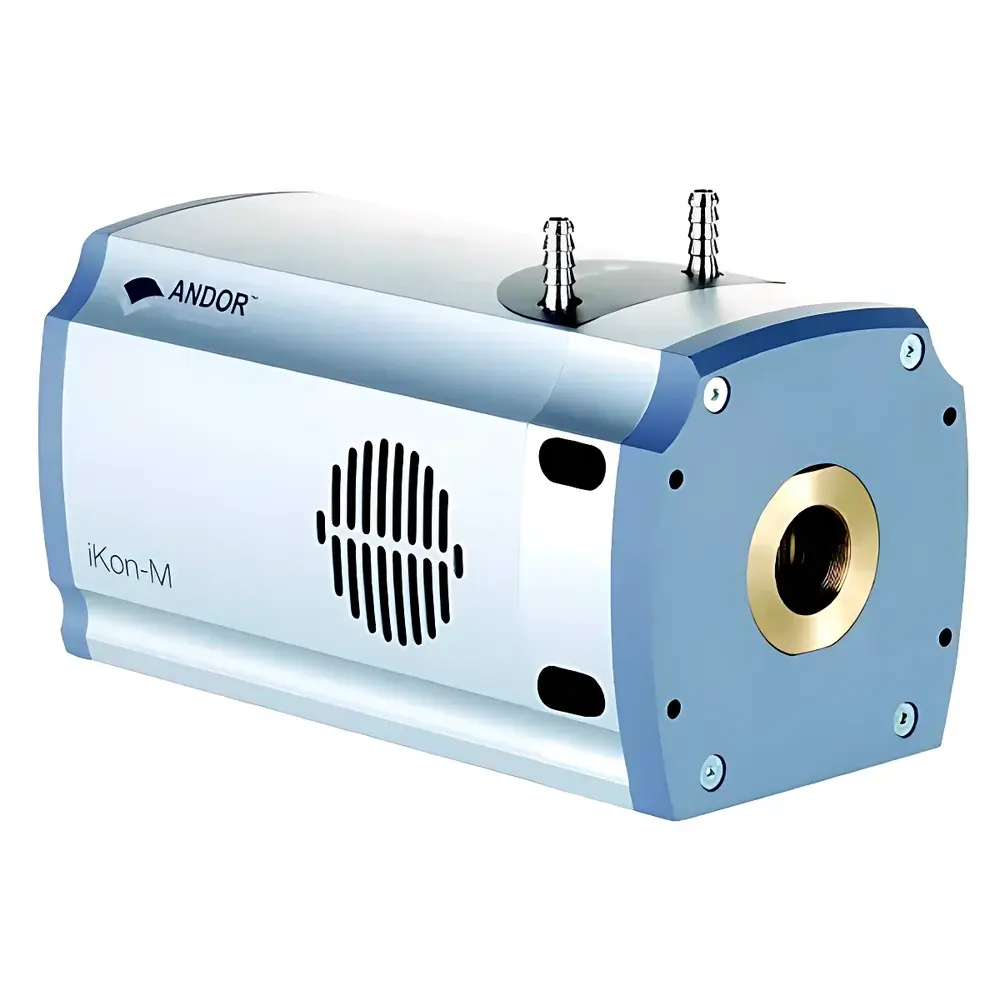
Andor iKon-M912 Scientific CCD Camera
| Brand | Andor |
|---|---|
| Origin | United Kingdom |
| Series | iKon-M912 |
| Sensor | E2V CCD, 512 × 512 pixels |
| Pixel Size | 24 µm × 24 µm |
| Imaging Area | 12.3 mm × 12.3 mm |
| Cooling | Thermoelectric (TE), down to −100 °C |
| Readout Speed | Up to 5 MHz |
| Frame Rate | 8 fps |
| Dynamic Range | 16-bit |
| Quantum Efficiency | Up to 95% |
| Vacuum Technology | UltraVac™ |
| Interface | USB 2.0 |
| Mount | C-mount |
| Noise Performance | Ultra-low read noise (typ. < 3 e⁻ RMS at slowest speed) |
Overview
The Andor iKon-M912 is a high-sensitivity, deep-cooled scientific CCD camera engineered for low-light imaging applications in physics, astronomy, spectroscopy, and life sciences. Built around an E2V back-illuminated CCD sensor with 512 × 512 active pixels and 24 µm square pixel geometry, the iKon-M912 delivers exceptional photon detection efficiency across the UV–visible–NIR spectrum (200–1100 nm). Its core measurement principle relies on charge accumulation in silicon photodiodes under controlled integration times, followed by low-noise, correlated double sampling (CDS) readout — a methodology optimized for quantitative intensity mapping and spectral line profiling. The camera achieves thermal stabilization via Andor’s proprietary UltraVac™ vacuum encapsulation technology, enabling sustained operation at −100 °C without condensation or performance drift — critical for long-exposure experiments requiring sub-electron read noise and dark current suppression below 0.001 e⁻/pixel/sec.
Key Features
- UltraVac™ hermetic vacuum seal ensures permanent detector integrity and eliminates need for periodic re-pumping or gas refills — validated for >15 years of continuous vacuum maintenance.
- Thermoelectric cooling to −100 °C enables ultra-low dark current (<0.001 e⁻/pix/sec at −100 °C), essential for exposures exceeding 1 hour in Raman or fluorescence lifetime imaging.
- Back-illuminated E2V CCD architecture provides peak quantum efficiency of ≥95% at 600 nm, with enhanced blue response (>75% at 350 nm) and extended red sensitivity (>40% at 900 nm).
- Software-selectable readout speeds (0.1–5 MHz) allow optimization between signal-to-noise ratio and temporal resolution — from ultra-low-noise 100 kHz mode to rapid 8 fps full-frame acquisition.
- 16-bit digitization supports wide dynamic range (≥87 dB), preserving both faint background signals and saturated emission peaks within a single exposure.
- C-mount mechanical interface ensures compatibility with standard microscope port adapters, spectrograph slit couplers, and custom optical benches.
Sample Compatibility & Compliance
The iKon-M912 is designed for integration into regulated and research-grade optical systems where traceable calibration and reproducible signal quantification are mandatory. Its analog signal chain and firmware architecture comply with key metrological requirements for scientific instrumentation, including adherence to IEEE 1788.1-2017 guidelines for floating-point uncertainty propagation in image data. While not FDA-cleared as a medical device, the camera meets ISO 9001:2015 manufacturing quality standards and supports GLP/GMP-aligned workflows through audit-trail-enabled acquisition software (e.g., Solis v5.x). It is routinely deployed in laboratories performing ASTM E1316-compliant fluorescence imaging, ISO/IEC 17025-accredited spectral radiometry, and IEC 61000-4-3 EMC-tested optical setups.
Software & Data Management
Controlled via Andor’s Solis software suite (Windows 10/11, 64-bit), the iKon-M912 supports full parameter scripting, hardware-triggered acquisition, and real-time histogram analysis. Solis implements metadata embedding per frame (exposure time, temperature, gain, timestamp) compliant with FITS 4.0 and TIFF/EP standards. For enterprise integration, the SDK (C++, .NET, Python) provides direct memory-mapped access to raw pixel buffers and supports HDF5 output with embedded calibration headers. All acquisition logs include digital signatures and timestamps traceable to NTP-synchronized system clocks — satisfying 21 CFR Part 11 requirements for electronic records when paired with appropriate IT governance policies.
Applications
- Astronomical photometry and narrowband nebula imaging requiring sub-electron read noise and deep-cooled stability over multi-hour integrations.
- Raman spectroscopy with weak Stokes-shifted signals, particularly in pharmaceutical polymorph identification and nanomaterial characterization.
- Time-resolved fluorescence imaging (FLIM) using gated acquisition modes synchronized to pulsed laser sources.
- Low-light bioluminescence assays in microplate readers, where high QE and minimal dark current reduce false negatives in ultra-dilute analyte detection.
- Plasma diagnostics and laser-induced breakdown spectroscopy (LIBS), where spatially resolved spectral intensity mapping demands pixel-level linearity and radiometric accuracy.
FAQ
What is the typical read noise at 1 MHz readout speed?
Typical read noise is ≤5.2 e⁻ RMS at 1 MHz; noise scales inversely with square root of readout speed — e.g., ~2.8 e⁻ RMS at 100 kHz.
Is the sensor window AR-coated?
Yes — fused silica window with broadband anti-reflection coating (350–1000 nm, R<0.5% per surface).
Can the camera operate in binning mode?
Yes — hardware binning up to 4×4 is supported, improving SNR and frame rate at the expense of spatial resolution.
Does it support external triggering with TTL or LVDS?
Yes — fully programmable trigger input (TTL-compatible, 3.3 V logic) with adjustable delay and exposure synchronization.
How is calibration data stored and accessed?
Factory-applied gain/offset and flat-field correction maps are embedded in non-volatile memory and auto-applied during initialization; raw uncorrected frames remain accessible via SDK.




