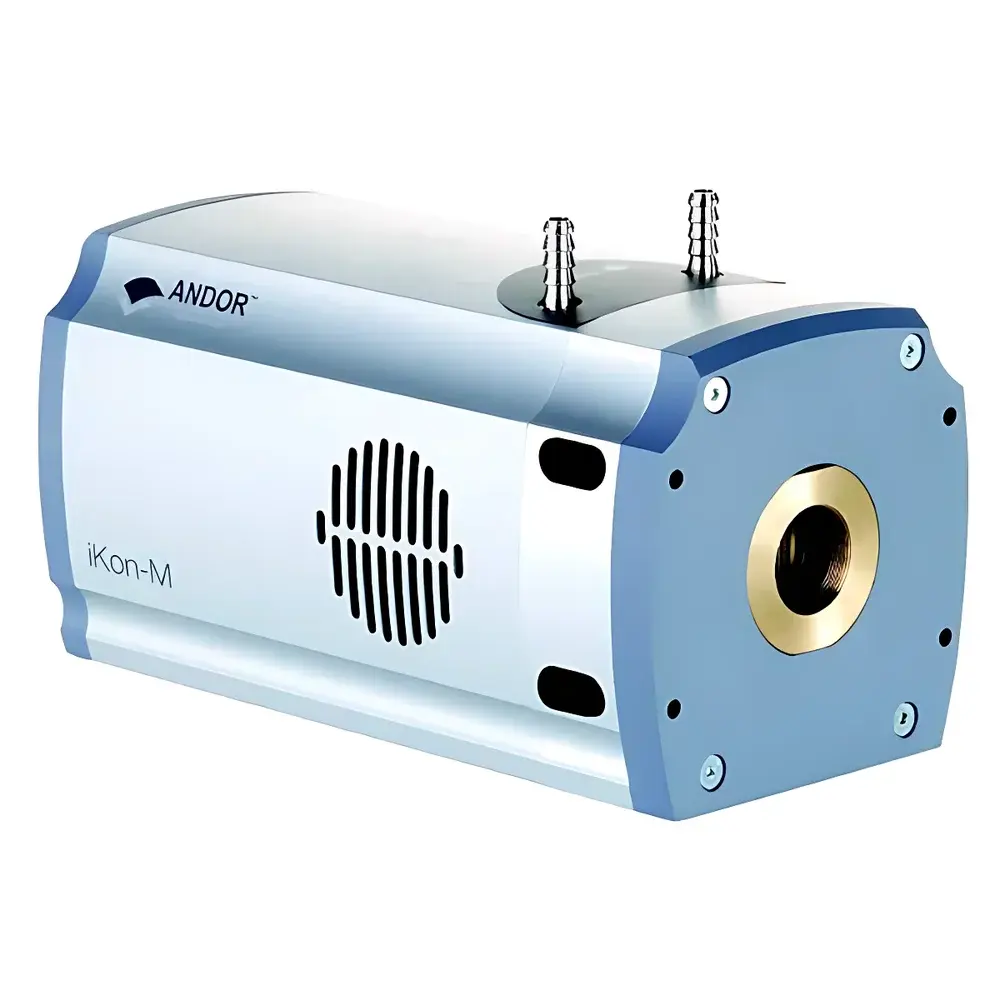
Andor iKon-M934 Series Scientific-Grade CCD Camera
| Brand | Andor |
|---|---|
| Origin | United Kingdom |
| Model | iKon-M934 Series |
| Sensor | E2V CCD, 1024 × 1024 pixels |
| Pixel Size | 13 µm × 13 µm |
| Imaging Area | 13.3 mm × 13.3 mm |
| Full Well Capacity | 100,000 e⁻ |
| Readout Noise | as low as 2.9 e⁻ |
| Readout Speed | up to 5 MHz |
| Frame Rate | 4.4 fps |
| Cooling Temperature | down to −100 °C |
| Quantum Efficiency | up to 95% |
| Interface | USB 2.0 |
| Mount | C-mount |
| Features | UltraVac™ vacuum sealing, Fringe Suppression Technology™ (for BR-DD & BEX2-DD variants), software-selectable readout speed, 16-bit dynamic range, integrated mechanical shutter |
Overview
The Andor iKon-M934 Series is a high-performance scientific-grade CCD camera engineered for low-light, quantitative imaging applications in physics, astronomy, life sciences, and materials characterization. Built around the E2V back-illuminated CCD sensor (1024 × 1024 format, 13 µm pixel pitch), it delivers exceptional photon detection efficiency across UV–VIS–NIR spectral ranges. Its core architecture leverages Andor’s proprietary UltraVac™ technology — a hermetically sealed, ultra-high-vacuum enclosure that ensures long-term sensor stability, eliminates condensation risks during deep cooling, and maintains optimal quantum efficiency over years of operation. The camera achieves thermoelectric (TE) cooling down to −100 °C, enabling sub-electron read noise performance and dark current suppression below 0.0001 e⁻/pixel/sec — critical for integration times spanning seconds to hours. Unlike standard industrial CCDs, the iKon-M934 is purpose-built for reproducible, calibration-grade data acquisition where signal fidelity, linearity, and temporal stability are non-negotiable.
Key Features
- UltraVac™ vacuum encapsulation ensures permanent, maintenance-free sensor integrity and eliminates the need for periodic re-pumping or gas refills.
- Deep-cooling capability to −100 °C enables ultra-low dark current and supports long-exposure applications such as Raman spectroscopy, luminescence lifetime imaging, and faint-object astronomy.
- Back-illuminated sensor options (including BR-DD and BEX2-DD variants) provide peak quantum efficiency exceeding 95% at key wavelengths (e.g., 600 nm), with Fringe Suppression Technology™ actively mitigating etalon fringing in the 700–1000 nm range.
- Software-configurable readout speeds (from 100 kHz to 5 MHz) allow optimization between sensitivity and frame rate — ideal for balancing signal-to-noise ratio against temporal resolution.
- 16-bit digitization provides >65,000:1 dynamic range, supporting both weak signal capture and high-intensity feature preservation within a single exposure.
- Integrated mechanical shutter ensures precise exposure control without reliance on external hardware; C-mount interface guarantees compatibility with standard microscope, spectrograph, and telescope optical trains.
Sample Compatibility & Compliance
The iKon-M934 supports a broad spectrum of sample types and experimental configurations, including fluorescence-labeled biological specimens, low-yield phosphorescent materials, astronomical point sources, and spatially resolved emission spectra from plasma or combustion diagnostics. Its calibrated linearity (±0.5% over 98% of full well), uniform pixel response (<1.5% RMS non-uniformity), and traceable gain/offset calibration make it suitable for GLP- and GMP-aligned environments. While not intrinsically FDA 21 CFR Part 11 compliant, its metadata-rich TIFF output (including temperature, exposure time, gain, and sensor ID) supports audit-ready data provenance when integrated into validated laboratory information management systems (LIMS). The camera conforms to CE, RoHS, and UKCA directives, and its vacuum housing meets ISO 10110 optical cleanliness standards for sensor protection.
Software & Data Management
Andor’s SOLIS® software (Windows-based) provides full instrument control, real-time image preview, multi-channel acquisition sequencing, and embedded calibration tools including flat-field correction, dark-frame subtraction, and pixel defect mapping. All acquired images are saved in vendor-neutral, metadata-embedded TIFF format — compatible with ImageJ/Fiji, MATLAB, Python (via Andor SDK), and commercial analysis platforms such as MetaMorph and NIS-Elements. The Andor SDK (C++, C#, Python) enables seamless integration into custom automation workflows, including synchronization with laser pulsing, stage motion, or spectrometer grating positioning. Raw data export preserves 16-bit depth and full header information, ensuring traceability for peer-reviewed publication or regulatory submission.
Applications
- Astronomy: High-resolution planetary imaging, narrowband nebula mapping, and adaptive optics wavefront sensing.
- Life Sciences: Confocal and widefield fluorescence microscopy, FRET, TIRF, and bioluminescence assays requiring photon-starved quantification.
- Physical Chemistry: Time-resolved spectroscopy, laser-induced fluorescence (LIF), and combustion imaging under controlled thermal conditions.
- Materials Science: Cathodoluminescence mapping, photoluminescence quantum yield measurement, and defect analysis in semiconductors.
- Industrial Metrology: High-dynamic-range inspection of micro-optical components and precision alignment verification in vacuum environments.
FAQ
What sensor technology does the iKon-M934 use?
It employs an E2V back-illuminated CCD with 1024 × 1024 pixels and 13 µm pitch, available in multiple variants (e.g., BR-DD, BEX2-DD) optimized for specific spectral responses.
Is the camera compatible with Linux or macOS?
Native SOLIS software is Windows-only; however, the Andor SDK provides cross-platform API access (Linux support via C/C++ bindings; macOS support limited to select legacy drivers — consult Andor technical documentation for version-specific compatibility).
How is cooling performance maintained over time?
UltraVac™ eliminates outgassing and moisture ingress, ensuring consistent −100 °C operating temperature without degradation in vacuum integrity over >10 years of typical use.
Can the iKon-M934 be synchronized with external triggers?
Yes — it supports TTL-compatible hardware triggering (start, stop, exposure gate) and programmable delay/timeout settings via SOLIS or SDK for precise timing-critical experiments.
Does the camera support binning?
Yes — on-chip hardware binning (2×2, 3×3, etc.) is supported, improving signal-to-noise ratio and frame rate at the expense of spatial resolution.