
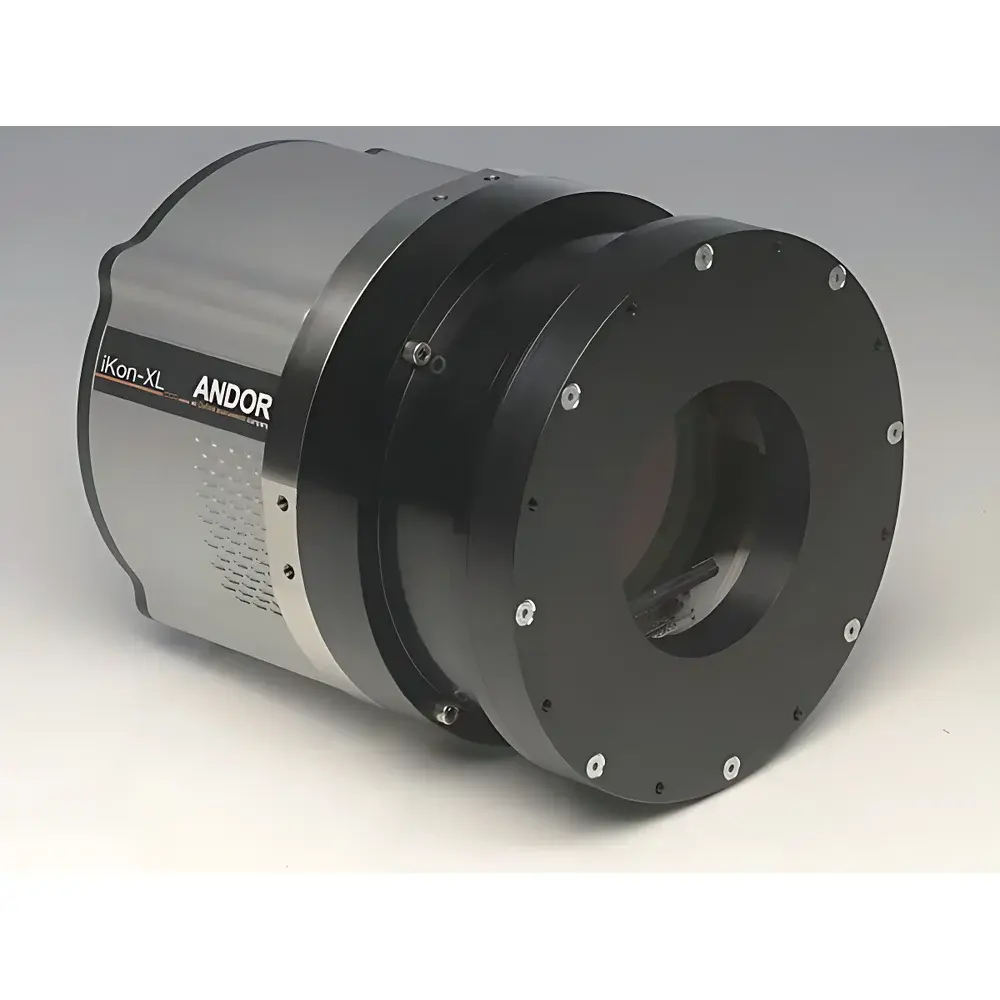
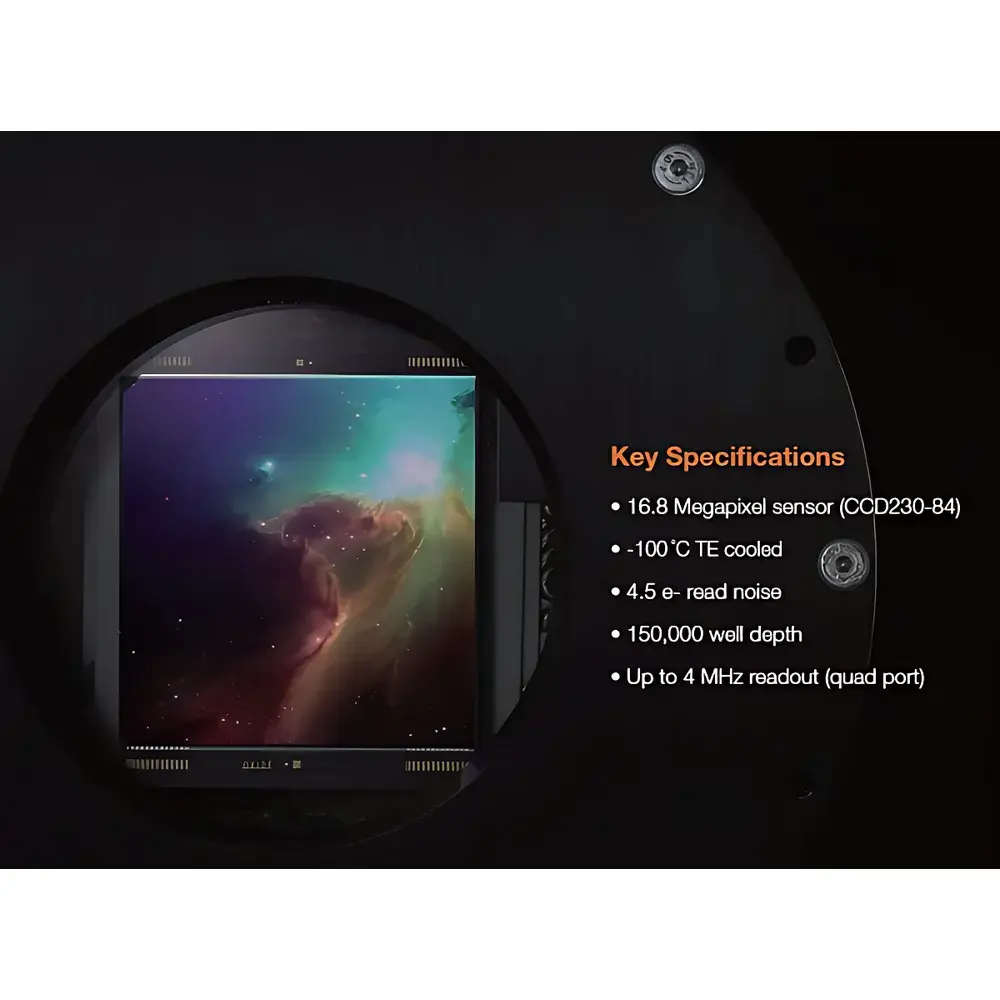
Andor iKON-XL Astronomical-Grade Large-Format Back-Illuminated CCD Camera
| Brand | Andor |
|---|---|
| Origin | United Kingdom |
| Model | iKON-XL |
| Sensor Format | 4096 × 4096 pixels |
| Pixel Size | 15 µm |
| Active Image Area | 61.4 mm × 61.7 mm |
| Sensor Type | Back-Illuminated (BI), BR-DD options available |
| Readout Depth | 18-bit |
| Cooling Technology | ColdSpace™ vacuum-sealed thermoelectric cooling to –100 °C |
| Cooling Method | No liquid nitrogen or cryocooler required |
| Vacuum Integrity | Maintenance-free sealed vacuum chamber |
| Shutter | Field-replaceable mechanical shutter |
| Readout Modes | Multi-port parallel readout with quantitative uniformity |
| Timestamping | iRig-B hardware timestamping, 10 ms resolution |
| Interface | USB 3.0 + optional fiber-optic data link for long-distance transmission |
Overview
The Andor iKON-XL is a purpose-engineered astronomical-grade large-format CCD camera designed for demanding ground-based and space-adjacent observatory applications where high quantum efficiency, ultra-low noise, and exceptional spatial uniformity are non-negotiable. At its core lies a scientific-grade, back-illuminated (BI) 4096 × 4096 pixel CCD sensor with 15 µm pixels, delivering a total active imaging area of 61.4 mm × 61.7 mm — among the largest monolithic formats available for deep-sky imaging, wide-field spectroscopy, and precision photometry. Unlike conventional large-format CCDs reliant on complex cryogenic infrastructure, the iKON-XL integrates Andor’s proprietary ColdSpace™ technology: a hermetically sealed, maintenance-free vacuum enclosure coupled with high-efficiency thermoelectric (Peltier) cooling capable of stabilizing the sensor at –100 °C continuously. This eliminates dependency on liquid nitrogen dewars or mechanical cryocoolers — significantly reducing operational overhead, vibration artifacts, and infrastructure footprint at remote telescope sites.
Key Features
- Monolithic 4k × 4k back-illuminated CCD sensor with peak QE >95% in visible to near-UV range
- ColdSpace™ vacuum-integrated thermoelectric cooling to –100 °C, enabling sub-electron read noise (<3 e⁻ rms) and dark current <0.0001 e⁻/pix/sec at operating temperature
- Maintenance-free vacuum architecture — no pump-down cycles, no getter regeneration, no scheduled venting
- Field-replaceable precision mechanical shutter with programmable open/close timing and TTL synchronization
- Multi-port parallel readout architecture ensuring quantitative pixel-to-pixel gain and linearity uniformity across full frame
- iRig-B hardware timestamping module providing absolute time stamps with 10 ms resolution, traceable to external GPS or PPS signals for synchronized multi-instrument campaigns
- Dual interface support: high-throughput USB 3.0 for local acquisition and optional fiber-optic data link (via Andor’s FIBRE-IO module) for noise-immune, kilometer-range data streaming to control rooms
Sample Compatibility & Compliance
The iKON-XL is optimized for integration into professional observatory environments adhering to ISO 14001 (environmental management) and IEC 61000-6-3 (EMC emission standards). Its vacuum-sealed design meets ASTM E595 outgassing requirements for space-qualified instrumentation, making it suitable for cleanroom installation and satellite ground-test facilities. The camera complies with CE marking directives for electromagnetic compatibility and low-voltage safety. While not FDA-regulated, its timestamping and deterministic readout behavior align with GLP/GMP principles for time-critical scientific recordkeeping. Firmware and driver stacks support audit-trail logging for traceability in regulated research contexts.
Software & Data Management
Controlled via Andor’s mature, cross-platform Solis® software suite (Windows/macOS/Linux), the iKON-XL supports full scripting (Python, MATLAB, LabVIEW APIs), real-time histogram analysis, and non-uniformity correction (NUC) with user-defined flat/dark libraries. All acquired frames include embedded FITS headers compliant with IAU Standard FITS v4.0, including WCS keywords, exposure metadata, temperature logs, and iRig-B timestamps. Raw data streams are saved in lossless 18-bit integer FITS format; optional on-the-fly conversion to floating-point (IEEE 754) is available for downstream processing pipelines. Solis also enables remote operation over secure SSH tunnels and integrates with observatory control systems via ASCOM and INDI protocols.
Applications
- Wide-field optical survey astronomy (e.g., transient detection, galaxy morphological studies)
- High-resolution slit and integral-field spectroscopy with large-format spectrographs
- Photometric monitoring of exoplanet transits and variable stars requiring sub-mmag stability
- Laboratory-based calibration reference sources and metrology setups demanding spatially uniform responsivity
- Adaptive optics wavefront sensor readout in closed-loop systems where low-latency, high-dynamic-range imaging is critical
- Space instrument ground verification testing under thermal-vacuum conditions
FAQ
Does the iKON-XL require periodic vacuum maintenance or re-pumping?
No. The ColdSpace™ chamber is permanently sealed during manufacture and contains no consumable getters. It maintains vacuum integrity for the lifetime of the sensor under normal operating conditions.
Can the camera operate continuously at –100 °C without thermal cycling fatigue?
Yes. The thermoelectric stack and thermal interface materials are qualified for >100,000 hours of continuous operation at –100 °C, with no observed degradation in cooling performance or vacuum integrity.
Is the iRig-B timestamp synchronized to UTC or only relative time?
iRig-B accepts external 1 PPS (pulse-per-second) and 10 MHz reference inputs, enabling full traceability to UTC via GPS-disciplined oscillators. Timestamps are stored as Modified Julian Date (MJD) with millisecond precision in FITS header keywords.
What is the maximum sustainable frame rate at full resolution and 18-bit depth?
At full 4096 × 4096 readout with dual-port mode and 1 MHz pixel clock, the sustained frame rate is 0.12 Hz. Binning and region-of-interest (ROI) modes increase speed proportionally while preserving calibrated linearity.
Are BR-DD (Blue-Responsive Deep-Depletion) sensor variants available for UV-enhanced applications?
Yes. Andor offers BR-DD and standard BI configurations; BR-DD provides extended quantum efficiency below 400 nm and reduced fringing in the NIR — selectable at time of order based on optical train specifications.




