
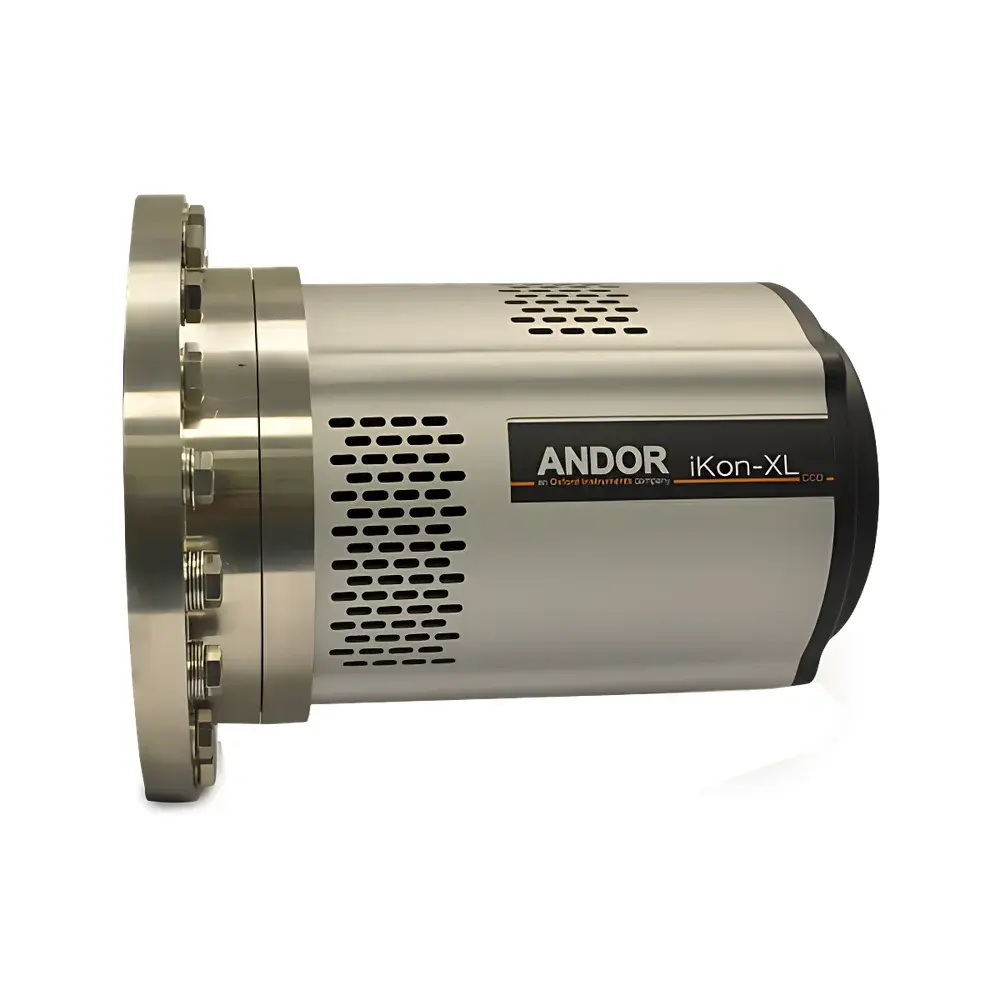
Andor iKon-XL CCD Camera
| Brand | Andor |
|---|---|
| Origin | United Kingdom |
| Model | iKon-XL CCD |
| Effective Pixels | 16.8 Megapixel |
| Pixel Size | 15 µm × 15 µm |
| Cooling | Deep Thermoelectric (−100 °C typical, with optional liquid nitrogen backup) |
| Readout Noise | <3 e⁻ (slow scan), <15 e⁻ (fast kinetics) |
| Full Well Capacity | ~100,000 e⁻ |
| Spectral Range | 200–1100 nm (UV-NIR optimized silicon sensor) |
| Interface | USB 3.0 / Camera Link (selectable) |
| Compliance | CE, RoHS, UKCA |
Overview
The Andor iKon-XL CCD Camera is a high-performance, deep-cooled scientific imaging platform engineered for quantitative low-light detection across astronomy, spectroscopy, and time-resolved photonics research. Built upon a large-format, back-illuminated CCD sensor with 16.8 megapixels and 15 µm × 15 µm pixels, the iKon-XL delivers exceptional quantum efficiency (>95% peak in visible range, >40% at 1000 nm) and ultra-low dark current (<0.001 e⁻/pixel/sec at −100 °C). Its core architecture leverages Andor’s proprietary deep thermoelectric cooling system—capable of sustained operation at −100 °C without cryogen refills—enabling integration times from milliseconds to multiple hours while maintaining sub-electron read noise in slow-scan mode. Unlike conventional CCDs optimized for speed or resolution alone, the iKon-XL balances spatial fidelity, spectral sensitivity, and temporal flexibility via its dual operational paradigm: standard high-sensitivity acquisition for static or quasi-static phenomena, and Fast Kinetics mode supporting up to 1000 frames per second at reduced region-of-interest (ROI) sizes, with microsecond-level time resolution.
Key Features
- Back-illuminated, deep-depletion CCD sensor with 16.8 MP resolution and 15 µm pixel pitch for optimal signal-to-noise ratio in low-flux regimes
- Deep thermoelectric cooling to −100 °C (air-cooled), with optional LN₂-assisted stabilization for extended exposures beyond 1 hour
- Ultra-low read noise: <3 e⁻ RMS (100 kHz readout), scalable to <15 e⁻ in Fast Kinetics mode (1 MHz)
- High dynamic range: >16-bit effective digitization (via on-chip correlated double sampling and programmable gain)
- UV-NIR broadband response (200–1100 nm) enabled by anti-reflection coating and thinned, passivated silicon architecture
- Hardware-based shutter control and precise exposure timing accuracy (±10 µs) for synchronization with pulsed lasers or mechanical choppers
- Robust mechanical housing with vacuum-tight hermetic seal and integrated desiccant for long-term stability in observatory or cleanroom environments
Sample Compatibility & Compliance
The iKon-XL is designed for direct coupling to telescopes (via standard C-mount or custom flange adapters), monochromators, and fiber-optic spectrometers. Its sensor geometry supports binning (1×1 to 8×8), region-of-interest readout, and non-destructive readout sequences—critical for adaptive optics wavefront sensing and lucky imaging applications. The camera complies with international electromagnetic compatibility standards (EN 61326-1), meets CE/UKCA marking requirements for laboratory instrumentation, and adheres to RoHS 2011/65/EU restrictions on hazardous substances. While not certified as medical or industrial safety equipment, its firmware and hardware architecture support GLP/GMP-aligned workflows through audit-trail-enabled acquisition logging and timestamped metadata embedding (ISO/IEC 17025 traceability compatible).
Software & Data Management
Controlled via Andor’s SDK-compatible software suite—including Solis® (GUI-based acquisition), SDK2 (C/C++, Python, MATLAB APIs), and optional integration with LabVIEW and EPICS—the iKon-XL provides full programmability of exposure parameters, gain, offset, and temperature setpoints. All acquired images embed FITS-compliant headers containing detector temperature, exposure duration, bias/dark reference status, and calibration metadata. Raw data are saved in lossless 16-bit TIFF or FITS format; Solis supports real-time background subtraction, flat-field correction, and cosmic-ray rejection using iterative Laplacian edge detection. Audit trails record user actions, parameter changes, and system events—supporting FDA 21 CFR Part 11 compliance when deployed with validated electronic signature modules.
Applications
- Astronomical imaging: Deep-sky object photometry, narrowband nebula mapping, exoplanet transit photometry, and solar corona observation
- Raman and fluorescence spectroscopy: High-resolution spectral line profiling with minimal thermal drift over multi-hour integrations
- Time-resolved luminescence: Microsecond-scale decay kinetics in phosphors, quantum dots, and biological fluorophores using Fast Kinetics mode
- Plasma diagnostics: Spatially resolved emission intensity mapping in fusion and laser-induced breakdown spectroscopy (LIBS)
- Quantitative microscopy: Low-dose live-cell imaging where photon budget constraints preclude EMCCD or sCMOS alternatives
FAQ
What is the maximum recommended continuous exposure time for the iKon-XL?
Continuous exposures up to 3600 seconds (1 hour) are routinely achieved at −100 °C; with LN₂-assisted cooling, exposures exceeding 10,000 seconds have been validated in observatory-grade installations.
Does the iKon-XL support hardware triggering and external synchronization?
Yes—TTL-compatible input/output trigger ports enable precise start/stop control synchronized to external sources such as Q-switched lasers, function generators, or telescope mount encoders.
Can I use the iKon-XL in vacuum or high-humidity environments?
The sealed, desiccated sensor chamber permits operation in ambient humidity ≤80% RH non-condensing; vacuum compatibility requires optional vacuum-flange adapter and is rated to 10⁻⁴ mbar.
Is calibration data (flat field, dark frame) provided with the camera?
Each unit ships with factory-acquired master bias, dark, and flat-field frames; users may also generate application-specific calibrations using Solis’ automated acquisition protocols.
How does the iKon-XL compare to EMCCD or sCMOS alternatives for low-light imaging?
The iKon-XL excels in applications demanding ultimate dark current suppression and linearity over wide dynamic range, whereas EMCCDs offer higher frame rates at single-photon sensitivity, and sCMOS provides superior speed and readout parallelism at moderate cooling levels.






