
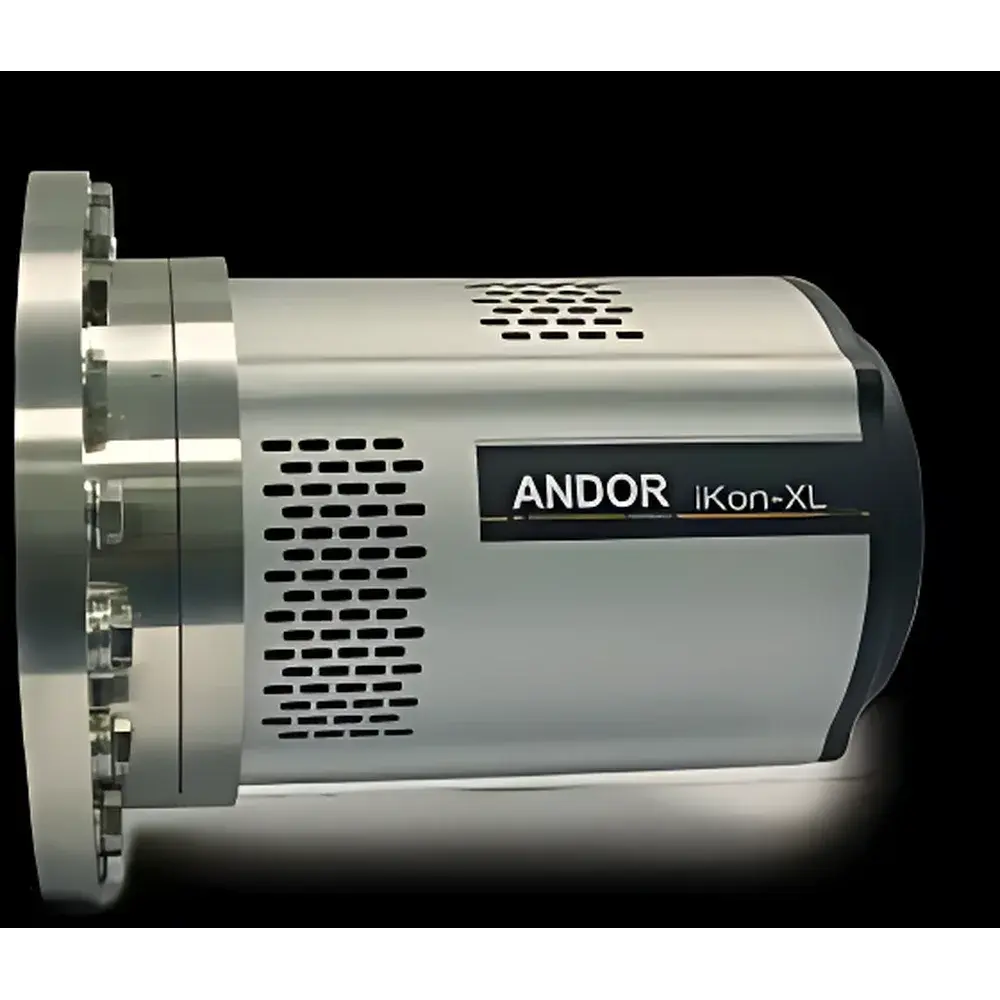
Andor iKon-XL SO Direct-Detection Soft X-ray CCD Camera
| Brand | Andor |
|---|---|
| Origin | United Kingdom |
| Model | iKon-XL SO |
| Sensor Format | 4096 × 4112 pixels |
| Pixel Size | 15 µm × 15 µm |
| Active Area | 61.7 mm × 61.7 mm |
| Readout Speed | 16 MHz (4 MHz × 4 channels) |
| Operating Temperature | −70 °C (thermoelectric cooling) |
| Sensor Type | Back-illuminated (BI) and Back-illuminated Deep-Depletion (BR-DD) CCD |
| Spectral Response | Near-IR to 20 keV (direct detection) |
| Full Well Capacity | 350,000 e⁻ |
| Interface | USB 3.0 and fiber-optic link |
| Compliance | CE, RoHS, ISO 9001-certified manufacturing |
Overview
The Andor iKon-XL SO is a high-performance, direct-detection soft X-ray CCD camera engineered for quantitative imaging in the extreme ultraviolet (EUV), vacuum ultraviolet (VUV), and soft X-ray (XUV) spectral ranges (≈0.1–20 keV). Unlike indirect scintillator-based detectors, the iKon-XL SO employs a monolithic, back-illuminated deep-depletion (BR-DD) or standard back-illuminated (BI) CCD sensor, enabling single-photon counting with high quantum efficiency (>80% at 500 eV, >40% at 1.5 keV, and measurable response up to 20 keV) and negligible read noise (<3 e⁻ rms at 100 kHz pixel rate). Its 4096 × 4112 pixel architecture delivers the largest active area (61.7 mm × 61.7 mm) among commercially available soft X-ray CCDs, supporting wide-field synchrotron beamline diagnostics, plasma emission mapping, and coherent diffractive imaging without tiling or stitching artifacts. The camera operates at a stabilized −70 °C via multi-stage thermoelectric cooling, suppressing dark current to <0.001 e⁻/pixel/s — critical for long-exposure applications such as tokamak edge-localized mode (ELM) monitoring or laser-produced plasma spectroscopy.
Key Features
- Monolithic 4k × 4k back-illuminated CCD sensor with 15 µm pixel pitch, optimized for soft X-ray photon detection without phosphor conversion losses
- Deep-depletion BR-DD option enhances quantum efficiency above 1 keV and reduces low-energy charge diffusion, improving spatial resolution and energy discrimination
- Four-output 16 MHz readout architecture enables sub-second frame rates for time-resolved plasma diagnostics while maintaining <3 e⁻ read noise
- Integrated −70 °C thermoelectric cooling ensures stable dark current performance over exposures ranging from milliseconds to tens of minutes
- Dual interface support: high-bandwidth USB 3.0 for lab integration and low-noise fiber-optic link for radiation-hardened or remote installations (e.g., fusion facility control rooms)
- Hermetically sealed vacuum package with MgF₂ or fused silica window options, compatible with UHV environments (<10⁻⁸ mbar) typical of synchrotron endstations and plasma chambers
Sample Compatibility & Compliance
The iKon-XL SO is designed for use with both pulsed and continuous soft X-ray sources, including synchrotron bending magnets and undulators, laser-produced plasmas (LPP), pinch discharges, and high-harmonic generation (HHG) systems. Its direct-detection architecture eliminates point-spread function degradation associated with scintillator coupling, preserving intrinsic spatial resolution (MTF >0.2 at Nyquist frequency). The system complies with ISO 17025 calibration traceability requirements when used with NIST-traceable X-ray sources and is routinely deployed in facilities adhering to IEC 61513 (nuclear instrumentation) and IEEE 1003.1 (software validation for scientific data acquisition). Firmware supports audit-trail logging per FDA 21 CFR Part 11 when integrated into GLP/GMP-compliant QA workflows.
Software & Data Management
Andor SOLIS v6.x provides native support for the iKon-XL SO, offering real-time image preview, region-of-interest (ROI) binning, photon-counting thresholding, and on-the-fly flat-field correction. Raw frames are saved in FITS format with embedded metadata (exposure time, temperature, gain, shutter status) compliant with IVOA standards. SDKs for Python (PyAndor), MATLAB, and LabVIEW enable custom acquisition sequences — essential for pump-probe experiments requiring precise trigger synchronization (jitter <50 ns). All software modules undergo annual regression testing against ASTM E1316-defined digital radiography validation protocols.
Applications
- Synchrotron-based X-ray microscopy and ptychography requiring large field-of-view and high dynamic range
- Tokamak and stellarator diagnostics: 2D imaging of impurity line emission (e.g., C VI, O VII, Fe XVII) across the divertor and core plasma
- Laser-plasma interaction studies: time-gated imaging of EUV emission from relativistic laser-solid interactions
- High-order harmonic spectroscopy: single-shot spectral-angular mapping of attosecond pulse trains
- X-ray diffraction (XRD) beam characterization: wavefront sensing and coherence measurement in free-electron laser (FEL) beamlines
- VUV astronomy calibration: laboratory verification of optical alignment and QE uniformity for space-borne spectrometers
FAQ
Is the iKon-XL SO suitable for hard X-ray imaging above 10 keV?
No — it is optimized for soft X-rays and EUV; photons above ≈15 keV exhibit low absorption in silicon and require thicker sensors or alternative technologies (e.g., hybrid pixel detectors).
Can the camera operate in ultra-high vacuum (UHV) environments?
Yes — optional UHV-compatible housing and CF-flange mounting enable direct integration into beamline vacuum chambers.
Does the system support hardware triggering for synchronized laser experiments?
Yes — TTL-compatible input/output triggers with programmable delay (10 ns resolution) and gate widths down to 100 ns are fully supported.
What calibration documentation is provided?
Each unit ships with factory-measured QE curves, linearity report (up to 95% full well), and dark current vs. temperature characterization — all traceable to NPL and PTB standards.
Is remote operation possible over Ethernet or fiber?
While USB 3.0 is standard, the optional fiber-optic interface supports distances up to 300 m with deterministic latency, enabling operation from shielded control rooms in nuclear or high-radiation facilities.



