
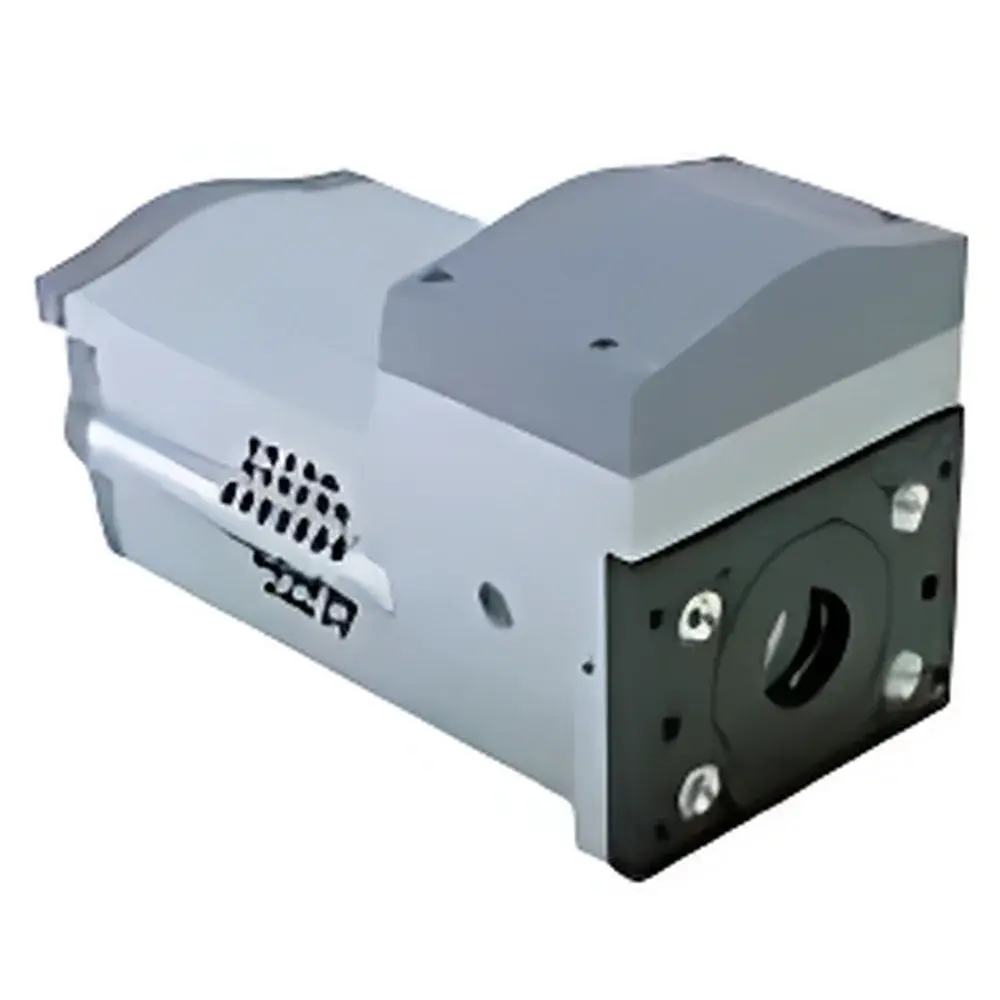
Andor iStar DH720/DH740/DH712/DH734 Intensified CCD (ICCD) Camera
| Brand | Andor |
|---|---|
| Origin | United Kingdom |
| Model Series | DH720, DH740, DH712, DH734 |
| Sensor Format Options | 512×512, 1024×1024, 1024×256, 2048×512 |
| Effective Pixel Count | Up to 2048 × 512 |
| Active Imaging Area | Up to 25 mm × 6.9 mm |
| Minimum Operating Temperature | −40 °C |
| Gating Resolution | 25 ps |
| Minimum Gate Width | 40 ns |
| Intensifier Diameter | 18 mm or 25 mm |
| Intelligate™ Synchronization | Yes |
| Built-in Digital Delay Generator | Yes |
| Remote Control Interface | Ethernet & USB 3.0 |
Overview
The Andor iStar series represents a benchmark in gated intensified charge-coupled device (ICCD) technology for time-resolved optical spectroscopy and ultra-low-light imaging. Engineered for precision temporal gating and high quantum efficiency across UV–VIS–NIR spectral ranges, the iStar ICCD leverages microchannel plate (MCP) intensification synchronized with the CCD readout via Andor’s proprietary Intelligate™ technology. This architecture enables true sub-nanosecond optical shuttering—critical for isolating transient emission events in pulsed-laser experiments. Unlike conventional CCDs, the iStar integrates a photocathode, MCP, and phosphor screen within a vacuum-sealed intensifier tube, amplifying weak photon signals before digitization while preserving spatial fidelity. Its compact, thermoelectrically cooled design supports stable operation down to −40 °C, minimizing dark current and enabling high signal-to-noise ratio (SNR) acquisition even at single-photon levels. The iStar is not merely a camera—it is a fully integrated time-gated detection platform optimized for spectroscopic applications requiring precise event synchronization, such as laser-induced breakdown spectroscopy (LIBS), laser-induced fluorescence (LIF), and coherent anti-Stokes Raman scattering (CARS).
Key Features
- Intelligate™ ultrafast gating: Synchronized photocathode–MCP gating with <40 ns minimum gate width and 25 ps timing resolution, ensuring precise temporal isolation of luminescent decay components.
- Integrated digital delay generator (DDG): On-board programmable DDG eliminates external timing hardware; supports multi-channel delays with jitter <100 ps (RMS), enabling complex pump–probe or multi-laser synchronization schemes.
- Thermoelectric cooling: Dual-stage Peltier cooling achieves sensor temperatures as low as −40 °C (DH720/DH740/DH712) or −30 °C (DH734), reducing thermal noise and supporting long integration times without significant dark current accumulation.
- High-resolution sensor options: Available with 512×512, 1024×1024, 1024×256, and 2048×512 pixel formats—optimized for both imaging and optical multichannel analysis (OMA); the 2048×512 variant is uniquely manufactured by Andor and delivers industry-leading spectral dispersion capability.
- Remote operation & software integration: Full control via Andor SOLIS® software over Gigabit Ethernet or USB 3.0; supports LabVIEW, MATLAB, and Python APIs for automated experiment orchestration and real-time data streaming.
- UV-optimized intensifier configurations: 18 mm and 25 mm diameter image intensifiers with S20, GaAs, or solar-blind CsTe photocathodes—enabling high quantum efficiency from 115 nm to 900 nm depending on configuration.
Sample Compatibility & Compliance
The iStar ICCD is compatible with standard C-mount and F-mount spectrographs, monochromators, and microscope adapters. Its modular intensifier interface allows customization for specific spectral bands and temporal response requirements. All models comply with CE, UKCA, and RoHS directives. For regulated environments—including pharmaceutical QC labs and contract research organizations—the system supports audit-trail-enabled acquisition workflows when used with SOLIS® in compliance mode, aligning with principles of FDA 21 CFR Part 11 for electronic records and signatures. While the ICCD itself is not certified under ISO/IEC 17025, its traceable calibration protocols (e.g., gain linearity, gate timing accuracy, QE mapping) are documented per ISO/IEC 17025-aligned internal procedures and may be validated during instrument qualification (IQ/OQ/PQ) as part of GLP or GMP-compliant installations.
Software & Data Management
Andor SOLIS® is the native acquisition and analysis suite, offering intuitive time-gated capture, real-time spectral fitting, kinetic series analysis, and multi-region-of-interest (ROI) extraction. It provides full access to all hardware parameters—including gate delay, width, intensifier voltage, and sensor temperature—with millisecond-level repeatability. Raw data is saved in vendor-neutral 32-bit TIFF or HDF5 format, preserving metadata (timestamps, trigger conditions, calibration flags) essential for reproducible scientific reporting. Batch processing pipelines support automated background subtraction, flat-field correction, and wavelength calibration using NIST-traceable Hg/Ar lamp spectra. Integration with third-party platforms (e.g., Igor Pro, OriginLab, Python-based SciPy stack) is enabled through documented SDKs and memory-mapped file interfaces.
Applications
- Laser-Induced Breakdown Spectroscopy (LIBS): Time-gated detection suppresses continuum background from plasma initiation, enhancing atomic line contrast and improving limits of detection for trace elemental analysis.
- Laser-Induced Fluorescence (LIF) & Planar LIF (PLIF): Sub-ns gating resolves short-lived excited-state lifetimes in combustion diagnostics, plasma chemistry, and biological fluorophore characterization.
- Light Detection and Ranging (LIDAR): High-sensitivity, time-resolved detection enables atmospheric aerosol profiling and differential absorption LIDAR (DIAL) with nanosecond-scale range resolution.
- Coherent Anti-Stokes Raman Scattering (CARS): Synchronization with picosecond pump–Stokes pulse pairs permits background-free vibrational imaging in live cells and polymeric materials.
- Pulsed Laser Deposition (PLD): Real-time monitoring of ablation plume dynamics, species identification, and stoichiometric transfer verification during thin-film growth.
- Time-resolved photoluminescence (TRPL): Quantitative carrier lifetime mapping in semiconductor wafers and perovskite optoelectronic devices under pulsed excitation.
FAQ
What is the difference between an ICCD and an EMCCD?
An ICCD uses an image intensifier (photocathode + MCP + phosphor) to amplify photons before CCD readout, enabling true optical gating and UV sensitivity; an EMCCD amplifies electrons after pixel readout via on-chip multiplication register, offering higher quantum efficiency in visible/NIR but no intrinsic temporal gating capability.
Can the iStar operate in photon-counting mode?
No—it is not designed for single-photon counting; however, its high gain (>10⁶) and low noise floor allow reliable detection of faint signals down to ~1–10 photons/pixel/frame under optimal gating and cooling conditions.
Is NIST-traceable calibration available?
Yes—spectral responsivity, quantum efficiency, and timing accuracy calibrations can be performed using Andor-certified reference sources and documented in accordance with ISO/IEC 17025 principles upon request.
Does the iStar support external trigger inputs with sub-ns jitter?
Yes—via SMA input with <50 ps RMS jitter referenced to internal clock; trigger latency is deterministic and configurable in steps of 25 ps.
How is cooling performance verified during factory acceptance testing?
Each unit undergoes thermal soak testing at −40 °C for ≥4 hours, followed by dark current measurement and uniformity mapping across full dynamic range; results are included in the Certificate of Conformance shipped with the instrument.




