
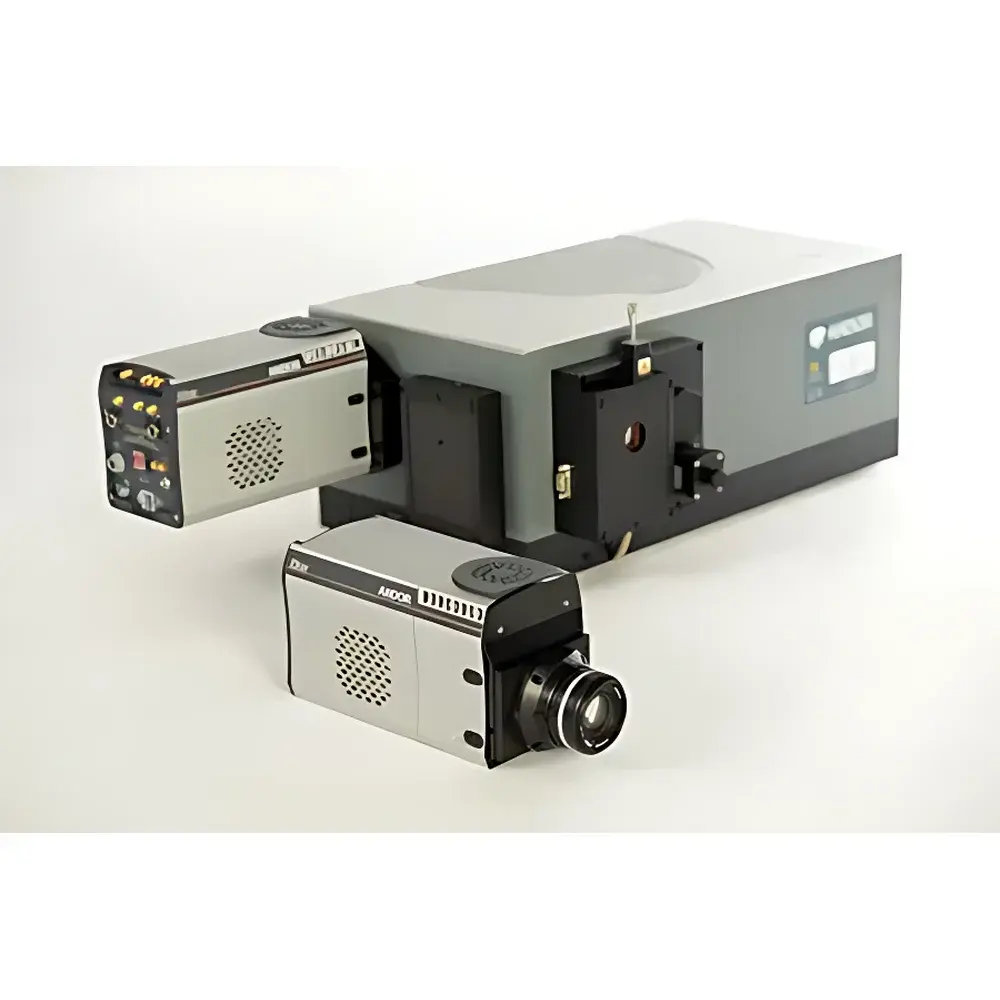
Andor iStar Gated Intensified sCMOS Camera
| Brand | Oxford Instruments |
|---|---|
| Origin | United Kingdom |
| Model | iStar |
| Sensor Resolution | 1024 × 1024 pixels |
| Pixel Size | 13 µm |
| Active Sensor Area | 13.3 mm × 13.3 mm |
| Onboard Memory | 2 GB |
| Readout Speed | 5 MHz |
| Quantum Efficiency | >50% |
| Gating Width | <2 ns |
| Minimum Inter-Frame Interval (PIV mode) | 300 ns |
| Frame Rate (full frame) | up to 4,000 fps |
| Interface | USB 3.0 |
Overview
The Andor iStar is a high-performance gated intensified sCMOS camera engineered for ultrafast, low-light scientific imaging applications requiring precise temporal control and exceptional signal fidelity. Unlike conventional CCD or interline CMOS architectures, the iStar integrates a microchannel plate (MCP) image intensifier with a back-illuminated sCMOS sensor—enabling sub-nanosecond optical gating, single-photon sensitivity, and high dynamic range without compromising spatial resolution. Its core measurement principle relies on time-gated intensification: incident photons strike a photocathode, generate photoelectrons accelerated through an MCP for gain multiplication, and are then phosphor-converted before detection by the sCMOS chip. This architecture delivers intrinsic temporal resolution down to <2 ns, making it ideal for pump-probe spectroscopy, laser-induced fluorescence lifetime imaging, plasma diagnostics, and time-resolved combustion analysis.
Key Features
- Sub-2 ns optical gating: Precision electronic gating synchronized to external triggers enables isolation of transient optical events with nanosecond-scale temporal discrimination.
- Ultrafast full-frame acquisition: Capable of sustained 4,000 fps at 1024 × 1024 resolution via USB 3.0 interface—exceeding frame rates of comparable intensified CCD systems by ≥50% at equivalent pixel count.
- Low-noise sCMOS readout: Engineered for <1.5 e⁻ rms read noise at 5 MHz readout speed, ensuring high signal-to-noise ratio even at minimal intensifier gain settings.
- Dual-frame PIV capability: Supports optical inter-frame intervals as short as 300 ns for high-fidelity particle image velocimetry, with hardware-synchronized dual acquisition buffers and zero dead-time switching.
- High quantum efficiency: Back-illuminated photocathode design achieves >50% QE in the 400–800 nm spectral range, optimized for visible and near-IR photon detection.
- Robust thermal management: Integrated thermoelectric cooling maintains sensor stability at –20 °C (±0.1 °C), minimizing dark current drift during long-duration gated acquisitions.
Sample Compatibility & Compliance
The iStar is compatible with standard C-mount and F-mount optical interfaces, supporting integration into vacuum-compatible laser chambers, spectroscopic setups, and industrial inspection environments. Its mechanical and electrical design conforms to CE, UKCA, and RoHS directives. For regulated laboratory use, the system supports audit-ready metadata logging—including timestamped trigger signals, gate width calibration records, and sensor temperature history—facilitating compliance with GLP and ISO/IEC 17025 documentation requirements. While not FDA 21 CFR Part 11 certified out-of-the-box, its Andor Solis software framework allows configuration of user access controls, electronic signatures, and immutable acquisition logs when deployed within validated workflows.
Software & Data Management
Controlled via Andor’s Solis software suite (v5.0+), the iStar provides intuitive GUI-based setup for gate delay, width, gain, and readout mode selection. Solis supports real-time histogram analysis, region-of-interest (ROI) binning, and live contrast enhancement. Raw image data is saved in TIFF or HDF5 format with embedded metadata (EXIF-compliant), including exposure parameters, trigger latency, and sensor calibration coefficients. Batch acquisition scripts can be authored in Python using the Andor SDK (C/C++, .NET, and Python bindings included), enabling seamless integration into automated synchrotron beamline control systems or OEM instrumentation platforms. Onboard 2 GB memory buffers support burst-mode capture at full resolution, reducing host PC bandwidth dependency during high-speed transient recording.
Applications
- Laser-induced breakdown spectroscopy (LIBS) with time-resolved spectral gating
- Time-correlated single-photon counting (TCSPC) pre-amplification stage
- Combustion flame front imaging and chemiluminescence lifetime mapping
- Plasma column dynamics in pulsed discharge experiments
- Ultrafast photoluminescence decay profiling in semiconductor defect analysis
- Ballistic photon imaging through scattering media using time-gated rejection
- High-speed schlieren and shadowgraph imaging in shockwave physics
FAQ
What is the minimum achievable gate width?
The iStar achieves optical gate widths down to <2 ns, limited primarily by MCP transit time spread and phosphor decay characteristics.
Can the iStar operate in photon-counting mode?
While not a true photon-counting detector, its high gain (>10⁴), low noise, and single-photon sensitivity enable effective single-event detection under appropriate intensifier gain and background suppression conditions.
Is synchronization with external lasers supported?
Yes—the iStar accepts TTL or LVDS trigger inputs with jitter <100 ps and supports programmable delay resolution of 10 ps for precise pump-probe alignment.
Does the camera support hardware binning?
No—binning is performed digitally in software post-acquisition to preserve full spatial sampling fidelity; hardware binning would compromise the temporal integrity of gated frames.
How is calibration traceability maintained?
Each unit ships with NIST-traceable photocathode quantum efficiency curves and MCP gain calibration reports, updated annually per Andor’s ISO 9001-certified metrology protocol.





