
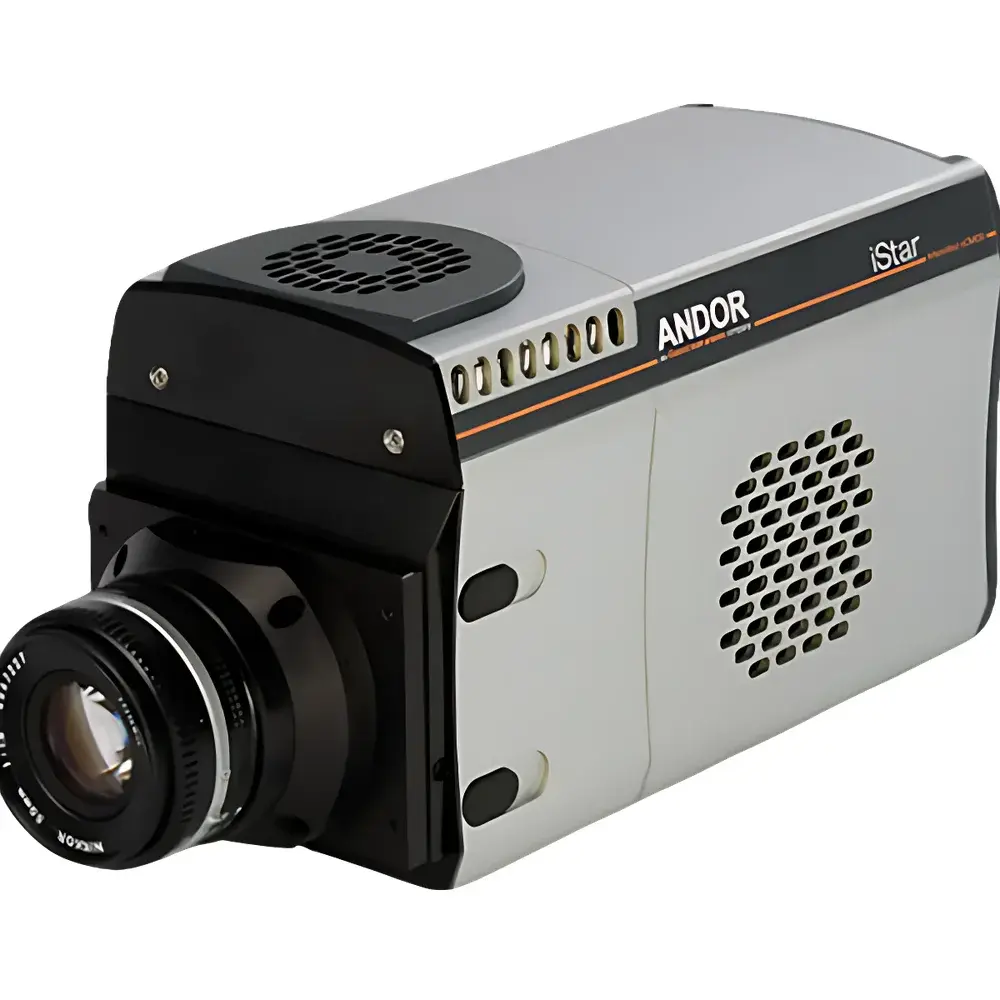
Andor iStar ICCD/sCMOS Nanosecond Time-Resolved Imaging Camera for Plasma Diagnostics and Combustion Analysis
| Brand | Andor |
|---|---|
| Origin | United Kingdom |
| Model | iStar |
| Image Resolution | 2560 × 2160 |
| Pixel Size | 6.5 µm (sCMOS variant) |
| Sensor Format | 2560 × 2160 |
| Quantum Efficiency | up to 50% |
| Gating Accuracy | <2 ns |
| Minimum Gate Width | <2 ns |
| Timing Jitter | <10 ps |
| Read Noise | as low as 2.6 e⁻ |
| Dark Current | as low as 0.1 e⁻/pix/s |
| Maximum Frame Rate | 50 fps (sCMOS), up to 4,000 sps (gated operation) |
| Dynamic Range | >15-bit equivalent (full well: 30,000–500,000 e⁻ depending on sensor variant) |
| Coupling | Fiber-optic taper (not prism-based) |
| Photocathode Types | Gen II (alkali-based) and Gen III (GaAs) |
| Spectral Response | 129 nm (VUV) to 1100 nm (SWIR) |
Overview
The Andor iStar series represents a class of scientific-grade, gated intensified imaging cameras engineered for ultrafast, time-resolved optical detection across demanding research domains including plasma diagnostics, combustion science, laser-induced breakdown spectroscopy (LIBS), and time-resolved fluorescence. Unlike conventional CMOS or CCD cameras, the iStar integrates a microchannel plate (MCP) image intensifier with either back-illuminated CCD or sCMOS sensor technology—enabling true nanosecond-scale temporal gating without compromising spatial fidelity or dynamic range. Its core measurement principle relies on precise electronic control of the MCP voltage to open and close the “optical shutter” in synchronization with transient light events. This gate-controlled amplification occurs prior to sensor readout, delivering single-photon sensitivity while maintaining sub-2 ns timing accuracy and minimal temporal jitter (<10 ps). The system is optimized for experiments requiring both high temporal resolution and quantitative photon counting—particularly where signal levels are extremely low, background noise is high, or event timing is deterministic (e.g., pulsed laser excitation, plasma ignition, shockwave propagation).
Key Features
- Sub-2 ns intrinsic gate width with <10 ps timing jitter, enabled by integrated Digital Delay Generator (DDG) architecture
- Fiber-optic taper coupling between intensifier and sensor—preserving modulation transfer function (MTF) and eliminating optical distortion inherent in prism-based alternatives
- Multi-photocathode compatibility: Gen II (Cs-Sb, UV-enhanced) and Gen III (GaAs, extended red/NIR response), supporting spectral coverage from 129 nm (VUV) to 1100 nm
- Dual-sensor platform: selectable CCD (high full-well capacity, low noise) or sCMOS (50 fps full-frame, 2.6 e⁻ read noise) variants for application-specific optimization
- IntelliGate™ technology: electronically tunable MCP bias for enhanced on/off contrast ratio (>10⁶:1 in UV), critical for rejecting stray light in plasma or flame environments
- Three independent external trigger inputs with 10 ps resolution, enabling precise synchronization with lasers, Q-switches, or oscilloscopes
- Real-time ROI (region-of-interest) readout and binning modes to maximize frame rate and signal-to-noise ratio in spectral or imaging applications
Sample Compatibility & Compliance
The iStar camera is designed for integration into vacuum-compatible, high-radiation, and thermally variable experimental setups common in fusion plasma diagnostics (e.g., tokamak edge imaging), engine combustion chambers, and synchrotron beamlines. Its sealed, hermetically packaged intensifier tube meets MIL-STD-810G environmental robustness requirements. All firmware and acquisition software comply with ISO/IEC 17025 traceability guidelines for measurement uncertainty reporting. For regulated environments—including GLP-compliant combustion emissions testing or FDA-regulated laser safety validation—the system supports audit-trail logging, user access controls, and electronic signature functionality when operated with Andor’s Solis Software v5.x or SDK-integrated custom applications.
Software & Data Management
Acquisition and analysis are managed via Andor’s Solis Scientific Imaging Software—a Windows-based platform certified for use in ISO 13485 medical device R&D and ASTM E2912-compliant spectral calibration workflows. Solis provides real-time gate parameter adjustment (delay, width, repetition), multi-channel spectral deconvolution, and pixel-wise intensity normalization against dark reference frames. Raw data export supports HDF5 and TIFF formats with embedded metadata (exposure time, gate delay, sensor temperature, photocathode type), ensuring FAIR (Findable, Accessible, Interoperable, Reusable) data principles. The Andor SDK (C++, Python, MATLAB) enables full programmability for integration into LabVIEW-based plasma control systems or ROS2-driven combustion test benches.
Applications
- Plasma diagnostics: Time-resolved imaging of arc discharges, tokamak edge-localized modes (ELMs), and laser-produced plasmas—leveraging nanosecond gating to isolate emission from specific ionization stages
- Combustion analysis: OH* and CH* chemiluminescence imaging in internal combustion engines and gas turbines, synchronized to crank-angle position for cycle-resolved flame front tracking
- LIBS quantification: Gated spectral acquisition to suppress continuum background and enhance atomic line signal-to-noise ratio during plasma decay phase
- Ultrafast spectroscopy: Multi-track temporal profiling of nonlinear optical processes (e.g., CARS, SRS) using synchronized pump-probe delays
- Time-resolved fluorescence: Lifetime mapping of phosphorescent catalysts or biological fluorophores under pulsed excitation, with picosecond-level timing precision
FAQ
What is the minimum achievable gate width, and how is it verified?
The iStar achieves a nominal gate width of <2 ns, measured using streak camera cross-calibration and confirmed via autocorrelation of femtosecond laser pulses. Actual width depends on photocathode type and MCP voltage settings.
Can the iStar be used in vacuum environments?
Yes—the intensifier tube and housing are rated for operation at pressures down to 10⁻⁶ mbar; optional CF-flange mounting kits are available for direct vacuum port integration.
Does the system support NIST-traceable radiometric calibration?
Andor offers factory-applied, NIST-traceable quantum efficiency (QE) and responsivity calibration certificates per sensor variant, valid for two years post-shipment.
How does fiber-optic coupling improve performance over lens or prism coupling?
Fiber-optic tapers maintain 1:1 pixel mapping, eliminate chromatic aberration, and provide >95% transmission efficiency—whereas prism coupling introduces field curvature, vignetting, and wavelength-dependent focal shift.
Is remote operation supported for hazardous environments (e.g., nuclear or high-voltage labs)?
Yes—Ethernet-based GigE Vision interface enables full remote control up to 100 m; optional fiber-optic extension modules support distances beyond 1 km with galvanic isolation.





