
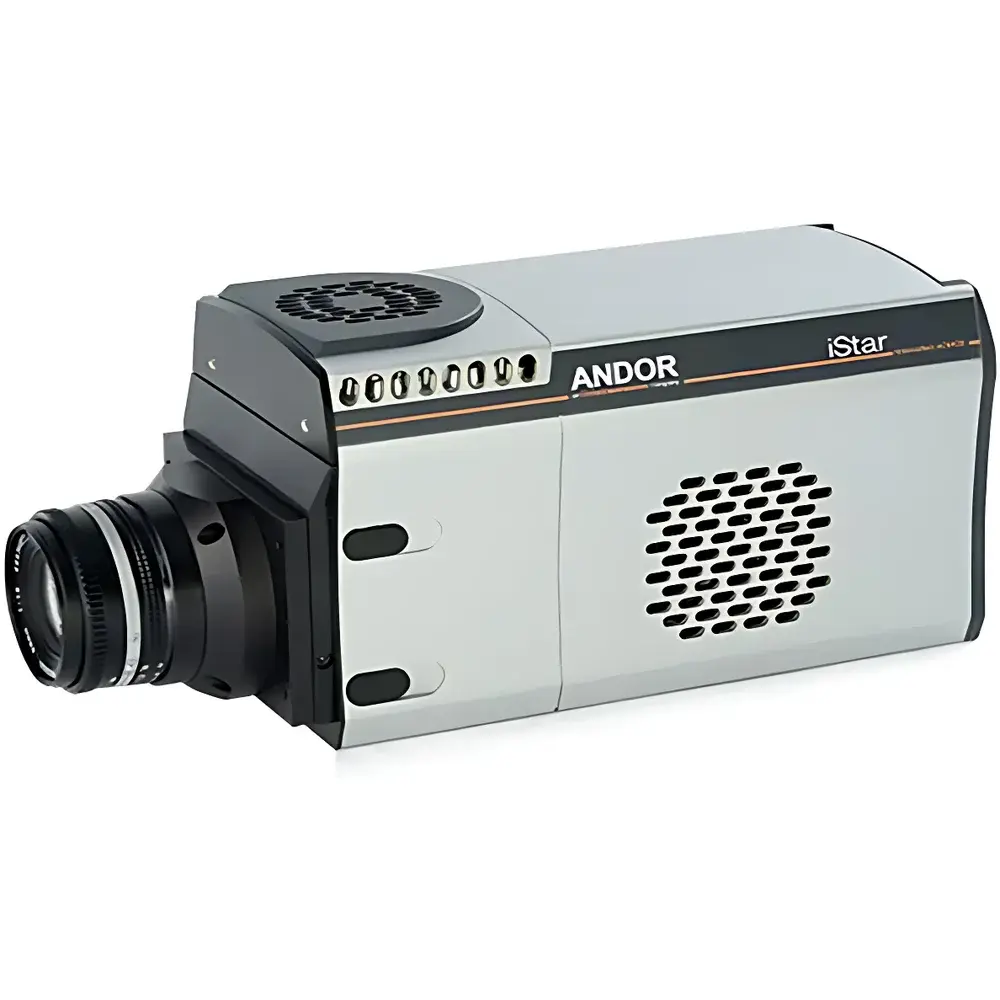
Andor iStar sCMOS Intensified Camera (ICMOS)
| Brand | Andor |
|---|---|
| Origin | United Kingdom |
| Model | iStar sCMOS (ICMOS) |
| Sensor Type | Fiber-Optically Coupled sCMOS |
| Resolution | 2560 × 2160 pixels |
| Max Frame Rate | 50 fps @ full resolution |
| Ultra-High Speed Mode | 4008 fps @ 2560 × 8 ROI |
| Read Noise | 2.7 e⁻ rms @ 560 MHz |
| Quantum Efficiency | Enhanced across UV-VIS-NIR |
| Linearity | >99.8% |
| Dynamic Range | Industry-Leading (≥85 dB typical) |
| Minimum Inter-Frame Interval (PIV mode) | 300 ns |
| Interface | USB 3.0 |
| Compliance | CE, RoHS, ISO 9001-certified manufacturing |
Overview
The Andor iStar sCMOS (ICMOS) is a next-generation intensified scientific camera engineered for ultrafast, low-light imaging applications requiring precise temporal resolution, high spatial fidelity, and exceptional signal-to-noise performance. Unlike conventional ICCD systems, the iStar sCMOS integrates Andor’s proprietary fiber-optic coupling technology with a back-illuminated sCMOS sensor—delivering a fundamental shift in performance architecture. Its operational principle combines gated image intensification (with sub-nanosecond gating capability) and high-fidelity sCMOS readout, enabling photon-limited detection while preserving quantitative linearity and dynamic range. Designed for time-resolved optical diagnostics, the system supports both single-shot and multi-frame acquisition modes—including Particle Image Velocimetry (PIV), laser-induced fluorescence (PLIF), and time-gated Raman spectroscopy—where synchronization accuracy, inter-frame timing stability, and radiometric integrity are critical.
Key Features
- Fiber-Optic sCMOS Integration: Eliminates pixel misregistration and light loss associated with lens-coupled intensifiers; ensures 1:1 pixel mapping between intensifier output and sensor plane.
- Ultra-High Temporal Resolution: Minimum inter-frame interval of 300 ns in PIV mode enables accurate velocity vector calculation in transient fluid dynamics and combustion processes.
- Full-Resolution Speed: Sustains 50 fps at native 2560 × 2160 resolution—more than 10× faster than legacy ICCDs at equivalent pixel count—without binning or region-of-interest compromises.
- Enhanced Quantum Efficiency: Optimized photocathode and phosphor stack deliver peak QE >55% in UV (200–400 nm) and >45% in visible/NIR (500–850 nm), significantly improving photon capture efficiency over standard Gen II/III intensifiers.
- Low-Noise Architecture: 2.7 e⁻ rms read noise at 560 MHz digitization rate—achieved via correlated double sampling (CDS) and on-chip clock optimization—ensures minimal signal degradation during high-speed acquisition.
- Quantitative Linearity & Dynamic Range: >99.8% pixel-level linearity over 4-decade intensity span; effective dynamic range exceeds 85 dB, supporting simultaneous capture of weak emission features and saturated peaks in single exposures.
Sample Compatibility & Compliance
The iStar sCMOS is compatible with standard C-mount and F-mount optical interfaces, and supports integration into vacuum-compatible, cryogenic, and laser-synchronized experimental setups. It operates within ambient temperature ranges of 15–30°C and meets electromagnetic compatibility requirements per EN 61326-1:2013. All firmware and hardware design comply with ISO 9001 quality management standards. The camera supports audit-ready metadata logging—including exposure time, gate delay, gain settings, and trigger timestamps—facilitating GLP/GMP-aligned data acquisition workflows. While not FDA-cleared as a medical device, its traceable calibration protocols and stable gain response make it suitable for regulated research environments requiring documentation per 21 CFR Part 11 Annex 11 principles.
Software & Data Management
Controlled via Andor’s Software Development Kit (SDK) and bundled Solis® software, the iStar sCMOS provides full programmability through Python, MATLAB, and LabVIEW APIs. Solis supports real-time histogram analysis, non-uniformity correction (NUC), dark frame subtraction, and synchronized multi-camera triggering. Raw image data is saved in vendor-neutral formats (e.g., TIFF, HDF5) with embedded EXIF-style metadata. Time-stamped frame headers include gate width, delay relative to external TTL trigger, and sensor temperature—enabling post-acquisition temporal reconstruction. Optional Andor Fusion software extends capabilities to automated PIV processing, spectral deconvolution, and batch-mode time-series analysis.
Applications
- Plasma Diagnostics: Sub-microsecond imaging of arc discharge evolution, plasma jet propagation, and breakdown dynamics in pulsed power systems.
- Time-Resolved Fluorescence: Nanosecond-scale lifetime mapping in biological tissues, quantum dot emitters, and organic semiconductors using TCSPC-compatible gating.
- Pulsed Raman Spectroscopy: Gated acquisition synchronized to Q-switched lasers for rejection of elastic scattering and fluorescence background in chemical identification.
- Combustion & Explosion Research: Simultaneous OH*, CH*, and C₂* chemiluminescence imaging with <1 µs temporal separation to resolve flame front propagation and detonation wave structures.
- High-Speed Hyperspectral Imaging: Line-scan or snapshot spectral acquisition at up to 4008 fps in narrow vertical ROI mode—ideal for real-time spectral fingerprinting in industrial process monitoring.
FAQ
What distinguishes iStar sCMOS from traditional ICCD cameras?
The iStar sCMOS replaces lens-coupled CCD sensors with fiber-optically coupled sCMOS, eliminating optical distortion, increasing fill factor, and enabling higher resolution, faster readout, and superior dynamic range without sacrificing gating precision.
Is the camera compatible with third-party timing controllers?
Yes—it accepts TTL, LVDS, and NIM trigger inputs with adjustable delay resolution down to 10 ps, and supports external clock synchronization for phase-locked acquisition across multi-instrument setups.
Can the system perform quantitative intensity measurements?
Yes—factory-calibrated gain maps, linearity verification reports, and NIST-traceable responsivity curves are provided, enabling absolute radiance quantification when paired with calibrated light sources.
Does the USB 3.0 interface support sustained full-resolution streaming?
Yes—the camera implements packet-level flow control and ring-buffer DMA architecture to sustain continuous 50 fps transfer of 2560 × 2160 16-bit frames without frame drop under standard host controller conditions.
What maintenance or recalibration is required during routine operation?
No periodic recalibration is needed; the intensifier gain is digitally stabilized via closed-loop HV regulation, and sensor dark current is automatically compensated via on-chip temperature monitoring and lookup-table correction.




