
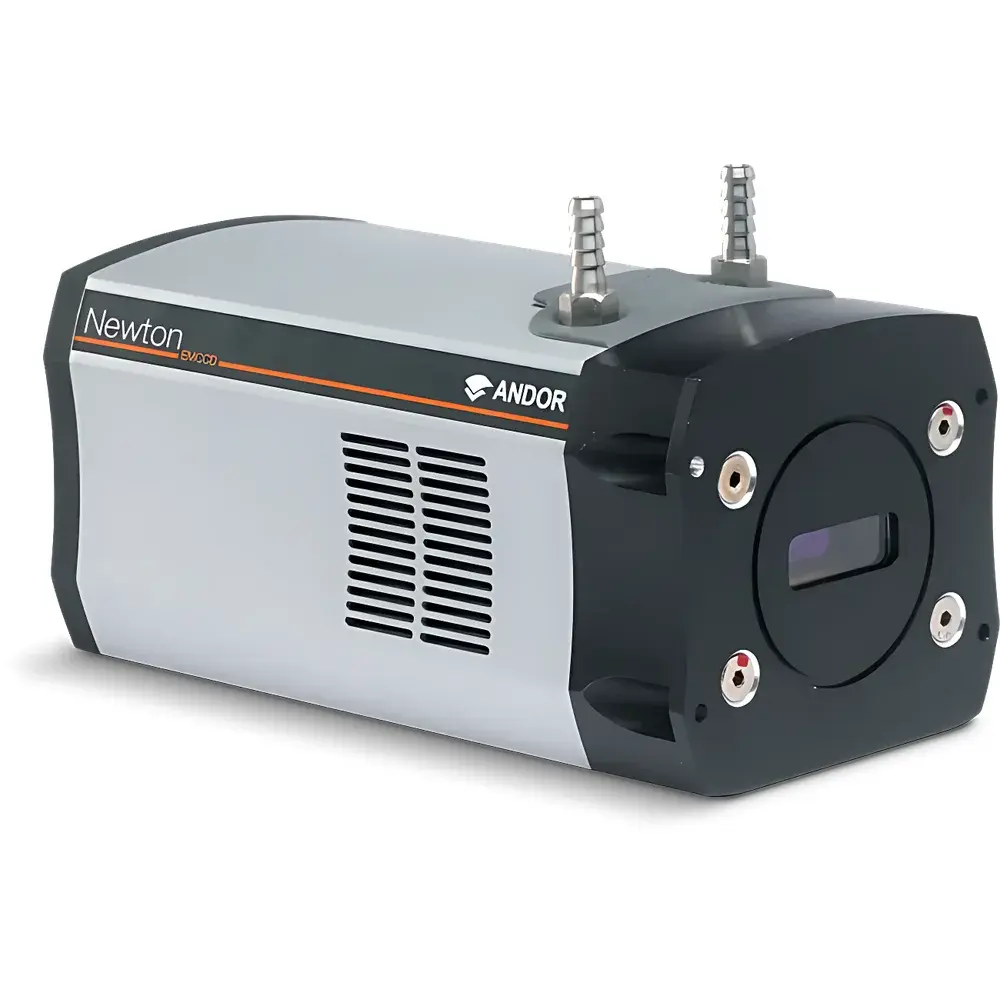
Andor Newton Series EMCCD and CCD Spectroscopic Cameras
| Brand | Oxford Instruments |
|---|---|
| Origin | United Kingdom |
| Model | Newton |
| Sensor Pixel Size | 13.5 × 13.5 µm or 26 × 26 µm |
| Cooling | Thermoelectric (TE) to –100°C |
| Readout Speed | Multi-Megahertz (up to 3 MHz) |
| Quantum Efficiency | Up to 95% |
| Vacuum Technology | UltraVac™ |
| Sensor Architecture | EMCCD or conventional CCD |
| Spectral Acquisition Rate | >1600 spectra/sec (Newton 920) |
| Pixel Array Options | 1024 × 255, 2048 × 512, or 1600 × 400 |
Overview
The Andor Newton Series represents a family of high-performance, thermoelectrically cooled scientific cameras engineered specifically for demanding spectroscopic applications. Built upon Oxford Instruments’ legacy in low-noise detector design, the Newton platform integrates either electron-multiplying CCD (EMCCD) or conventional back-illuminated CCD sensor architectures—each optimized for maximum photon detection efficiency under ultra-low-light conditions. The core measurement principle relies on precise charge accumulation and readout in silicon-based photodiodes, with spectral data acquisition enabled via direct coupling to spectrometers (e.g., Czerny–Turner, echelle, or transmission grating systems). With deep-cooling capability down to –100°C, UltraVac™ vacuum encapsulation, and dual anti-reflection (AR) coatings for extended spectral response (UV–NIR), the Newton series delivers exceptional signal-to-noise ratio (SNR), negligible dark current (<0.001 e⁻/pix/sec at –100°C), and high quantum efficiency (QE) peaking at 95% in the visible range. These characteristics make it suitable for time-resolved fluorescence, Raman spectroscopy, plasma diagnostics, astronomical spectroscopy, and synchrotron beamline experiments where sensitivity, speed, and stability are critical.
Key Features
- Thermoelectric cooling to –100°C, enabling sub-electron dark current performance and long integration times without thermal noise degradation
- UltraVac™ sealed vacuum housing ensures permanent sensor protection and eliminates condensation or outgassing-related QE drift over time
- Multi-Megahertz readout architecture supports frame rates exceeding 1600 full-frame spectra per second (Newton 920), ideal for rapid kinetic studies
- Flexible pixel formats: 1024 × 255, 2048 × 512, and 1600 × 400 arrays available across models; pixel sizes include 13.5 × 13.5 µm (high-resolution mode), 26 × 26 µm (high-sensitivity mode), and 16 × 16 µm (EMCCD-optimized)
- Dual-band AR coating option extends spectral responsivity from 200 nm to 1100 nm, supporting UV resonance Raman and NIR photoluminescence measurements
- USB 3.0 plug-and-play interface with hardware-triggered acquisition and programmable ROI (Region of Interest) readout for real-time spectral binning
- On-chip crop mode operation allows dynamic adjustment of active pixel area to maximize frame rate without sacrificing SNR
Sample Compatibility & Compliance
The Newton series is compatible with standard fiber-optic coupled spectrometers, monochromators, and imaging spectrographs across OEM and research-grade configurations. Its mechanical footprint and C-mount/F-mount adaptability support integration into vacuum chambers, cryostats, and laser-aligned optical tables. From a regulatory perspective, the system complies with CE marking requirements for electromagnetic compatibility (EMC Directive 2014/30/EU) and low-voltage safety (LVD Directive 2014/35/EU). While not a medical device, its stable calibration traceability and audit-ready metadata logging (via Andor SOLIS software) align with GLP and GMP laboratory practices where instrument qualification (IQ/OQ/PQ) and data integrity (per FDA 21 CFR Part 11 guidelines) are required. All sensors undergo individual factory calibration for gain, offset, and pixel response non-uniformity (PRNU), with certificates provided upon delivery.
Software & Data Management
Andor SOLIS software provides native control, real-time visualization, and advanced processing tools—including spectral deconvolution, background subtraction, multi-channel fitting, and time-series analysis. The SDK (Software Development Kit) supports integration with LabVIEW, MATLAB, Python (via PyAndor), and .NET environments, enabling custom automation in high-throughput screening or synchrotron control systems. All acquired datasets include embedded metadata: exposure time, temperature, gain setting, sensor ID, and timestamp with microsecond resolution. Audit trails record user actions, parameter changes, and file exports—critical for laboratories operating under ISO/IEC 17025 or ASTM E2500-17 validation frameworks. Raw data is saved in vendor-neutral TIFF or HDF5 format, ensuring long-term archival compatibility and third-party analysis interoperability.
Applications
- Time-resolved photoluminescence spectroscopy of quantum dots, perovskites, and 2D materials
- Low-light Raman mapping of biological tissues and pharmaceutical polymorphs
- Plasma emission analysis in fusion diagnostics and industrial process monitoring
- Astronomical spectroscopy using slitless or echelle configurations on medium-aperture telescopes
- Single-molecule fluorescence detection in TIRF and confocal microscopy-coupled spectrographs
- Ultrafast pump-probe experiments requiring sub-millisecond spectral acquisition cadence
FAQ
What distinguishes the Newton 971 from other EMCCD models in the series?
The Newton 971 features a 1600 × 400 active pixel array with 16 × 16 µm pixels and supports variable readout up to 3 MHz via USB 3.0—delivering the highest single-photon sensitivity and temporal resolution among Newton EMCCD variants.
Is the –100°C cooling sustained continuously during operation?
Yes. The two-stage thermoelectric cooler maintains stable –100°C sensor temperature under continuous acquisition, verified by integrated platinum resistance thermometer (PRT) feedback and logged in real time.
Can I use the Newton camera with non-Andor spectrometers?
Absolutely. Standard C-mount interface and configurable trigger logic ensure seamless integration with third-party spectrometers from Horiba, Ocean Insight, Princeton Instruments, and others.
Does the UltraVac™ system require periodic maintenance or re-pumping?
No. UltraVac™ is a permanently sealed, getter-pumped vacuum enclosure with no moving parts or consumables—designed for lifetime operational stability without service intervention.
How is calibration traceability documented for quality-controlled environments?
Each unit ships with a NIST-traceable calibration certificate covering dark current, gain, linearity, and QE response curves, along with software-generated calibration logs compliant with ISO/IEC 17025 documentation requirements.




